


Announce for Unify: A PoE W5500 Audio Announcer That Reacts to UniFi Webhooks
A UK maker's DIY UniFi AI Horn alternative: an ESP32-S3 with WIZnet W5500 wired Ethernet and PoE that plays audio announcements from UniFi camera webhooks.
WIZnet - W5500
x 1

Overview
Announce for Unify is an open-source (GPL3+) hardware project published on Hackster on July 10, 2026 by Christopher (Hackster handle c_m_cooper), a UK-based maker. It is a self-built, weatherproof, network-powered audio announcer designed as a cleaner alternative to the Ubiquiti UniFi AI Horn. The core idea: a UniFi camera with AI detection fires a webhook when it spots an animal or intruder, and this device receives that webhook and plays an audio announcement.
For a WIZnet reader, the relevant part is the network path. The device runs an ESP32-S3 web server and can sit on the LAN over either Wi-Fi or, for reliability, a WIZnet W5500 hardwired Ethernet link, powered over the same cable by PoE. The W5500 is the wired backbone that lets a single Ethernet run carry both power and the webhook traffic to a device mounted outdoors.
The problem it solves
The maker had spent three years restoring a garden, only to have Muntjac deer repeatedly destroy it. A Ubiquiti UniFi camera system with AI animal detection reliably reported the intrusions but did nothing to stop them. The missing piece was an actuator: something on the network that could hear a detection event and respond with sound. Off-the-shelf IP speakers did not integrate cleanly with UniFi, and the official UniFi AI Horn was, in the maker's words, overkill and unattractive. So he designed his own.
How it works
UniFi supports webhooks: when an event triggers (animal detected, motion, intrusion), the controller sends an HTTP POST to a URL you specify. Announce for Unify is the endpoint that receives that POST and turns it into audio.
The signal chain is straightforward once the network layer is in place. The ESP32-S3 hosts a built-in web server that both receives webhooks and serves a configuration UI. Incoming events are mapped to specific announcements, the selected audio is pulled from a local SD card, and the TAS5760L Class-D amplifier drives a weatherproof speaker. Because the audio lives on the SD card, announcements still fire even if the server or controller is unreachable.
From the web UI the operator can upload audio files, choose which webhook event triggers which announcement, set volume, and push firmware updates over the air.
The hardware, and where WIZnet fits
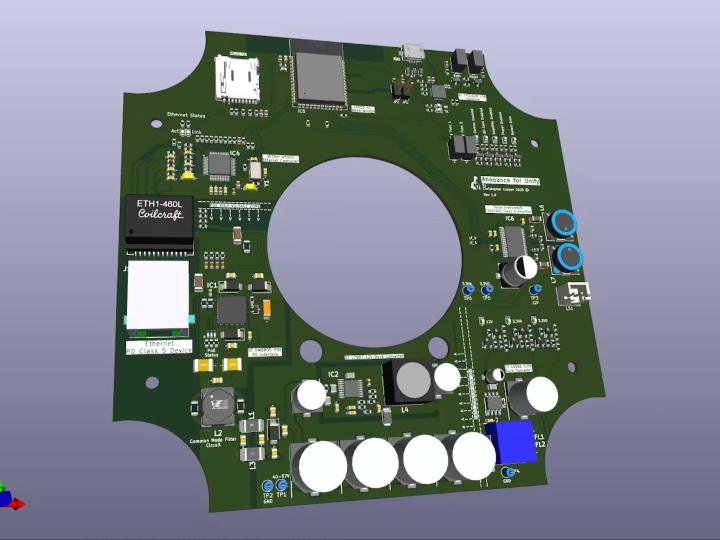
The final board centres on four parts:
- ESP32-S3 WROOM (N8R8) running Arduino C++ firmware with a built-in web server, acting as the brains and webhook receiver.
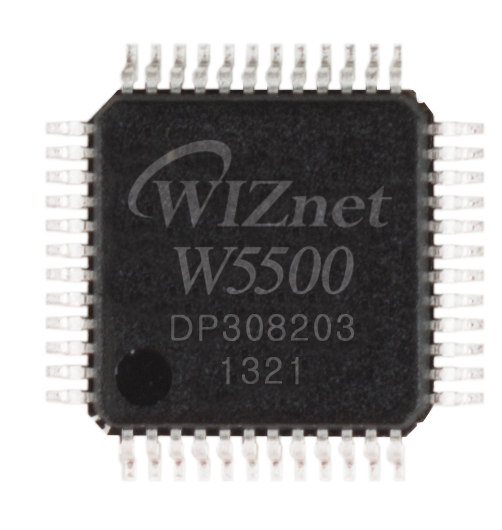
- WIZnet W5500 providing hardwired 10/100 Ethernet as the wired networking option alongside the ESP32's Wi-Fi.
- ST PM8805 PoE powered-device controller, Class 5, pulling up to 25W from the network switch so the unit needs no separate power supply.
- TI TAS5760L Class-D amplifier driving a Visaton waterproof speaker.
The board was designed in KiCad, with the maker noting that routing the Ethernet differential pairs was his first encounter with signal-integrity discipline. A dedicated W5500 Ethernet controller schematic is among the published design files.
The WIZnet role here is deliberate. For an outdoor device on a single PoE cable, wired Ethernet through the W5500 gives a more reliable link than Wi-Fi for time-sensitive alerts, while the PoE PD controller means one cable carries both power and data. The W5500's hardwired TCP/IP handling keeps that networking off the ESP32's main workload while it manages audio and the web UI.
A real debugging story
The first boards from the fab powered up dead. The PM8805 asserts a Power Good signal once PoE negotiation finishes and the rails are stable, and the ESP32 is meant to wait for it before booting. The RC timing components were sized wrong, so Power Good arrived too early and the ESP32 tried to boot into an unstable supply. The fix was to recompute the RC values and re-spin the board. It is a useful, honest lesson for anyone integrating a PoE PD front end with an MCU.
Value and limits
The value is a clean, source-backed example of the W5500 as the wired, PoE-friendly network interface for a real home-automation actuator, not just a demo that pings a server. The build includes schematics, enclosure and speaker datasheets, a costed BOM (about £800 for five assembled boards from a China fab, versus a circa £4,000 UK quote), and a candid engineering narrative.
The limits are worth stating plainly. Hackster classifies this as a Showcase with no step-by-step instructions, and there is no public firmware repository linked, so it is a documented design to learn from rather than a clone-and-flash tutorial. And the maker is honest about the outcome: the deer eventually learned to ignore the announcements, though the unit has proven useful on his driveway for unwanted human visitors.
Related reading on the Maker site
Readers interested in the same wired-plus-PoE pattern can compare this with existing W5500 PoE and industrial-Ethernet write-ups on the Maker site, and with other ESP32-plus-W5500 web-server projects, to see how the same networking building blocks are reused across very different applications.
FAQ
Which WIZnet chip does it use, and for what? The WIZnet W5500, as the wired 10/100 Ethernet interface. It gives the device a reliable PoE-powered wired network option alongside the ESP32's Wi-Fi.
Is this Wi-Fi or wired? Both. The maker deliberately supported Wi-Fi and wired Ethernet; the W5500 provides the wired path.
Can I build one from this page? You can learn the full design from it, but it is a showcase with schematics rather than a step-by-step guide, and no firmware repo is linked. Expect to fill in the firmware yourself.
Who made it? Christopher (c_m_cooper on Hackster), a UK-based maker, released under GPL3+ on July 10, 2026.