


Where Do the Eight W5500 Hardware Sockets Go in Somon's Halow-GW?
Somon's Halow-GW Wi-Fi HaLow gateway spends all eight W5500 hardware sockets on three TCP servers, two TCP clients, two UDP channels and one HTTP listener.
WIZnet - W5500
x 1

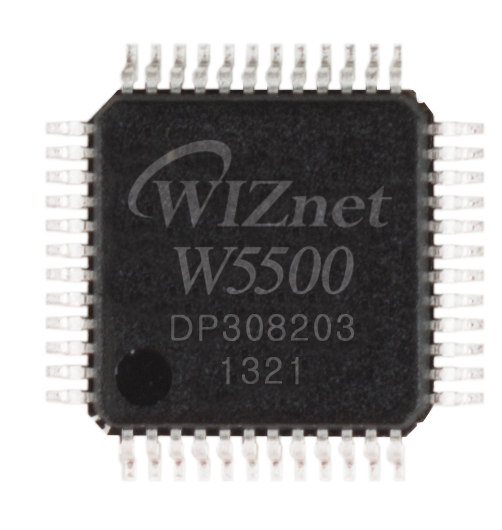
Named as the Ethernet part in Somon's own Communication table for the Halow-GW: 'Ethernet PHY: WIZnet W5500 (HW TCP/IP, 8 socket)'. Driven from an STM32F446 over SPI, with all eight hardware sockets a
📌 A Sub-1 GHz Sensor Gateway With a W5500 Wired Exit
Somon Co., Ltd. is an industrial communication device maker in Bucheon, Gyeonggi-do, incorporated in November 2016 and presenting itself under the heading "IOT Solution". Its delivery history is dominated by municipal work: emergency call systems, LED information boards, LoRa facility management and SIP intercom servers.
The Halow-GW is Somon's Wi-Fi HaLow gateway, a compact box that collects data from many Wi-Fi HaLow (IEEE 802.11ah) sensors in industrial, smart city and smart farm settings and relays it onto an Ethernet TCP or UDP network. The wired half of that job is a WIZnet W5500. Somon's overview states that the design adopts the W5500 hardware TCP/IP engine and supports up to 8 simultaneous sockets, with a 32 KB EEPROM holding network and wireless settings permanently.
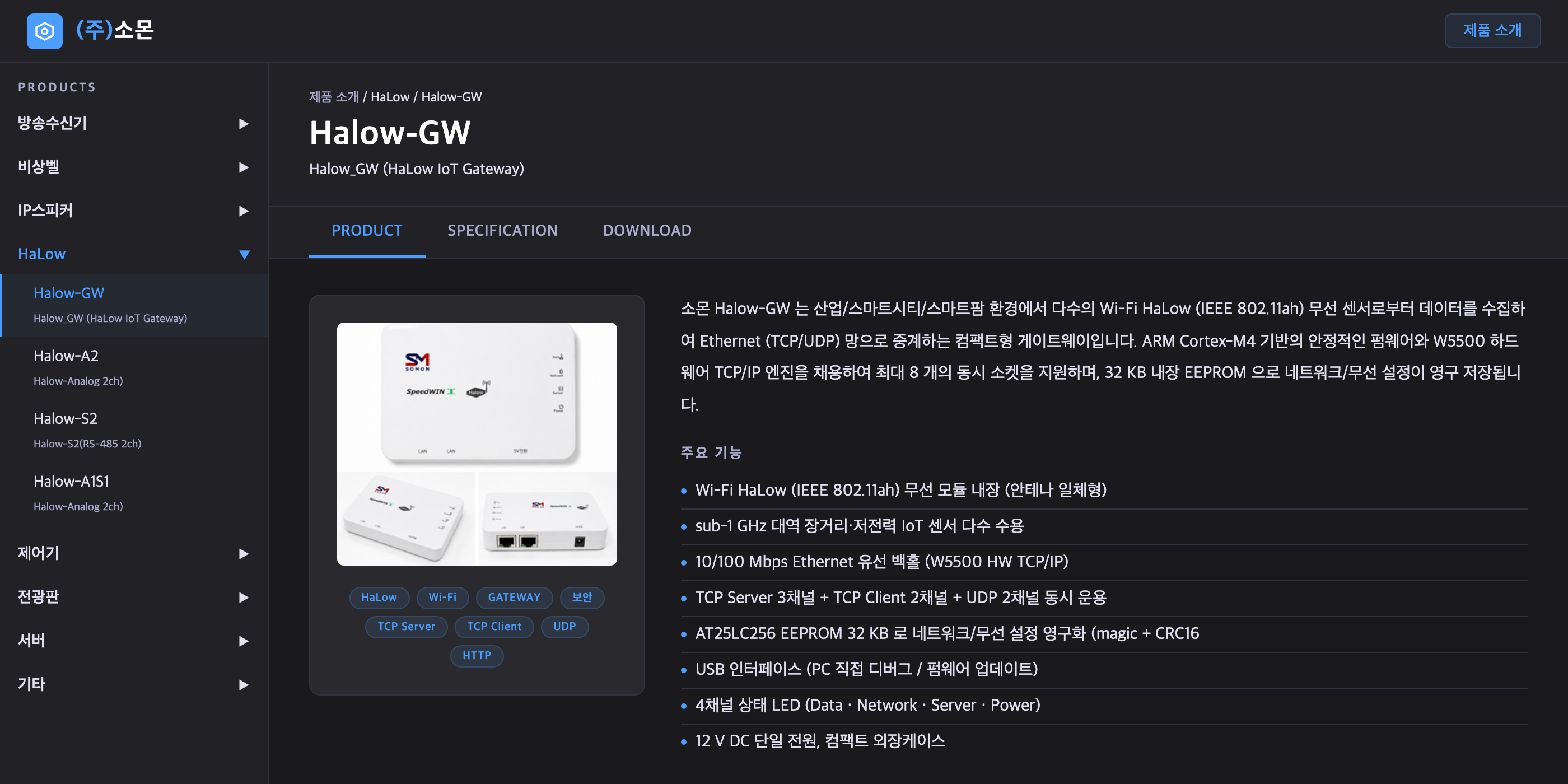
All eight W5500 sockets are spent in the published specification: three TCP servers on port 5000, two TCP clients on port 5001, two UDP channels on ports 6001 and 6002, and one HTTP listener on port 80. Somon announced the line on 4 June 2026 and released it on 1 July 2026; on 27 August 2026 the datasheet still read rev. 0.1 dated May 2026, firmware OT_GW_v0.00.
What Wi-Fi HaLow Is, and Why It Needs a Wired Exit
Wi-Fi HaLow is the marketing name for IEEE 802.11ah, a Wi-Fi variant that trades throughput for range and wall penetration by moving from 2.4 GHz into sub-1 GHz spectrum, which suits sensor telemetry better than video. The Halow-GW spec table gives the Korean allocation as 917 to 923.5 MHz with 1, 2 or 4 MHz channel bandwidth, and Open, WPA2-PSK and WPA3-SAE security.
A HaLow network becomes useful only when something hands its traffic to the IP world where the SCADA host or the cloud endpoint lives. The Halow-GW is that hand-off point, its radio named in the catalogue as "Newracom WHM110A (IEEE 802.11ah)", with an antenna inside the case and an RJ45 port at 10/100 Mbps.
Section 8 of the datasheet lists five deployment targets, and the Edaily report of 4 June 2026 adds water quality diagnostics and construction displacement:
- Smart agriculture: greenhouse and livestock temperature, humidity, CO2, light
- Industrial monitoring: vibration, current and temperature on pumps and motors
- Smart city: street lighting, parking, air quality and noise nodes
- Asset and vehicle tracking: position with status data
- Environmental sensor networks: rivers, forests, facilities
⚙️ Role of the WIZnet W5500 in the Halow-GW
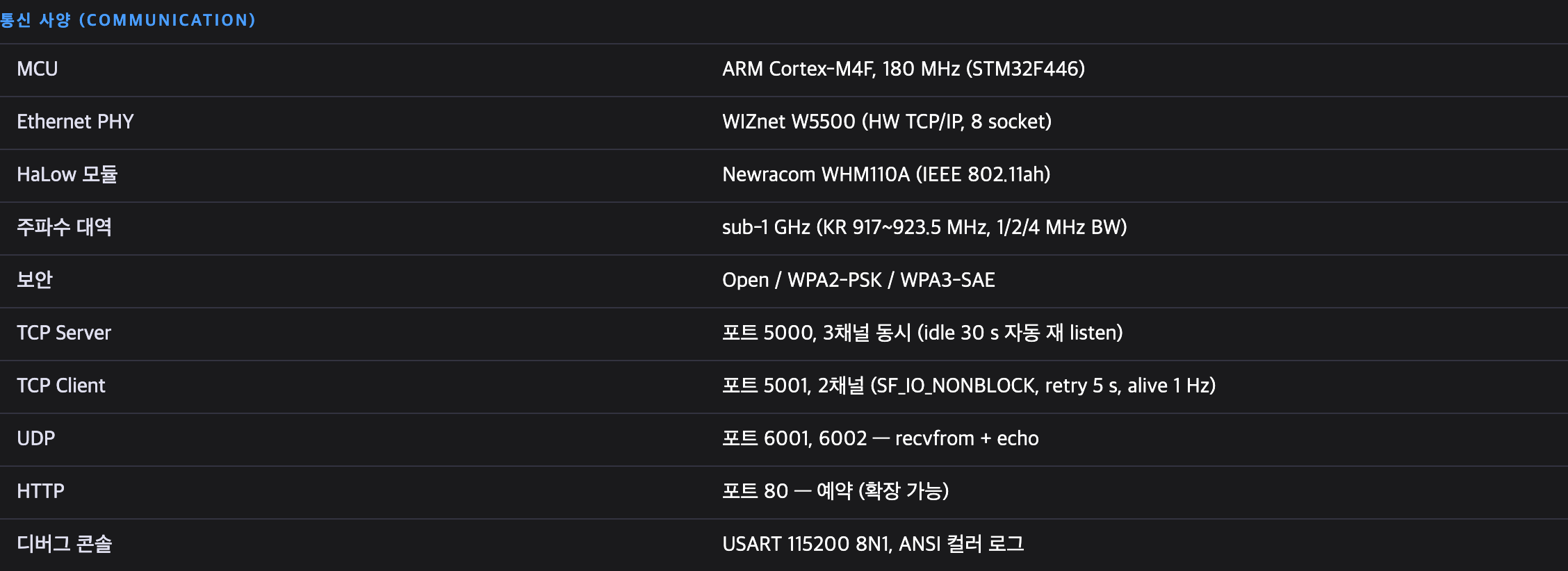
The Halow-GW communication table names the Ethernet part directly. The row reads "Ethernet PHY" against the value "WIZnet W5500 (HW TCP/IP, 8 socket)", and the same string appears twice: on the catalogue page at halowkorea.com and in the datasheet DOCX inside Somon_Halow_GW_Datasheet.zip, created 26 May 2026 and last revised 2 June 2026.
Calling the W5500 an Ethernet PHY undersells it, because the chip is a hardware TCP/IP engine. A W5500 carries the MAC, the PHY and the TCP and UDP state machines in silicon, with 32 KB of internal buffer split between transmit and receive. The STM32F446 writes payload into a socket buffer over SPI and reads it back, instead of running a software stack such as lwIP and paying for it in RAM and interrupt latency.
The MCU keeps its 180 MHz for HaLow association and packet reassembly. Somon rates the finished box at 1.0 W typical and 2.0 W peak from a single 12 V supply, in an 85 by 120 by 18 mm case weighing about 60 g.
Where the Eight Hardware Sockets Go
A W5500 has exactly eight hardware sockets, a count fixed in silicon, and the Halow-GW spends all of them: three TCP Server channels, two TCP Client channels, two UDP channels and one HTTP listener. That HTTP socket on port 80 is reserved for future expansion, so one of the eight is held rather than used.
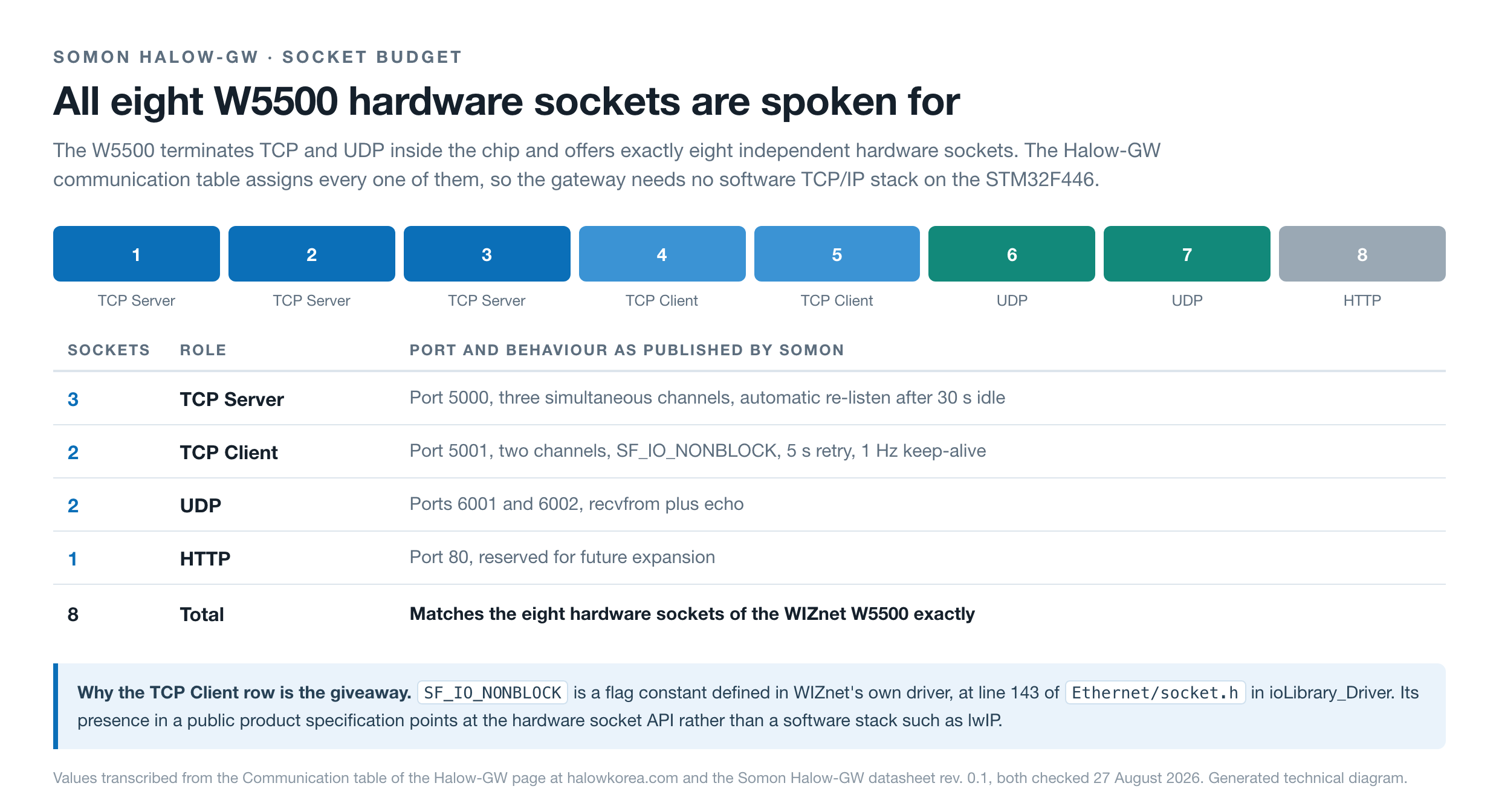
The TCP Client row gives the software layer away. Its parenthetical reads "SF_IO_NONBLOCK, retry 5 s, alive 1 Hz", and SF_IO_NONBLOCK is not a generic networking term: it is a flag constant defined at line 143 of Ethernet/socket.h in WIZnet's own ioLibrary_Driver, where the comment reads "Socket nonblock io mode. It used parameter in socket()." A vendor that had wrapped the W5500 in lwIP would have no reason to put that identifier in a public specification.
| Role | Sockets | Port and published behaviour |
|---|---|---|
| TCP Server | 3 | Port 5000, three channels at once, automatic re-listen after 30 s idle |
| TCP Client | 2 | Port 5001, two channels, SF_IO_NONBLOCK, 5 s retry, 1 Hz keep-alive |
| UDP | 2 | Ports 6001 and 6002, recvfrom plus echo |
| HTTP | 1 | Port 80, reserved for expansion |
| Debug console | 0 | USART at 115200 8N1 with ANSI colour logging, outside the socket budget |
The Somon HaLow Product Line, and Where the W5500 Sits In It
Somon's catalogue lists four HaLow products, and the other three are remote terminals at the sensor end of the same radio link, with each Halow-S2 RS-485 channel galvanically isolated by an ISO3088 transceiver and its own DC-DC supply. All three pack incoming bytes into a fixed 128 byte wireless packet, sent at 126 bytes of payload or after 100 ms idle.
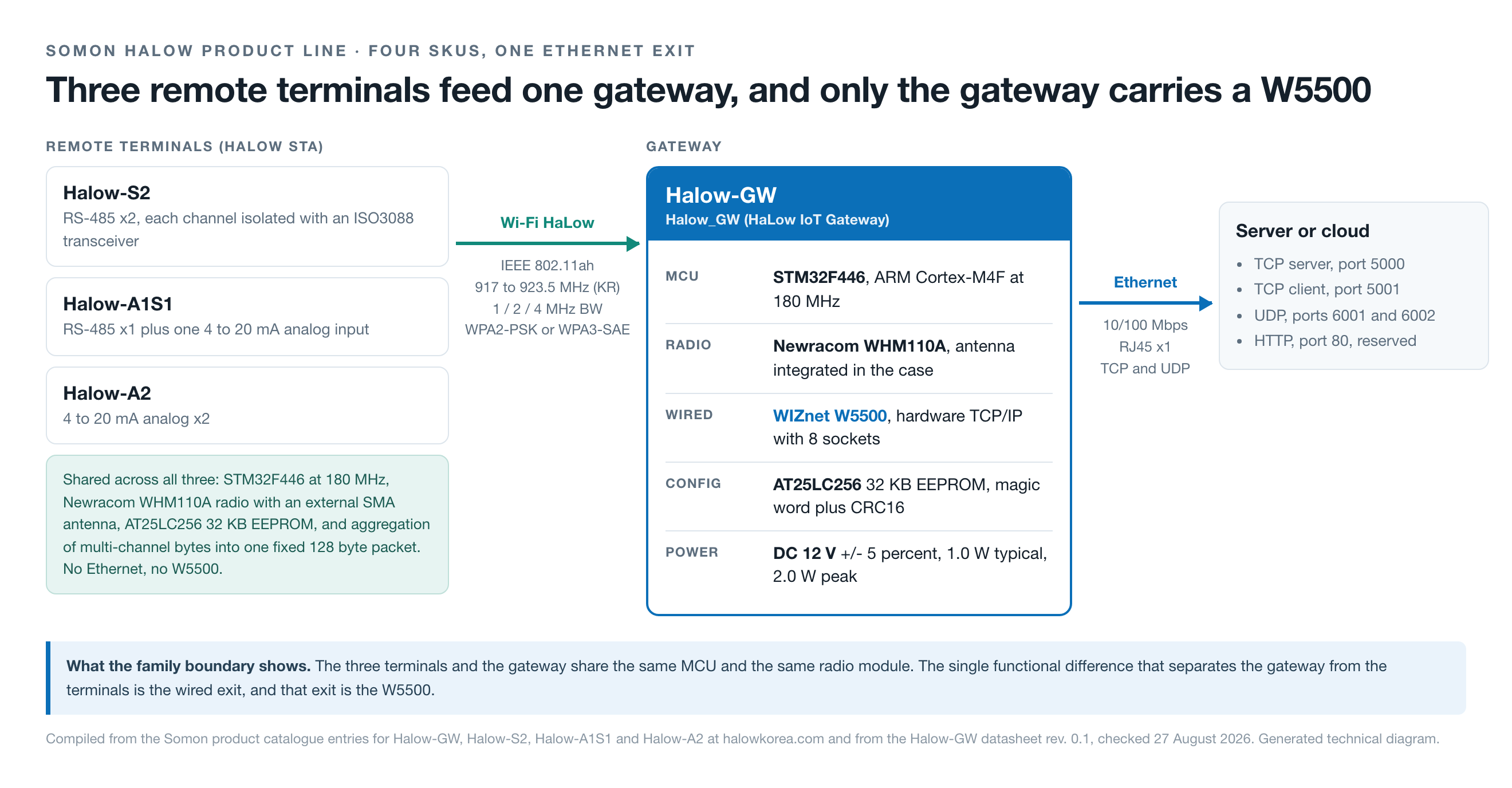
Little separates the four SKUs electrically: the same ARM Cortex-M4F STM32F446 at 180 MHz, the same Newracom WHM110A radio and the same AT25LC256 32 KB EEPROM guarded by a magic word and a CRC16, with Somon's system diagram labelling the gateway as HaLow access point and the terminals as stations. The one difference that makes the gateway a gateway is the W5500 wired exit.
| Model | Field interface | Radio role | Wired exit |
|---|---|---|---|
| Halow-GW | Optional 3 pin RS-485 socket, chosen instead of the RJ45 | HaLow access point for the cell | RJ45 10/100, WIZnet W5500 |
| Halow-S2 | RS-485 x2, ISO3088 isolated | HaLow station | None |
| Halow-A1S1 | RS-485 x1 plus 4 to 20 mA x1 | HaLow station | None |
| Halow-A2 | 4 to 20 mA x2 | HaLow station | None |
The catalogue needs one caveat: the Halow-A2 and Halow-A1S1 entries reuse the Halow-S2 description and interface table verbatim, so RS-485 wording lands on partly or wholly analog products. The channel counts and the external SMA antenna given here follow each model's own tag list, subtitle and feature line instead, and Korean press of 4 June 2026 spells the mixed model "Halow-S1A1".
Three items on the Halow-GW interface list are options rather than base configuration: a second RJ45 port, a 3 pin RS-485 socket fitted instead of the RJ45, and an external antenna. The base unit ships with one RJ45 port, an internal antenna and a 12 V 2 A barrel jack, and the W5500 is not one of them, sitting unmarked in the standard Communication table.
Vendor, Availability, and Price
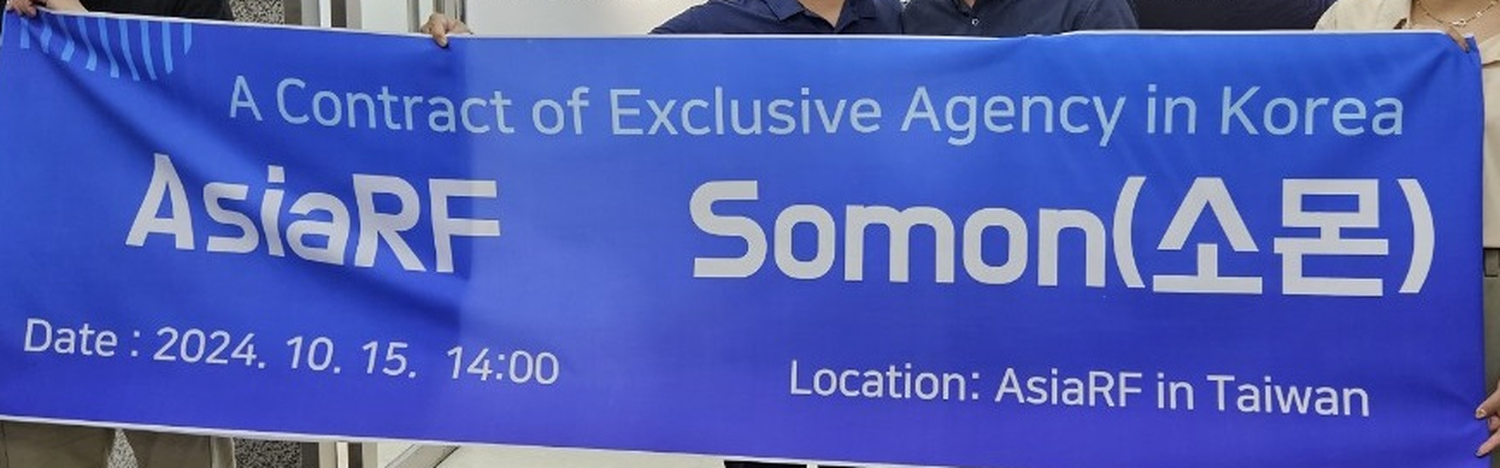
Somon Co., Ltd. is both manufacturer and seller, and it signed an exclusive Korean agency contract for AsiaRF Wi-Fi HaLow products on 15 October 2024, reported by ETNews on 31 October 2024. The Halow-GW is Somon's own product built on that foundation rather than a rebadged AsiaRF unit.
There is no public price. Checked on 27 August 2026, the Halow-GW page shows no cart, no buy button and no quote form. The only order path Somon publishes is section 10 of the datasheet, Ordering and Contact, listing denis.kim@somon.co.kr, +82-10-8814-8325 and +82-32-327-8641.
The absence of a number is a house pattern rather than a Halow-GW omission. No product among the 28 entries in the Somon catalogue shows a selling price: 22 carry Korean public procurement fields, 20 of them a dash and 2 in progress, and the Halow-GW entry carries none. Currency, tax, shipping, returns and warranty are not stated anywhere.
| Commerce question | Status on 27 August 2026 | Where it comes from |
|---|---|---|
| Seller and manufacturer | Somon Co., Ltd., Bucheon, South Korea | Datasheet section 10 and company contact page |
| Price and currency | Not published, quotation on request | Product page and datasheet, no figure anywhere |
| Order path | Email or phone to the datasheet contact | Datasheet section 10 |
| Public procurement listing | No item identification code registered | Catalogue entry compared with 22 other SKUs |
| Release status | Released 1 July 2026 | Edaily and Newspim, both 4 June 2026 |
| Stock, lead time, warranty | Not stated in any published source | Absence across product page and datasheet |
What Somon Publishes and What It Does Not
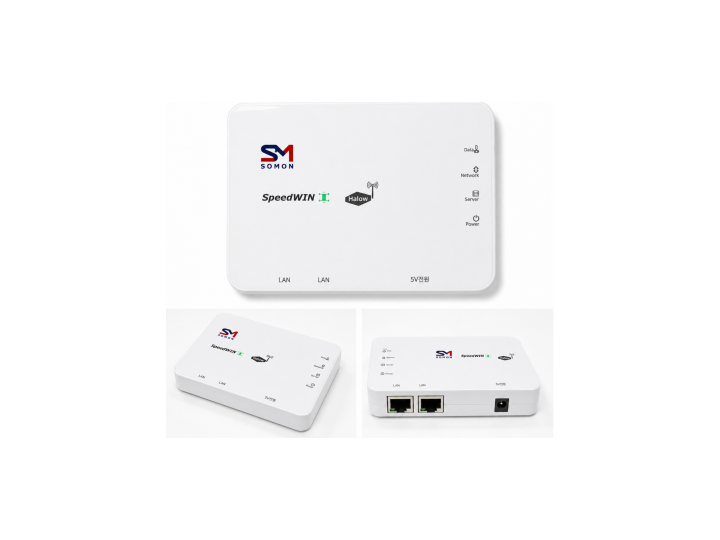
The published product image does not match the datasheet. The same three-view image runs on the product page and inside the datasheet, showing a white desktop box with two LAN ports, a barrel jack labelled for 5 V, and a SpeedWIN wordmark found on no other product in the catalogue. The datasheet specifies one RJ45 port as standard and DC 12 V plus or minus 5 percent, so every hardware figure here follows the datasheet rather than the picture.
| Item | What is published | What is not |
|---|---|---|
| Chip evidence | W5500 named in the catalogue spec table and the datasheet Communication table | No schematic, BOM or board photograph |
| Firmware | Version string OT_GW_v0.00 in the ordering block | No source, no binary, no repository, no changelog |
| Certification | EMC described as in-house testing passed, external certification by separate agreement | No KC, CE or FCC certificate located |
| Documentation | Datasheet rev. 0.1, May 2026, four pages | No manual, no API document, no register or protocol description |
| Independent use | Trade press coverage and a smart farm association listing | No buyer review, installation photo or third-party test |
Certification is the first of two gaps to check. Somon's company history records KC approval for a voice guidance unit in August 2025 and two LED display products in May 2025, with no HaLow entry, so certification for a 917 to 923.5 MHz radio is an open question for the vendor.
Independent evidence of the product in service is the second gap. The Edaily and Newspim reports of 4 June 2026 and the Korea Smart Farm Industry Association listing establish that company and product line are real, but no buyer report, installation photograph or third-party measurement was found on 27 August 2026.
Related WIZnet Maker Projects
Systembase eHaLow/Br, published 13 August 2026, is the closest neighbour on the Maker site. Both are Korean Wi-Fi HaLow devices with a W5500 on the wired side, but the eHaLow/Br is a transparent bridge carrying Ethernet frames over MACRAW, using its W5500 as a raw MAC, where the Halow-GW terminates TCP and UDP sessions in the chip.
NRC7394 W5500 Bridge Firmware for Fixed Wi-Fi HaLow Node Deployment, published 1 June 2026, reaches the same junction from the open firmware side, publishing prebuilt HaLow plus W5500 bridge images, where the Halow-GW is a sealed box with no published firmware.
How to Build an Interrupt-Driven W5500 UDP Server on STM32F4 with FreeRTOS and ioLibrary shows the software layer the Halow-GW specification hints at, driving W5500 hardware sockets from an STM32F4 through the ioLibrary that defines SF_IO_NONBLOCK.
How Can W5500 and SX1262 Connect Remote LoRa Nodes to an Industrial Ethernet Network? solves the same problem with a different radio, trading longer range and a smaller payload for a link that behaves like Wi-Fi. Both end at a W5500 for the wired hop.
❓ FAQ
Q. Where do the eight W5500 hardware sockets go in the Halow-GW? Three go to TCP Server channels on port 5000, two to TCP Client channels on port 5001, two to UDP channels on ports 6001 and 6002, and one to an HTTP listener on port 80 reserved for future expansion.
Q. Which WIZnet chip is that, and does the Halow-GW use its hardware engine or a software stack? The W5500, named in the catalogue and datasheet Communication tables as "WIZnet W5500 (HW TCP/IP, 8 socket)", checked 27 August 2026. The specification points at the hardware sockets, because the TCP Client row names SF_IO_NONBLOCK, a flag constant from WIZnet's ioLibrary_Driver.
Q. What does the Halow-GW cost and how do I order one? Somon publishes no price and no online purchase path. The datasheet gives an ordering contact of denis.kim@somon.co.kr, +82-10-8814-8325 or +82-32-327-8641, so the product is quotation based, confirmed on 27 August 2026.
Q. Do the other Somon HaLow products also contain a W5500? No. Halow-S2, Halow-A1S1 and Halow-A2 are remote terminals with RS-485 or 4 to 20 mA inputs and no Ethernet port, so the W5500 appears only in the Halow-GW, though all four share the STM32F446 and the WHM110A radio.
Q. Is the Halow-GW shipping, and is it certified? Somon released the HaLow line on 1 July 2026, according to Edaily and Newspim reports of 4 June 2026. The datasheet records EMC only as in-house testing passed, with external certification by separate agreement, and no KC, CE or FCC certificate was located.
-
Halow-GW product page (halowkorea.com)
Somon's HaLow catalogue entry. The SPECIFICATION tab carries the Communication table with the Ethernet PHY row naming the WIZnet W5500 and the TCP Client row naming SF_IO_NONBLOCK

-
Somon Halow-GW datasheet archive
Vendor datasheet rev. 0.1, May 2026, distributed as a ZIP containing a four page DOCX. Sections 3 to 7 hold the mechanical, interface, electrical, communication and environmental tables
-
Somon Co., Ltd. company site and history
Company timeline from incorporation in November 2016, the October 2024 AsiaRF exclusive agency contract, the October 2025 office move, and the contact block with the Bucheon address
-
WIZnet W5500
Datasheet and documentation for the hardwired TCP/IP controller used on the Halow-GW, including the eight hardware sockets and the 32 KB internal buffer
-
WIZnet ioLibrary_Driver socket.h
Line 143 defines SF_IO_NONBLOCK, the flag constant that appears in the Halow-GW TCP Client specification row
-
Edaily: Somon launches Wi-Fi HaLow industrial IoT solution on 1 July
Korean trade report dated 4 June 2026 naming the release date, the Halow-S2 terminal family and the Halow-GW gateway, plus water treatment and construction displacement use cases
-
Newspim: Somon next-generation Wi-Fi HaLow line-up
Second independent report of the same 4 June 2026 announcement, describing the gateway as carrying a hardware communication engine able to drive up to eight simultaneous socket connections
-
ETNews: Somon supplies AsiaRF Wi-Fi HaLow in Korea
Published 31 October 2024, reporting the exclusive Korean agency contract signed on 15 October 2024 that put Somon into Wi-Fi HaLow
-
Korea Smart Farm Industry Association member listing for Somon
Independent registry entry listing Somon with its Wi-Fi HaLow long range low power module work, contact number and representative


