



STM32 & W5100S HAT for micro-ROS
This project is a practical tutorial by Ar-Ray demonstrating how to build a reliable micro-ROS node using STM32 and the WIZnet Ethernet HAT (W5100S)
Source Mention
Original Blog Post by Ar-Ray This curation is based on a technical blog post by Ar-Ray, where he documents the process of enabling Ethernet on STM32 for micro-ROS using WIZnet hardware.
1. Introduction: Breaking Hardware Boundaries
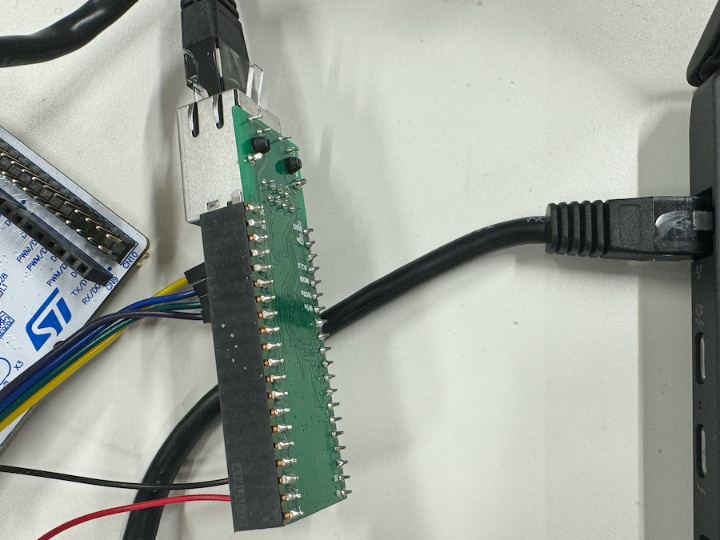
- The Concept: Typically, developers use dedicated shields for their specific MCU boards. Ar-Ray challenged this by taking a WIZnet Ethernet HAT (form-factor designed for Raspberry Pi Pico) and wiring it to an STM32 Nucleo board.
- The Goal: To achieve a stable, hardwired micro-ROS connection on an STM32 device without waiting for a specific STM32 Ethernet shield.
2. Why WIZnet? (Versatility & Performance)
- Universal SPI Interface: This project proves that WIZnet's W5100S is truly platform-agnostic. As long as there is an SPI bus (SCK, MISO, MOSI, CS), WIZnet chips can provide TCP/IP connectivity to any MCU.
- Critical Stability: Ar-Ray emphasizes that for ROS 2 communication, stability is paramount. The W5100S handles the network stack, ensuring that the STM32 can process sensor data and motor control loops without jitter, which is often unavoidable with Wi-Fi.
3. Technical Deep Dive (Implementation)
- Wiring Strategy: The blog details the connection between the Nucleo and the HAT:
- SPI Bus: Connected standard SPI pins.
- Power: 3.3V and GND shared between boards.
- CS Pin: Manually assigned in code.
- Code Adaptation: Using his
micro_ros_arduino_simplerlibrary, the setup remains elegant despite the non-standard hardware pairing.
// Configuring the custom hardware setup
// CS pin 6 is used for the W5100S HAT connection
int cs = 6;
set_microros_native_ethernet_udp_transports(mac, ip, agent_ip, agent_port, cs);
4. Conclusion
- This project serves as an excellent reference for developers who need to add Ethernet to their existing MCU boards using whatever WIZnet modules are available, proving the flexibility of the W5100S ecosystem.
[Korean Version]
원문 출처 (Source Mention)
Original Blog Post by Ar-Ray 이 큐레이션은 Ar-Ray 님의 기술 블로그 포스트를 기반으로 하며, 그가 WIZnet 하드웨어를 사용하여 STM32에서 micro-ROS를 위한 이더넷을 활성화한 과정을 기록하고 있습니다.
1. 소개: 하드웨어 경계를 넘어서 (Introduction)
- 컨셉: 보통 개발자들은 자신의 MCU 보드에 맞는 전용 쉴드를 사용합니다. Ar-Ray 님은 WIZnet Ethernet HAT(라즈베리 파이 피코용 폼팩터)을 STM32 Nucleo 보드에 배선하여 연결함으로써 이러한 관행에 도전했습니다.
- 목표: 전용 STM32 이더넷 쉴드를 기다리지 않고, STM32 장치에서 안정적인 유선 micro-ROS 연결을 구현하는 것입니다.
2. 왜 WIZnet인가? (범용성 & 성능)
- 보편적인 SPI 인터페이스: 이 프로젝트는 위즈네트의 W5100S가 진정으로 플랫폼에 구애받지 않음을 증명합니다. SPI 버스(SCK, MISO, MOSI, CS)만 있다면, WIZnet 칩은 어떤 MCU에도 TCP/IP 연결을 제공할 수 있습니다.
- 결정적인 안정성: Ar-Ray 님은 ROS 2 통신에서 안정성이 무엇보다 중요함을 강조합니다. W5100S가 네트워크 스택을 처리함으로써, STM32는 Wi-Fi 사용 시 피할 수 없는 지터 없이 센서 데이터와 모터 제어 루프를 처리할 수 있습니다.
3. 기술적 심층 분석 (Implementation)
- 배선 전략: 블로그는 Nucleo와 HAT 사이의 연결을 상세히 설명합니다:
- SPI 버스: 표준 SPI 핀 연결.
- 전원: 보드 간 3.3V 및 GND 공유.
- CS 핀: 코드에서 수동 할당.
- 코드 적용: 그의
micro_ros_arduino_simpler라이브러리를 사용하여, 비표준 하드웨어 조합임에도 불구하고 설정 코드는 우아함을 유지합니다.
// 커스텀 하드웨어 설정 구성
// W5100S HAT 연결을 위해 CS 핀 6번 사용
int cs = 6;
set_microros_native_ethernet_udp_transports(mac, ip, agent_ip, agent_port, cs);
4. 결론 (Conclusion)
- 이 프로젝트는 사용 가능한 WIZnet 모듈을 활용하여 기존 MCU 보드에 이더넷을 추가해야 하는 개발자들에게 훌륭한 레퍼런스가 되며, W5100S 생태계의 유연성을 증명합니다.