


How Does W5300 Ethernet Support an OPC-UA Agent for Legacy PLCs?
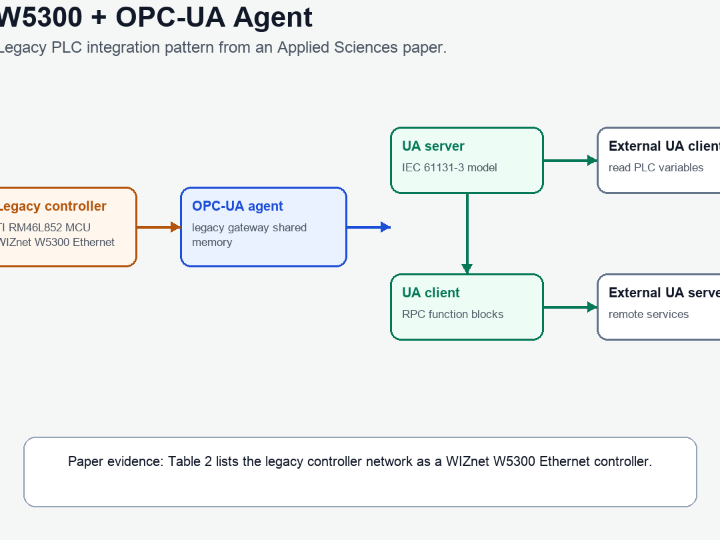
This paper validates an OPC-UA agent using a legacy controller whose network interface is a WIZnet W5300 Ethernet controller.
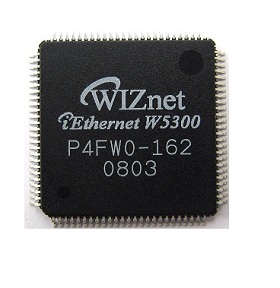
WIZnet - W5300
x 1

The paper's experimental system table lists the legacy controller network as a WIZnet W5300 Ethernet controller
📌 Overview
Seung-Yong Lee and Minyoung Sung published this Applied Sciences paper on an OPC-UA agent for legacy programmable logic controllers. The paper is useful for WIZnet readers because its experimental system identifies the legacy controller network interface as a WIZnet W5300 Ethernet controller.
The paper does not present a W5300 firmware release. Instead, it validates a system architecture: an external OPC-UA agent runs beside a legacy controller, keeps a synchronized image of PLC variables, exposes an IEC 61131-3 information model, and executes OPC-UA client function blocks on behalf of the PLC.
System Configuration
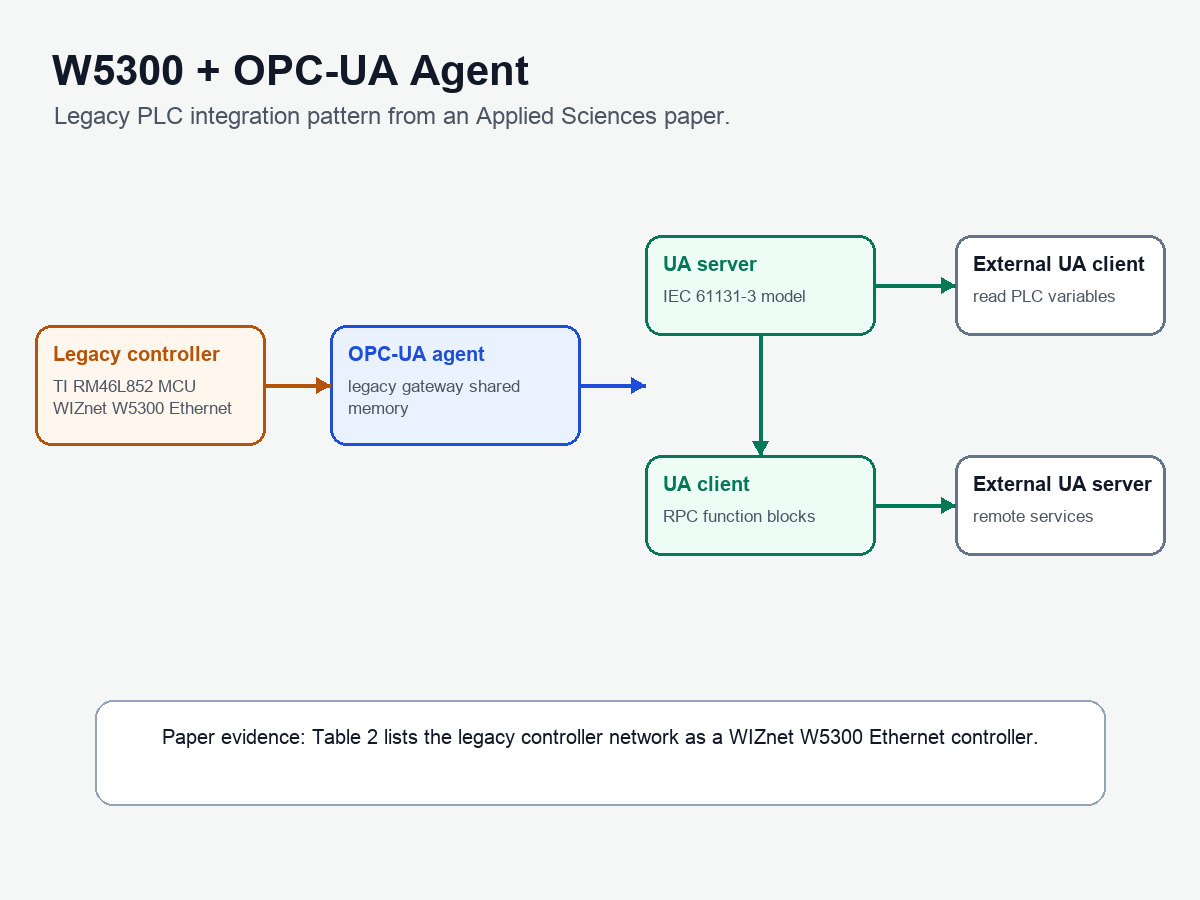
The experimental setup has three main sides. The external OPC-UA system runs on a PC with open62541. The OPC-UA agent runs on another PC, also using open62541. The legacy controller is described as an Arm Cortex-R4F-based TI RM46L852 MCU, and the paper's experimental-system table lists its network as a WIZnet W5300 Ethernet controller.
That distinction matters. The W5300 is not the paper's OPC-UA software stack. The agent PCs handle OPC-UA server and client functionality. The W5300 appears as the Ethernet controller in the legacy controller side of the experimental system, which makes the paper a useful W5300-connected legacy-control case study rather than an open W5300 OPC-UA firmware project.
System Architecture & Data Flow
The agent design has three concurrent components. The legacy gateway communicates with the PLC and maintains an image of selected PLC variables in shared memory. The UA server exposes those variables through an IEC 61131-3 information model. The UA client contains the OPC-UA client stack and handles RPC-style execution of client function blocks.
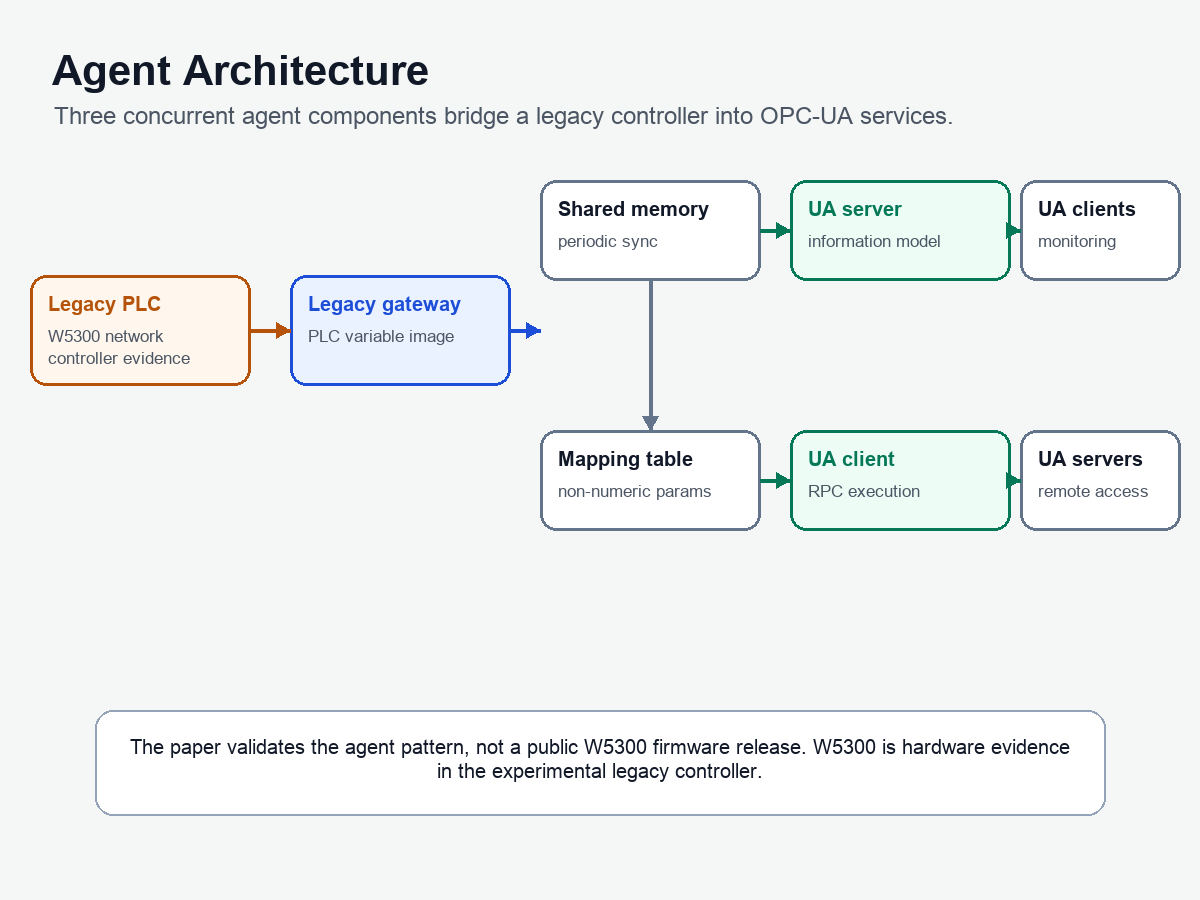
The shared memory is the key bridge. It stores synchronized PLC variable values, the state of UA function blocks, and input/output parameters. For function arguments that the legacy PLC cannot represent directly, such as strings or complex structures, the paper describes a mapping-table approach so the PLC can pass an index while the agent looks up the richer argument values.
⚙️ Role of the WIZnet Chip
W5300 is the WIZnet component confirmed by the paper. It appears in the experimental system specification as the legacy controller's Ethernet controller. That is important because the paper is about moving a legacy control system into modern OPC-UA connectivity without forcing all OPC-UA functionality into the controller itself.
The practical reading is conservative: W5300 provides the Ethernet controller evidence on the legacy-controller side, while the OPC-UA agent architecture handles the heavy information-model and client/server work externally. This separation is a useful pattern for older controllers with limited compute, memory, or data-type support.
This post does not mark the project as a public WIZnet TOE implementation. The paper does not publish W5300 firmware, WIZnet socket API code, register access, schematics, or reusable board files. The W5300 evidence is hardware-system evidence from the experimental setup.
Public Evidence and Limits
The strongest evidence is the experimental-system table: it names WIZnet W5300 for the legacy controller network. The strongest architectural contribution is the agent pattern: legacy gateway, shared memory, UA server, UA client, and mapping tables for RPC of OPC-UA function blocks.
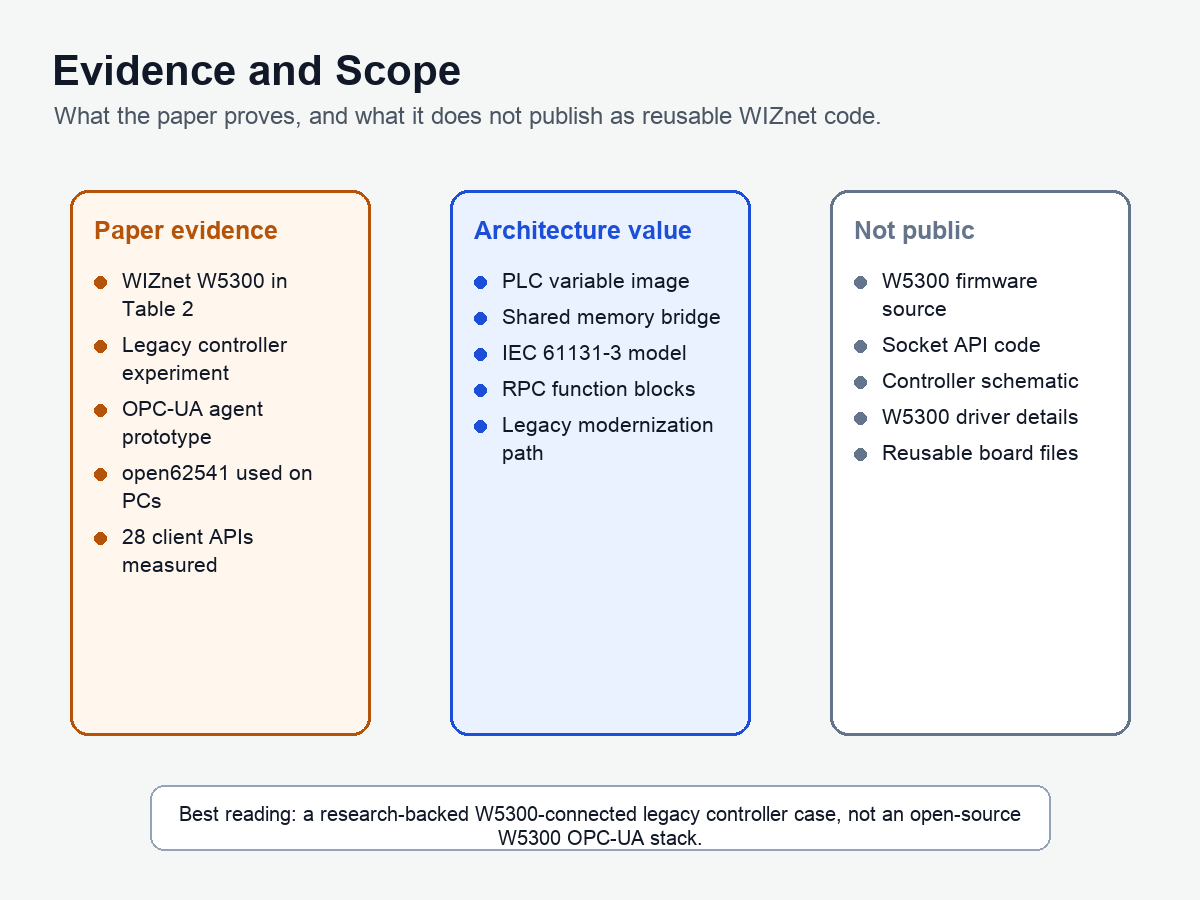
The limits are equally important. This is not a ready-to-build W5300 OPC-UA stack. It is a research paper with a validated prototype and performance evaluation. Reusing the idea in a WIZnet reference design would require separate firmware, protocol mapping, security review, and real PLC integration testing.
Where It Fits - Value & Limits
This paper fits industrial modernization, brownfield PLC integration, robot-controller monitoring, and OPC-UA gateway design. It is especially relevant when a controller can communicate over Ethernet but cannot safely host the full OPC-UA information model, security layer, and client function block logic by itself.
For WIZnet, the value is the system pattern. A W5300-connected controller can remain focused on control logic while a nearby agent handles OPC-UA semantics and richer data exchange. That pattern also maps well to future WIZnet examples around PLC gateways, protocol translation, and industrial edge agents.
The limitation is that the paper does not expose the embedded networking implementation. Any real product or reference design would still need a source-backed W5300 driver path, timeout behavior, security handling, and long-running industrial reliability validation.
Related WIZnet Maker Projects
OPC UA server on KinCony KC868-A16v3 / W5500 is the closest OPC-UA Maker comparison. It runs OPC-UA server functionality on W5500-connected hardware, while this paper keeps the OPC-UA stack in an external agent and uses W5300 evidence on the legacy controller side.
How to Build Modbus TCP Slaves with W5500 on STM32 (Rust) and Bridge Them to OPC-UA? is related because it bridges industrial field protocols toward OPC-UA. The difference is that the Maker post is a source-level W5500/STM32/Rust implementation, while this paper is an academic agent architecture validated with a W5300-equipped legacy controller.
Securing Industrial PLCs with WIZnet W5500: An Open-Source IoT Gateway Solution shares the legacy-PLC gateway theme. It focuses on an open-source security and gateway stack, while the paper focuses on OPC-UA information service and client function blocks for legacy controllers.
❓ FAQ
Q. Does the paper use a WIZnet chip? Yes. The experimental system table lists the legacy controller network as a WIZnet W5300 Ethernet controller.
Q. Is this a W5300 OPC-UA firmware project? No. The paper validates an OPC-UA agent architecture and does not publish W5300 firmware or socket API code.
Q. What does the OPC-UA agent do? It keeps synchronized PLC variable data, exposes an IEC 61131-3 information model, and executes OPC-UA client function blocks on behalf of a legacy PLC.
Q. Why use an external agent instead of putting OPC-UA inside the PLC? The paper targets legacy PLCs with limited data types, compute resources, or safety constraints, so the agent handles richer OPC-UA functionality on a separate machine.
Q. How should WIZnet readers use this paper? Treat it as a validated architecture pattern for W5300-connected legacy-control systems, not as a finished open-source W5300 reference design.
한국어 (Korean)
개요
Seung-Yong Lee와 Minyoung Sung은 레거시 PLC를 위한 OPC-UA agent 논문을 Applied Sciences에 발표했습니다. 이 논문은 실험 시스템에서 legacy controller의 네트워크 인터페이스를 WIZnet W5300 Ethernet controller로 명시하기 때문에 WIZnet 독자에게 의미가 있습니다.
이 논문은 W5300 펌웨어 릴리스가 아닙니다. 대신 외부 OPC-UA agent가 레거시 컨트롤러 옆에서 실행되고, PLC 변수 이미지를 동기화하며, IEC 61131-3 정보 모델을 제공하고, OPC-UA client function block을 PLC 대신 실행하는 시스템 아키텍처를 검증합니다.
시스템 구성
실험 구성은 세 부분으로 볼 수 있습니다. 외부 OPC-UA 시스템은 open62541을 사용하는 PC에서 동작합니다. OPC-UA agent도 별도 PC에서 동작하며 open62541을 사용합니다. legacy controller는 Arm Cortex-R4F 기반 TI RM46L852 MCU로 설명되며, 논문의 실험 시스템 표는 이 컨트롤러의 network 항목을 WIZnet W5300 Ethernet controller로 적고 있습니다.
이 구분이 중요합니다. W5300이 논문의 OPC-UA 소프트웨어 스택이라는 뜻은 아닙니다. OPC-UA server와 client 기능은 agent PC가 담당합니다. W5300은 실험 시스템의 legacy controller 쪽 Ethernet controller로 등장하므로, 이 논문은 공개 W5300 OPC-UA 펌웨어 프로젝트라기보다 W5300으로 연결된 레거시 제어 시스템 사례로 보는 것이 정확합니다.
시스템 아키텍처와 데이터 흐름
agent 설계는 세 개의 동시 실행 컴포넌트로 구성됩니다. legacy gateway는 PLC와 통신하고 선택된 PLC 변수 이미지를 shared memory에 유지합니다. UA server는 이 변수들을 IEC 61131-3 정보 모델로 외부에 제공합니다. UA client는 OPC-UA client stack을 포함하고 client function block의 RPC 방식 실행을 처리합니다.
핵심 브리지는 shared memory입니다. 여기에는 동기화된 PLC 변수 값, UA function block 상태, 입력 및 출력 파라미터가 저장됩니다. 레거시 PLC가 문자열이나 복잡한 구조체처럼 직접 표현하기 어려운 인자를 다루기 위해, 논문은 PLC가 index를 전달하고 agent가 더 풍부한 인자 값을 찾아 쓰는 mapping table 접근을 설명합니다.
WIZnet 칩의 역할
이 논문에서 확인되는 WIZnet 부품은 W5300입니다. 실험 시스템 사양에서 legacy controller의 Ethernet controller로 등장합니다. 이는 레거시 제어 시스템을 현대적인 OPC-UA 연결성으로 옮기되, 모든 OPC-UA 기능을 컨트롤러 내부에 억지로 넣지 않는 구조라는 점에서 의미가 있습니다.
보수적으로 읽으면, W5300은 legacy controller 쪽 Ethernet controller 근거이고, OPC-UA agent 아키텍처는 무거운 정보 모델과 client/server 처리를 외부에서 담당합니다. 이런 분리는 연산 성능, 메모리, 데이터 타입 지원이 제한된 오래된 컨트롤러에 유용한 패턴입니다.
이 글은 이 논문을 공개 WIZnet TOE 구현으로 표시하지 않습니다. 논문은 W5300 펌웨어, WIZnet socket API 코드, 레지스터 접근, 회로도, 재사용 가능한 보드 파일을 공개하지 않습니다. W5300 근거는 실험 구성표에서 확인되는 하드웨어 시스템 근거입니다.
공개 근거와 한계
가장 강한 근거는 실험 시스템 표입니다. 여기서 legacy controller network로 WIZnet W5300이 명시됩니다. 가장 큰 아키텍처 기여는 legacy gateway, shared memory, UA server, UA client, OPC-UA function block RPC를 위한 mapping table 구조입니다.
한계도 분명합니다. 이것은 바로 빌드할 수 있는 W5300 OPC-UA stack이 아닙니다. 검증된 프로토타입과 성능 평가를 담은 연구 논문입니다. 이 아이디어를 WIZnet 레퍼런스 설계로 재사용하려면 별도 펌웨어, 프로토콜 매핑, 보안 검토, 실제 PLC 통합 검증이 필요합니다.
활용 가치와 한계
이 논문은 산업 현대화, brownfield PLC 통합, 로봇 컨트롤러 모니터링, OPC-UA 게이트웨이 설계에 맞습니다. 특히 컨트롤러가 Ethernet 통신은 가능하지만 OPC-UA 정보 모델, 보안 계층, client function block 로직을 안전하게 직접 처리하기 어려운 경우와 잘 맞습니다.
WIZnet 관점의 가치는 시스템 패턴입니다. W5300으로 연결된 컨트롤러는 제어 로직에 집중하고, 가까운 agent가 OPC-UA 의미 계층과 더 풍부한 데이터 교환을 담당할 수 있습니다. 이 패턴은 PLC 게이트웨이, 프로토콜 변환, 산업용 edge agent 관련 WIZnet 예제로 확장하기 좋습니다.
한계는 임베디드 네트워킹 구현이 공개되어 있지 않다는 점입니다. 실제 제품이나 레퍼런스 설계로 만들려면 소스 기반 W5300 드라이버 경로, timeout 동작, 보안 처리, 장시간 산업 환경 신뢰성 검증이 별도로 필요합니다.
관련 WIZnet Maker 프로젝트
OPC UA server on KinCony KC868-A16v3 / W5500은 가장 가까운 OPC-UA Maker 비교 대상입니다. 이 글은 W5500 연결 하드웨어에서 OPC-UA server 기능을 실행하고, 본 논문은 OPC-UA stack을 외부 agent에 두며 legacy controller 쪽 W5300 근거를 제공합니다.
How to Build Modbus TCP Slaves with W5500 on STM32 (Rust) and Bridge Them to OPC-UA?는 산업용 필드 프로토콜을 OPC-UA 쪽으로 연결한다는 점에서 관련이 있습니다. 차이점은 Maker 글은 소스 수준의 W5500/STM32/Rust 구현이고, 이 논문은 W5300이 들어간 legacy controller로 검증한 학술적 agent 아키텍처라는 점입니다.
Securing Industrial PLCs with WIZnet W5500: An Open-Source IoT Gateway Solution은 legacy PLC gateway라는 주제를 공유합니다. 해당 글은 오픈소스 보안 및 게이트웨이 stack에 초점을 두고, 이 논문은 레거시 컨트롤러를 위한 OPC-UA information service와 client function block에 초점을 둡니다.
FAQ
논문에 WIZnet 칩이 사용되나요? 네. 실험 시스템 표에서 legacy controller의 network 항목이 WIZnet W5300 Ethernet controller로 명시됩니다.
이것은 W5300 OPC-UA 펌웨어 프로젝트인가요? 아닙니다. 이 논문은 OPC-UA agent 아키텍처를 검증하며 W5300 펌웨어나 socket API 코드를 공개하지 않습니다.
OPC-UA agent는 무엇을 하나요? PLC 변수 데이터를 동기화하고, IEC 61131-3 정보 모델을 제공하며, legacy PLC를 대신해 OPC-UA client function block을 실행합니다.
왜 PLC 안에 OPC-UA를 직접 넣지 않나요? 논문은 데이터 타입, 연산 자원, 안전 제약이 있는 레거시 PLC를 대상으로 하므로, 더 풍부한 OPC-UA 기능을 별도 머신의 agent가 처리하도록 설계합니다.
WIZnet 독자는 이 논문을 어떻게 활용해야 하나요? 완성된 오픈소스 W5300 레퍼런스 설계가 아니라, W5300으로 연결된 레거시 제어 시스템을 위한 검증된 아키텍처 패턴으로 보는 것이 적절합니다.
-
WIZnet W5300
Hardwired TCP/IP Ethernet controller identified in the paper's experimental legacy controller

-
open62541
Open-source OPC UA implementation used by the paper's external OPC-UA system and agent PCs
-
OPC UA overview
OPC Foundation overview of the OPC UA architecture


