



W5500 Hardware Protocol Stack Accelerates Voice Upload and Cloud Backup
W5500 Hardware Protocol Stack Accelerates Voice Upload and Cloud Backup
W5500 Hardware Protocol Stack Accelerates Voice Upload and Cloud Backup
In today's world where smart recording devices are becoming increasingly complex, have you ever encountered this awkward situation? 🎙️Even
though the microphone is of good quality and the recording is clear, it stutters, drops frames, and even the audio pieced together by the server is intermittent when uploading to the cloud—the user thinks, "Is this device a haphazardly made product?"
Where is the problem? Many people's first reaction is "the network is too bad" or "the server can't handle it", but the truth is often: your MCU is working to the point of collapse for the TCP/IP protocol stack!
Especially when using mainstream MCUs like STM32 for voice acquisition and uploading, if you rely on software protocol stacks like LwIP to handle network packets, the CPU will basically be stuck in place under the dual pressure of "sampling and packaging simultaneously." The result is: before the audio DMA transfer is complete, an SPI interrupt occurs, and in the end, you have no choice but to lose data to save the CPU.
So what to do? Don't worry, today we'll talk about a cutting-edge solution that "makes the MCU lie flat"—👉using
the W5500's full hardware TCP/IP protocol stack to completely delegate network processing to the chip itself!
Imagine this scenario:
You simply push the encoded voice data into the W5500's buffer and say, "Send!"
The rest—connection establishment, packet fragmentation, retransmission, ACK confirmation, congestion control—is all handled automatically by its internal hardwired logic. ✅
MCU? Time to go to sleep. 😴
This is not boasting, but a proven and highly efficient approach that has been widely validated by industrial-grade voice recorders and security intercom terminals.
Why is it necessary to use a hardware protocol stack?
Let me start by throwing cold water on this: If you're just making a small local area network toy and occasionally sending voice messages, the software protocol stack is perfectly adequate. But once you enter a scenario requiring continuous uploads, low latency, and high stability , such as remote inspections, medical consultations, or security monitoring, traditional solutions immediately become inadequate.
Let's look at a real comparison below 👇:
Dimension Software protocol stack (such as LwIP) W5500 Hardware Protocol Stack
CPU usage High-frequency interrupts and protocol parsing consume over 30% of performance. I hardly participate; I only handle configuration and data transfer.
Real-time The jitter is obvious due to scheduling issues. Hardware response, strong determinism
Power consumption The MCU cannot enter sleep mode, and its power consumption remains high. During idle periods, the system can enter Stop mode to save energy.
Development difficulty Porting is troublesome, and memory pool management is prone to errors. Register + SPI driver, API as concise as a textbook.
Throughput Bottleneck by CPU computing power Approaching the physical link limit (80Mbps SPI)
See? The key is not "whether it can be passed", but "whether it can be passed reliably".
The W5500's core strength lies in its fully hardware-wired TCP/IP protocol stack hidden within the chip . What does that mean?
It doesn't run code; it uses dedicated logic circuits to implement the entire suite of protocols, including TCP, UDP, IP, ARP, ICMP, and PPPoE—essentially giving network communication a "dedicated GPU."
📌 Fun fact: "Hardwired" means that even the state machine is fixed on the silicon chip, making it more punctual than the tasks running in an RTOS.
How does it help you "reduce your burden"?
The W5500 communicates with the main control MCU via SPI, and the whole process is like you are directing a super obedient assistant:
You say, "I want to connect to this IP."
→ Configure the target address, port, and working mode;
You say, "Open a socket."
→ It automatically completes the three-way handshake (if it's TCP).
You say, "Send this data out."
→ It segments, adds headers, performs checks, and retransmits the data itself until the other party sends an ACK;
Once finished, it taps you: "Done!"
→ An interrupt is triggered via the INT pin, allowing you to proceed to the next step.
You don't need to worry about how to calculate the checksum, how to adjust the sliding window, or how to set the RTO—all of these are handled by the chip's internal logic.
Even better, it supports 8 independent sockets ! This means you can upload voice streams, send heartbeat packets, and even secretly run an OTA upgrade channel at the same time, without any interference.
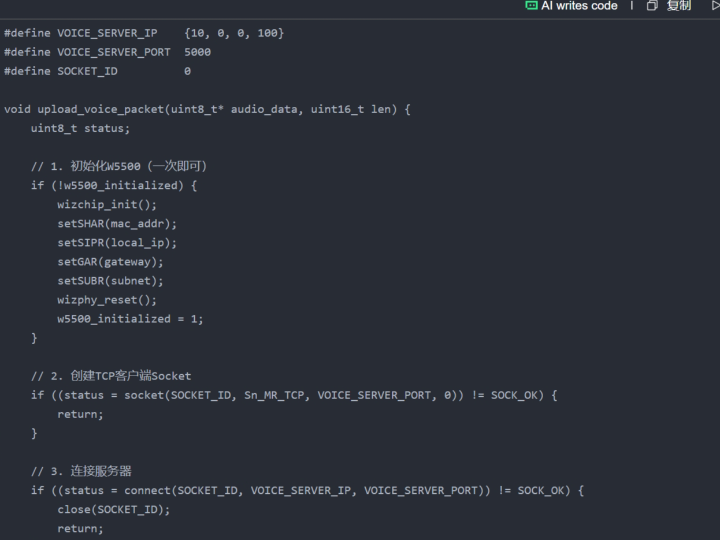
How easy is it to get started? Just look at this code snippet and you'll know.
The following example, based on the STM32 HAL library, demonstrates how to upload encoded voice data using a W5500:
#define VOICE_SERVER_IP    {10, 0, 0, 100}
#define VOICE_SERVER_PORT  5000
#define SOCKET_ID          0
void upload_voice_packet(uint8_t* audio_data, uint16_t len) {
   uint8_t status;
   // 1. 初始化W5500(一次即可)
   if (!w5500_initialized) {
       wizchip_init();
       setSHAR(mac_addr);
       setSIPR(local_ip);
       setGAR(gateway);
       setSUBR(subnet);
       wizphy_reset();
       w5500_initialized = 1;
   }
   // 2. 创建TCP客户端Socket
   if ((status = socket(SOCKET_ID, Sn_MR_TCP, VOICE_SERVER_PORT, 0)) != SOCK_OK) {
       return;
   }
   // 3. 连接服务器
   if ((status = connect(SOCKET_ID, VOICE_SERVER_IP, VOICE_SERVER_PORT)) != SOCK_OK) {
       close(SOCKET_ID);
       return;
   }
   // 4. 等待连接建立
   while (getSn_SR(SOCKET_ID) != SOCK_ESTABLISHED) {
       if (getSn_IR(SOCKET_ID) & Sn_IR_TIMEOUT) {
           close(SOCKET_ID);
           return;
       }
   }
   // 5. 发送语音数据块 💥
   send(SOCKET_ID, audio_data, len);
   // 6. 等待发送完成(可改为中断方式)
   while (!(getSn_IR(SOCKET_ID) & Sn_IR_SENDOK));
   setSn_IR(SOCKET_ID, Sn_IR_SENDOK);
   // 7. 断开连接(短连接模式)
   disconnect(SOCKET_ID);
   close(SOCKET_ID);
}


Isn't it clean and straightforward? There are no complex protocol state machines or memory pool allocation pitfalls. You only need to focus on two things:
- Where does the data come from (PCM acquisition)
- Where does the data go (call send)
The rest can be left to the W5500.
⚠️ Tips:
- SPI clock speed is recommended to be ≥30MHz, preferably 80MHz to achieve maximum throughput;
- Each socket is allocated a 2KB buffer by default, which can be adjusted according to needs;
- It is strongly recommended to use interrupt mechanism instead of polling to further free up CPU.
Voice Acquisition and Encoding: Don't Let the Front End Hold You Back
Of course, a fast internet connection isn't enough; the source of the network also needs to keep up. Otherwise, it's like having a highway built, but the tollbooth is still issuing tickets by hand...
A typical speech processing chain looks like this:
[麦克风] → [ADC/I2S采样] → PCM原始数据 → 编码压缩 → 封装上传
AI writes code
1
Taking an 8kHz sampling rate as an example, it generates
8000 × 16bit = 128kbps of PCM data per second
, which puts a considerable strain on the network.
Therefore, compression is necessary! Common options are as follows:
Encoding format Bitrate (8kHz) Features
G.711 (μ-law) 64 kbps Excellent compatibility, lossless sound reproduction, suitable for telephone-quality audio.
ADPCM ~32–40 kbps High compression ratio, lightweight computation, preferred for embedded systems
Opus Variable bit rate (16~64kbps) Ultra-low latency, but requires strong computing power.
AAC-LC ~48–96 kbps Good sound quality, suitable for high-quality recording.
If you are using a resource-limited MCU like the STM32F1/F4, the G.711 or ADPCM is the safest choice.
For example, the following is a timer-triggered PCM acquisition + G.711 encoding upload process:
#define FRAME_SIZE 160  // 20ms @ 8kHz
int16_t pcm_buffer[FRAME_SIZE];
uint8_t encoded_buffer[FRAME_SIZE];
void HAL_TIM_PeriodElapsedCallback(TIM_HandleTypeDef *htim) {
   if (htim == &htim6) {
       // 假设pcm_buffer已由DMA填充
       for (int i = 0; i < FRAME_SIZE; i++) {
           encoded_buffer[i] = linear_to_ulaw(pcm_buffer[i]);
       }
       upload_voice_packet(encoded_buffer, FRAME_SIZE);  // 非阻塞最佳配合RTOS
   }
}

Packing every 20ms reduces bandwidth from 128kbps to 64kbps, instantly halving network pressure!
Moreover, G.711 decoding is extremely simple, and it can be restored to a standard WAV file in the cloud at almost zero cost, making it very suitable for long-term backup.
What does the actual system architecture look like?
Here's a simplified architecture diagram to show how the components work together:
[麦克风]
  ↓ (模拟信号)
[ADC/MEMS麦克风]
  ↓ (I2S/DMA)
[MCU: STM32] ——→ [W5500] ——→ Router ——→ Internet ——→ Cloud Server
    ↑                  ↑
 PCM采集         SPI控制与数据传输
 G.711编码         TCP自动封装
                硬件协议栈处理
MCU task : Focus on audio acquisition, encoding, and calling the W5500 API;
W5500 task : Take over all network details, including connection management, fragmentation, retransmission, and verification;
Cloud task : Receive binary streams, reconstruct the audio by timestamps, and save the archive.
The "network protocol processing" stage, which is most likely to become a bottleneck in the entire chain, has been perfectly offloaded to the peripheral chip.
Common pain points and their "solutions"
Pain points Solution
High MCU load caused recording stuttering The W5500 takes over the protocol stack, and the CPU only needs to move data.
Network fluctuations cause packet loss and chaos Hardware-level automatic retransmission and congestion control ensure stability and reliability.
Multitasking to seize upload opportunities The MCU can enter a low-power sleep mode during non-sampling periods.
Protocol stack porting is complex and error-prone. Provides a mature SPI driver library with a clear and concise API.
Especially the last point, which many teams have encountered: LwIP porting and debugging can easily take weeks, and finding memory leaks can be incredibly frustrating. However, the W5500 official documentation provides a complete wiznet_io_lib library, which is ready to use out of the box, saving you enough time to optimize three rounds of algorithms.
Pitfalls in Engineering Design
Of course, even the best techniques have their precautions. Here are a few common pitfalls in practice:
🔧The typical operating current of the W5500 power supply
is about 150mA, and the transient current is even higher. It is essential to use an LDO or DC-DC power supply with sufficient margin to avoid voltage drops that could cause PHY malfunctions.
📏 PCB Layout:
Differential network traces (H/L) must be of equal length, with the length difference controlled within ±5mil, and kept away from clock lines and power supply noise sources.
🌡️Heat dissipation considerations:
When transmitting at full load for a long time, the chip temperature rises significantly. It is recommended to lay copper over a large area and add heat dissipation pads for grounding.
🔒 Enhanced Security
: If encryption is required, a lightweight AES layer (such as CTR mode) can be added after encoding. Since the W5500 does not participate in encryption, it can be handled entirely by the MCU before transmission.
💾Supports resuming interrupted downloads.
An offset or sequence number can be added to the header of each frame, which the cloud uses to determine whether the data has been lost and to request a retransmission.
So, who is it actually suitable for?
If your product meets any of the following conditions, then the W5500 is definitely worth considering:
✅ Requires long-term, stable uploading of audio segments (e.g., for security recorders)
✅ Latency sensitive , end-to-end latency <500ms required
✅ Uses a resource-constrained MCU ; avoids running complex protocol stacks
✅ Desires to reduce development cycle and achieve rapid mass production
It has already been successfully implemented in multiple fields:
- 🏢 Intelligent building intercom system
- 🏭 Remote inspection terminal for industrial equipment
- 🏥 Medical consultation recording backup
- 🚓 Data synchronization of law enforcement recorders
The final sentence summarizes...
The W5500 is more than just an Ethernet chip; it's a "lifeboat" that liberates MCUs from the quagmire of network problems . 🚤
When your main controller can finally be freed from the heavy protocol processing and focus on audio acquisition and local logic, the stability, efficiency and maintainability of the entire system will experience a qualitative leap.
Next time you encounter the problem of "voice upload lag", try a different approach:
instead of thinking about how to squeeze the MCU to its limits, think about how to make it do less work?
The W5500 is the secret weapon that allows the MCU to "elegantly slack off." 😎
Related resources: W5500 official library application library_ w5500 official library, w5500 library resources
You may be interested in related content to this article
———————————————— Copyright Notice: This article is an original work by CSDN blogger "魔王不造反" and is licensed under CC 4.0 BY-SA. Please include the original source link and this statement when reprinting.
Original Link: https://blog.csdn.net/weixin_28999139/article/details/154926095