



How Does STM32 Communicate with W5500 at the Register Level?
This article explains how an STM32 microcontroller communicates with the WIZnet W5500 Ethernet controller through SPI at the register level.
How Does STM32 Communicate with W5500 at the Register Level?
SPI Transaction Rules and Network Setup Explained for Reliable Ethernet Bring-Up
(STM32와 W5500은 레지스터 수준에서 어떻게 통신하는가?)
Summary (40–60 words)
This article explains how an STM32 microcontroller communicates with the WIZnet W5500 Ethernet controller through SPI at the register level. By analyzing SPI frame structure, chip-select timing, and network configuration registers, it shows how correct low-level handling enables reliable Ethernet bring-up before any TCP or UDP sockets are used.
1. Why SPI-Level Understanding Matters More Than Applications
Many Ethernet issues on embedded systems appear before any socket is opened:
Link LED is on, but ping fails
Network works once, then stops after reset
Registers read back incorrect values
In STM32 + W5500 systems, these problems almost always originate from SPI communication discipline and register sequencing, not TCP or application logic.
If SPI and registers are wrong, higher-layer protocols never had a chance.
2. STM32 ↔ W5500 Hardware Communication Model
Architectural Separation
STM32:
Executes firmware logic
Parses data
Controls peripherals
W5500:
Implements Ethernet MAC + PHY
Implements full hardware TCP/IP
Exposes configuration and data through registers
All interaction happens through SPI register access.
3. W5500 SPI Frame Structure (Critical Detail)
Every SPI transaction to W5500 follows a strict, multi-byte frame:
16-bit address
Register offset within a block
8-bit control byte
Read / Write bit
Block select (common, socket, TX, RX)
Data mode (variable or fixed length)
Data bytes
This design allows W5500 to expose its entire internal memory map over SPI.
4. Chip Select (CS) Timing Rules
The Golden Rule
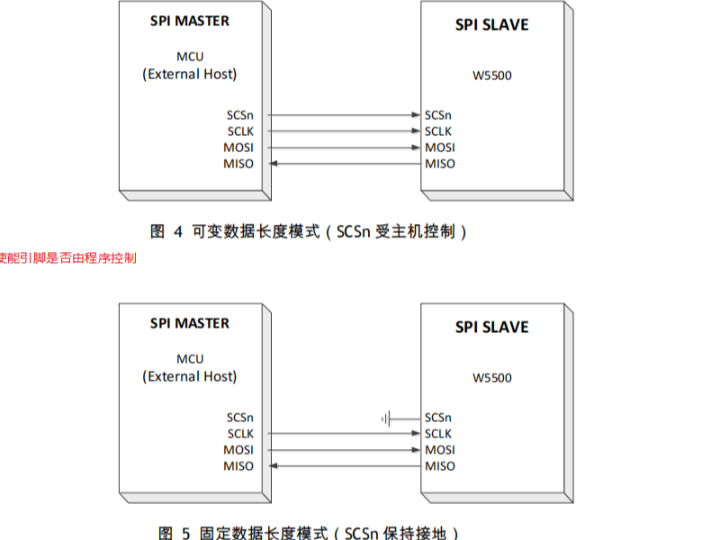
CS must remain LOW for the entire SPI frame — from address to last data byte.
Violations cause:
Partial register writes
Block selection errors
Corrupted network configuration
On STM32, this means:
No CS toggling inside HAL SPI calls
No interrupt-driven SPI access without protection
Extra care when using DMA
Many “mysterious” Ethernet bugs originate here.
5. Reset Sequence and SPI Readiness
Before any SPI access:
Assert W5500 RESET low
Hold for the minimum datasheet time
Release RESET
Wait for internal stabilization
Why this matters:
Internal registers reset to known values
PHY and socket logic initialize correctly
Writing registers too early leads to undefined behavior.
6. Register-Level Network Setup Flow
Network bring-up requires configuring common registers in the W5500.
Mandatory Configuration Order
MAC address
IPv4 address
Subnet mask
Gateway address
These registers define the device’s network identity.
Important distinction:
A physical Ethernet link does not imply IP-level connectivity.
Until these registers are written correctly, the device is invisible on the network.
7. SPI Access Patterns for Register Writes
Best practices for STM32 firmware:
Write registers using variable-length SPI mode
Group related register writes to minimize CS toggling
Read back registers to verify correctness
Reading back values is not optional during bring-up — it is the fastest way to confirm SPI integrity.
8. Verifying Network Configuration at Register Level
After writing network registers:
Read them back over SPI
Compare with expected values
Confirm no byte-order or alignment issues
If values mismatch:
SPI framing is wrong
CS timing is broken
Control byte is misconfigured
Debug here before testing ping or sockets.
9. Common SPI and Register-Level Failure Modes
❌ Link LED on, but cannot ping
Cause:
IP or gateway registers not written
Subnet mismatch
❌ Registers read back incorrectly
Cause:
CS deasserted too early
Wrong SPI mode (CPOL/CPHA)
❌ Network works only after power cycle
Cause:
Reset timing too short
Registers written before W5500 ready
These are deterministic, reproducible errors.
10. Why W5500’s Register Model Is Industrial-Friendly
W5500 uses:
Fixed register addresses
No dynamic memory
Explicit state exposure
This means:
Behavior is predictable
Debugging is straightforward
Long-term stability is achievable
For industrial and field devices, this transparency is a major advantage.
11. Transition from Network Setup to Socket Usage
Only after:
SPI verified
Registers verified
Network reachable
Should firmware proceed to:
TX/RX buffer allocation
Socket initialization
TCP or UDP communication
Skipping these steps guarantees instability.
12. Key Takeaway
In STM32 + W5500 systems, reliable Ethernet starts with SPI discipline and register correctness — not with TCP or application code.
When SPI framing, CS timing, and register sequencing are correct:
Network bring-up is deterministic
Debug time is minimal
Higher-level protocols “just work”
FAQ (Engineer-Focused)
Q1. Does W5500 tolerate SPI timing mistakes?
No. SPI framing must be exact.
Q2. Is HAL SPI safe to use?
Yes, if CS is managed correctly.
Q3. Should registers always be read back?
Yes, especially during bring-up.
Q4. Is this STM32-specific?
No. These rules apply to all MCUs.
Q5. Can this run without an RTOS?
Yes. SPI and register logic are RTOS-independent.
Source
CSDN article: weixin_44742767 (131244488)
WIZnet W5500 Datasheet
Tags
W5500, WIZnet, STM32, SPI Communication, Register-Level Ethernet, Network Bring-Up, Embedded Ethernet
🇰🇷 한국어 번역 (1:1 Full Translation)
STM32와 W5500은 레지스터 수준에서 어떻게 통신하는가?
SPI 통신 규칙과 네트워크 초기화 절차로 이해하는 이더넷 브링업
요약
본 문서는 STM32 마이크로컨트롤러가 WIZnet W5500 이더넷 컨트롤러와 SPI를 통해 레지스터 수준에서 통신하는 방식을 설명한다. SPI 프레임 구조, CS 타이밍, 네트워크 설정 레지스터를 분석함으로써, TCP나 UDP 이전 단계에서 안정적인 이더넷 브링업이 어떻게 이루어지는지를 보여준다.
1. 애플리케이션 이전 단계의 중요성
대부분의 이더넷 문제는
소켓 이전 단계에서 발생한다.
2. SPI 프레임 구조
주소 + 제어 바이트 + 데이터
3. CS 타이밍 규칙
CS는
프레임 전체 동안 유지되어야 한다.
4. 네트워크 레지스터 설정
MAC, IP, 서브넷, 게이트웨이
5. 흔한 오류
CS 조기 해제
잘못된 SPI 모드
리셋 타이밍 부족
6. 핵심 메시지
W5500 이더넷의 신뢰성은 SPI 규율에서 시작된다.
태그
W5500, STM32, SPI 통신, 레지스터 수준 이더넷, 네트워크 브링업