



How Does MQTT Work on Renesas RA6M4 with W5500 Ethernet?
This article explains how the Renesas CPK-RA6M4 development board integrates with the WIZnet W5500 Ethernet controller to implement an MQTT demo.
How Does MQTT Work on Renesas RA6M4 with W5500 Ethernet?
An Integration Walkthrough of CPK-RA6M4 (Cortex-M33) and Hardware TCP/IP
(Renesas RA6M4와 W5500을 사용한 MQTT 통합은 어떻게 동작하는가?)
Summary (40–60 words)
This article explains how the Renesas CPK-RA6M4 development board integrates with the WIZnet W5500 Ethernet controller to implement an MQTT demo. By walking through hardware architecture, SPI integration, TCP offloading, and MQTT session flow, it shows how hardware TCP/IP simplifies cloud messaging on Cortex-M33–based embedded systems.
1. Why Combine Renesas RA6M4 with W5500 for MQTT?
The Renesas RA6M4, based on the Arm Cortex-M33, is designed for:
Industrial and commercial embedded systems
Deterministic real-time behavior
Strong peripheral and security support
However, implementing Ethernet-based MQTT directly on an MCU typically requires:
A full software TCP/IP stack
Significant RAM and CPU resources
Careful timing and retransmission handling
By pairing RA6M4 with WIZnet W5500, these responsibilities are offloaded to hardware.
RA6M4 focuses on application and MQTT logic, while W5500 guarantees TCP/IP correctness.
2. System Architecture Overview
Hardware–Software Partitioning
Key architectural decision:
RA6M4 does not implement TCP/IP
W5500 implements TCP, UDP, ARP, IP in hardware
SPI is the only interface between MCU and network stack
This greatly simplifies firmware design.
3. CPK-RA6M4 as the Control MCU
The CPK-RA6M4 development board provides:
Cortex-M33 core with deterministic interrupt handling
Sufficient SRAM/Flash for MQTT logic
Multiple SPI interfaces suitable for Ethernet controllers
In this demo, RA6M4 is used strictly as:
System controller
MQTT packet generator/parser
Application logic host
All network transport complexity is delegated to W5500.
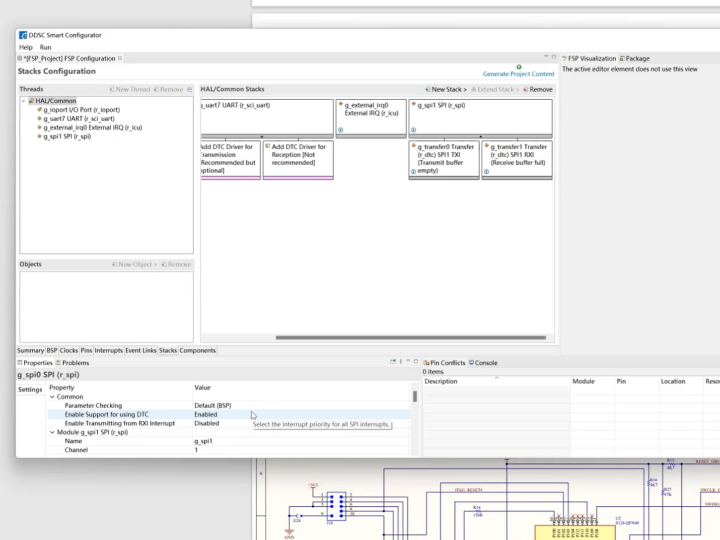
4. SPI Integration Between RA6M4 and W5500
SPI Responsibilities
The SPI interface is used for:
Reading/writing W5500 registers
Accessing TX/RX buffers
Issuing socket commands
A correct SPI driver must ensure:
Atomic transactions (CS asserted for full frames)
Correct address + control + data framing
No interruption during multi-byte operations
This SPI discipline is fundamental to MQTT reliability.
5. W5500’s Role: Hardware TCP/IP Offloading
The W5500 internally implements:
TCP state machines
Retransmission and acknowledgment
Window management
Checksum handling
From the RA6M4’s perspective:
MQTT packets are just payload data
TCP session stability is guaranteed
This separation is especially valuable on bare-metal or lightweight RTOS systems.
6. MQTT Workflow on RA6M4 + W5500
End-to-End MQTT Flow
In this flow:
RA6M4 constructs MQTT packets
W5500 delivers them reliably over TCP
Broker behavior validates correctness
7. Why This Integration Is Engineer-Friendly
Compared to software-only Ethernet solutions, this design offers:
Predictable timing
Minimal firmware complexity
Easier debugging (SPI + registers)
No large TCP/IP stack footprint
For Cortex-M33 systems, this is a major advantage.
8. Practical Demo Observations
From the MQTT demo behavior:
TCP connection establishes cleanly
MQTT CONNECT/CONNACK exchange is reliable
PUBLISH messages reach the broker consistently
Keep-alive packets maintain session stability
These observations confirm:
The integration is transport-stable and protocol-correct.
9. Industrial IoT Perspective
In industrial deployments, MQTT over Ethernet is preferred because:
Wired Ethernet avoids RF instability
Hardware TCP/IP reduces failure modes
Long-lived connections are more reliable
The RA6M4 + W5500 combination fits well for:
Industrial gateways
Data acquisition systems
Factory monitoring devices
10. Key Takeaway
By pairing Renesas RA6M4 with W5500, MQTT becomes an application-level concern rather than a networking burden.
This integration demonstrates how:
Cortex-M33 handles logic cleanly
W5500 guarantees TCP/IP stability
MQTT can be implemented with confidence on embedded systems
FAQ (Engineer-Focused)
Q1. Does RA6M4 run a TCP/IP stack in this demo?
No. All TCP/IP is handled by W5500 hardware.
Q2. Why use W5500 instead of software Ethernet?
To reduce complexity and improve determinism.
Q3. Is this suitable for production devices?
Yes, especially for industrial and long-running systems.
Q4. Does W5500 support MQTT directly?
No. MQTT runs on RA6M4; W5500 handles transport only.
Q5. What does this demo mainly validate?
Correct MCU–Ethernet integration and MQTT stability.
Source
Bilibili video: BV1t3411G7rn
Renesas RA6M4 documentation
WIZnet W5500 Datasheet
Tags
Renesas RA6M4, Cortex-M33, W5500, WIZnet, MQTT, Ethernet Integration, Industrial IoT, Hardware TCP/IP
🇰🇷 한국어 번역 (1:1 Full Translation)
Renesas RA6M4와 W5500으로 MQTT는 어떻게 동작하는가?
CPK-RA6M4(Cortex-M33)와 하드웨어 TCP/IP 통합 가이드
요약
본 문서는 Renesas CPK-RA6M4 개발 보드와 WIZnet W5500 이더넷 컨트롤러를 사용한 MQTT 데모 통합 구조를 설명한다. 하드웨어 아키텍처, SPI 연동, TCP 오프로딩, MQTT 세션 흐름을 통해 Cortex-M33 기반 시스템에서 안정적인 MQTT 구현이 어떻게 가능한지를 분석한다.
1. RA6M4와 W5500을 결합하는 이유
RA6M4는 강력한 MCU이지만
TCP/IP까지 소프트웨어로 처리하면 복잡해진다.
W5500은 이를 하드웨어로 해결한다.
2. 시스템 아키텍처
3. SPI 연동의 중요성
SPI 프레임 무결성이
MQTT 안정성을 결정한다.
4. MQTT 동작 흐름
TCP → CONNECT → CONNACK → PUBLISH → Keep-alive
5. 산업용 관점
예측 가능한 네트워크
장시간 안정성
유지보수 용이성
6. 핵심 메시지
RA6M4 + W5500 조합은 MQTT를 네트워크 문제가 아닌 애플리케이션 문제로 만든다.
태그
Renesas RA6M4, W5500, MQTT, Cortex-M33, 산업용 IoT, 하드웨어 TCP/IP