



How Does a W5500 + ESP32-S3 PoE Module Become an Industrial IoT Product?
This article introduces an industrial IoT product architecture built on the WIZnet W5500 Ethernet controller and the ESP32-S3-WROOM-1U-N16R8 module.
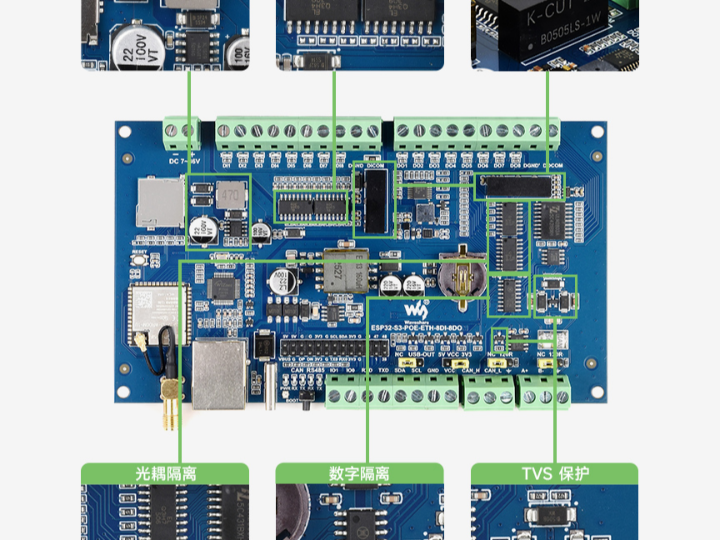
How Does a W5500 + ESP32-S3 PoE Module Become an Industrial IoT Product?
Secure Ethernet (MQTTS / HTTPS) Design with Hardware TCP/IP Offloading
(W5500과 ESP32-S3 PoE 모듈은 어떻게 산업용 IoT 제품이 되는가?)
Summary (40–60 words)
This article introduces an industrial IoT product architecture built on the WIZnet W5500 Ethernet controller and the ESP32-S3-WROOM-1U-N16R8 module. By combining PoE power, hardware TCP/IP offloading, and secure MQTTS/HTTPS communication, the design demonstrates how a value-added Ethernet module can meet reliability, security, and deployment requirements in industrial environments.
1. From Demo to Product: Why Architecture Matters
Many embedded Ethernet demos stop at “it works.”
Industrial products require much more:
Deterministic networking
Secure cloud connectivity
Simplified field installation
Long-term stability
Clear hardware–software responsibility boundaries
The combination of W5500 + ESP32-S3-WROOM-1U-N16R8 + PoE is not accidental — it directly addresses these product-level requirements.
This is what transforms a reference design into a value-added industrial module.
2. Product Overview: What This Module Actually Is
At a system level, this product can be described as:
A PoE-powered industrial Ethernet IoT module with hardware TCP/IP offload and secure cloud connectivity.
Core Components
ESP32-S3-WROOM-1U-N16R8
Dual-core MCU
Large Flash (16 MB) + PSRAM (8 MB)
TLS acceleration and crypto support
Application logic & security layer
WIZnet W5500
Hardware TCP/IP Ethernet controller
SPI interface
Deterministic socket-based networking
Offloads TCP/IP, ARP, ICMP from MCU
PoE subsystem
Single-cable power + data
Simplifies installation
Industrial wiring compatibility
This division of labor is key to product robustness.
3. Why W5500 Is Critical in an Industrial Product
In many ESP32 designs, Ethernet relies on:
Software TCP/IP stacks
DMA-heavy MAC drivers
Complex interrupt timing
The W5500 changes this fundamentally.
What W5500 Contributes at Product Level
Removes TCP/IP timing uncertainty from firmware
Eliminates large networking code paths
Avoids heap fragmentation over long uptime
Makes Ethernet behavior predictable and inspectable
In a product context, predictability beats peak performance.
This is especially important for:
24/7 operation
Harsh EMI environments
Field-installed devices with limited maintenance access
4. ESP32-S3 Role: Security and Application Brain
With TCP/IP offloaded, the ESP32-S3 can focus on what it does best:
MQTTS client logic
HTTPS REST APIs
Device authentication
Certificate management
Application-level protocols
The large Flash and PSRAM in the N16R8 variant are particularly important for:
TLS certificates
JSON payloads
OTA metadata
Future feature expansion
This is a product scalability decision, not just a convenience.
5. PoE: Installation Is Part of the Product
PoE is not just a power feature — it is a deployment strategy.
Why PoE Matters for Industrial Customers
One cable (Ethernet only)
No local power adapters
Easier enclosure design
Centralized power management
Better compliance with industrial wiring standards
For factories, buildings, and infrastructure projects, PoE often determines whether a device is deployable at scale.
6. Secure Communication: MQTTS and HTTPS by Design
MQTTS (MQTT over TLS)
Used for telemetry and control
Persistent, lightweight connection
Ideal for cloud platforms and device management
HTTPS
Used for configuration
REST APIs
Firmware update triggers
Diagnostics and provisioning
Crucially:
Security is handled at the ESP32-S3 layer, not inside W5500.
W5500 ensures reliable transport.
ESP32-S3 ensures cryptographic trust.
This separation simplifies certification and security audits.
7. Data Flow Architecture (End-to-End)
Each layer has a clear responsibility, which is essential for long-term maintenance.
8. Reliability and Long-Running Stability
From a product perspective, the biggest risks are:
Silent network stalls
Memory leaks
TLS session instability
Field resets
This architecture mitigates them:
W5500 uses fixed internal buffers
No dynamic TCP memory allocation
Socket state visible via registers
ESP32-S3 handles security without touching TCP internals
This is why the design scales from demo → pilot → production.
9. Typical Industrial Application Scenarios
This value-added module fits naturally into:
Industrial gateways
Energy monitoring devices
Building automation controllers
Factory data collectors
Secure edge nodes
Especially where:
Ethernet is mandatory
Wi-Fi is unreliable or forbidden
Security compliance is required
10. Why This Is a Value-Added Product (Not Just a Board)
What differentiates this from a generic dev board:
Pre-integrated Ethernet + PoE + security
Clear hardware/software separation
Predictable network behavior
Product-ready component choices
Scalable firmware architecture
Customers buy reliability and integration, not chips.
11. Key Takeaway
By combining W5500 hardware TCP/IP, ESP32-S3 security capabilities, and PoE deployment simplicity, this design moves beyond a demo into a true industrial IoT product platform.
It is not about “making Ethernet work.”
It is about making Ethernet deployable, secure, and maintainable at scale.
Tags
W5500, ESP32-S3, PoE, Industrial IoT, MQTTS, HTTPS, Secure Ethernet, WIZnet, Product Design
🇰🇷 한국어 번역 (1:1 Full Translation)
W5500 + ESP32-S3 PoE 모듈은 어떻게 산업용 IoT 제품이 되는가?
하드웨어 TCP/IP 기반의 보안 이더넷(MQTTS / HTTPS) 제품 설계
요약
본 문서는 WIZnet W5500과 ESP32-S3-WROOM-1U-N16R8 모듈을 기반으로 한 산업용 IoT 제품 아키텍처를 소개한다. PoE 전원, 하드웨어 TCP/IP 오프로딩, MQTTS 및 HTTPS 보안 통신을 결합함으로써, 이 설계가 산업 환경에서 요구되는 신뢰성, 보안성, 배포 용이성을 어떻게 충족하는지를 설명한다.
1. 데모와 제품의 차이
산업용 제품은
“동작”이 아니라
“지속성”을 요구한다.
2. 제품 구성 개요
ESP32-S3: 애플리케이션과 보안
W5500: 결정적인 이더넷 전송
PoE: 현장 배포 단순화
3. W5500의 제품적 가치
W5500은
TCP/IP를
문제가 아닌
자원으로 만든다.
4. 보안 통신 구조
TLS는 ESP32-S3에서,
전송은 W5500에서.
5. PoE의 의미
PoE는
기능이 아니라
배포 전략이다.
6. 산업 적용 사례
게이트웨이
에너지 모니터링
빌딩 자동화
7. 핵심 메시지
이 설계는 칩 조합이 아니라 산업용 제품 플랫폼이다.
태그
W5500, ESP32-S3, PoE, 산업용 IoT, 보안 이더넷, MQTTS, HTTPS