



How Can a W5500-Based Gateway Control a Motor Through MQTT?
This article explains how a W5500-based embedded gateway controls a motor using MQTT communication over Ethernet.
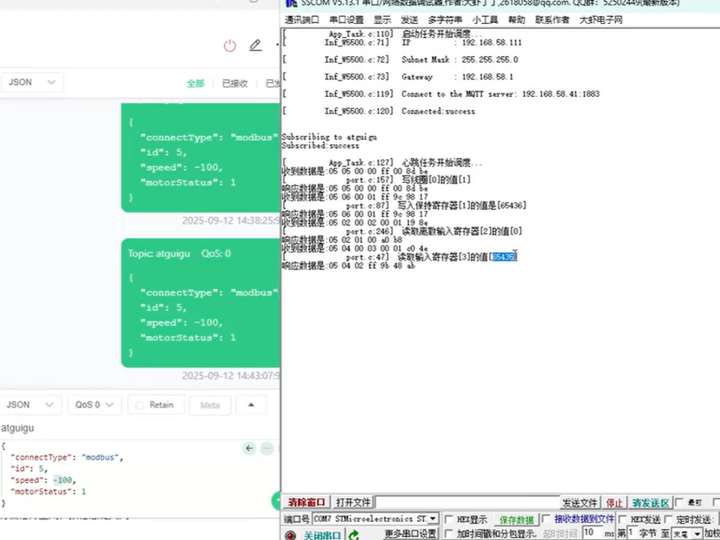
How Can a W5500-Based Gateway Control a Motor Through MQTT?
Understanding the End-to-End Protocol Workflow for Industrial IoT Devices
(W5500 기반 게이트웨이는 MQTT를 통해 모터를 어떻게 제어하는가?)
Summary (40–60 words)
This article explains how a W5500-based embedded gateway controls a motor using MQTT communication over Ethernet. By analyzing the protocol workflow—from TCP socket connection to MQTT message processing and motor actuation—developers can understand how hardware TCP/IP offloading simplifies industrial IoT gateway design while maintaining reliable wired networking.
1. Introduction: Gateway-Based Motor Control in IoT Systems
Modern industrial and IoT systems increasingly rely on network-controlled devices. Instead of operating motors locally through switches or serial interfaces, devices can now be controlled remotely through cloud messaging systems.
One of the most common messaging protocols used in IoT environments is MQTT (Message Queuing Telemetry Transport).
MQTT is designed for:
lightweight communication
low bandwidth networks
asynchronous messaging systems
Typical IoT control scenarios include:
remote motor control
industrial actuator management
smart building automation
environmental monitoring systems
In this architecture, a gateway device equipped with a W5500 Ethernet controller connects to an MQTT broker and receives control commands through network messages.
2. Why Use the W5500 for MQTT Networking?
The WIZnet W5500 is a hardware TCP/IP Ethernet controller designed for embedded systems.
Unlike traditional network implementations that require a full software TCP/IP stack, the W5500 integrates networking functions directly into hardware.
Key technical specifications include:
Hardware TCP/IP stack
SPI interface up to ~80 MHz
32 KB internal packet buffer
8 independent hardware sockets
Because of this design, the microcontroller does not need to process low-level networking protocols. Instead, it communicates with the W5500 using simple register operations and socket commands.
This approach significantly simplifies the development of Ethernet-based IoT gateways.
3. Typical System Architecture
A typical motor-control gateway using W5500 follows this architecture:
│
│ MQTT publish command
▼
MQTT Broker
│
▼
Gateway Device (MCU + W5500)
│
│ GPIO / driver control
▼
Motor Driver
│
▼
Motor
Each component plays a specific role.
Cloud or Client
A remote application (PC, mobile app, or cloud service) sends MQTT messages containing control commands.
MQTT Broker
The broker manages message distribution between clients and devices.
Gateway Device
The gateway receives MQTT messages and translates them into physical control signals for the motor.
4. Network Initialization Using W5500
Before MQTT communication can begin, the W5500 must initialize its network configuration.
Typical initialization process:
│
▼
SPI initialization
│
▼
W5500 reset
│
▼
Configure network parameters
│
▼
Ethernet link established
Network configuration typically includes:
MAC address
IP address
subnet mask
gateway
Once the device joins the network, it can establish a TCP connection to the MQTT broker.
5. MQTT Connection Workflow
MQTT communication operates on top of TCP.
The W5500 hardware manages the TCP connection, while the MCU runs the MQTT client logic.
The connection workflow typically follows this sequence:
│
▼
TCP connection to MQTT broker
│
▼
MQTT CONNECT packet
│
▼
Broker sends CONNACK
│
▼
Subscribe to control topic
Once subscribed, the device waits for incoming control messages.
6. End-to-End Motor Control Protocol Workflow
The most important part of the system is the command-control workflow.
Example MQTT command flow:
│
▼
MQTT Broker
│
▼
W5500 receives TCP packet
│
▼
MCU MQTT client parses payload
│
▼
Motor control command executed
Example payload message:
payload: ON
The MCU interprets the command and triggers the appropriate GPIO output.
7. Motor Control Logic
Once the command is received, the MCU interacts with the motor driver circuit.
Typical workflow:
│
▼
MCU parses message
│
▼
GPIO output activated
│
▼
Motor driver enabled
│
▼
Motor rotates
In some systems, feedback messages may also be published.
Example status update:
payload: RUNNING
This allows remote monitoring of the motor state.
8. Advantages of W5500 in Gateway Applications
Using the W5500 Ethernet controller provides several benefits for IoT gateway design.
Hardware TCP/IP Offloading
The microcontroller does not need to run a full networking stack.
This reduces firmware complexity and memory usage.
Reliable Wired Communication
Ethernet provides:
lower latency
stable connectivity
reduced interference compared to Wi-Fi
These properties are important in industrial control environments.
Deterministic Network Performance
Hardware networking ensures consistent timing behavior, which is useful for control systems.
9. Educational Value of This Tutorial
This gateway demonstration helps developers understand several key IoT concepts:
Ethernet networking in embedded systems
MQTT messaging architecture
remote device control workflows
gateway-based IoT system design
By combining W5500 Ethernet networking with MQTT communication, developers can build reliable remote control systems for industrial and automation applications.
FAQ
Why use W5500 for MQTT instead of Wi-Fi modules?
The W5500 provides stable wired Ethernet communication with hardware TCP/IP offloading. This reduces MCU workload and improves reliability in industrial environments where wireless interference or unstable connections could affect system operation.
How does the W5500 connect to the microcontroller?
The W5500 communicates with the MCU through an SPI interface. The MCU sends socket commands and reads data buffers through SPI transactions while the W5500 hardware manages Ethernet packet transmission and TCP/IP protocol processing.
What role does the W5500 play in MQTT communication?
The W5500 handles the TCP/IP transport layer, including packet buffering, retransmission, and Ethernet frame generation. The MCU runs the MQTT client logic on top of the TCP connection established by the W5500.
Can beginners build this kind of system?
Yes. Because the W5500 integrates the TCP/IP stack in hardware, developers only need to implement application-level protocols like MQTT. This significantly reduces the complexity of embedded networking projects.
How does this compare to software TCP/IP stacks?
Using software stacks such as LwIP requires significant MCU resources and RAM. The W5500 hardware stack offloads networking tasks, allowing smaller microcontrollers to support reliable Ethernet communication.
Source
Bilibili Video
BV18MpFz4Ef1
Tags
W5500
MQTT Gateway
Industrial IoT
Embedded Ethernet
Motor Control
🇰🇷 한국어 번역
W5500 기반 게이트웨이는 MQTT를 통해 모터를 어떻게 제어하는가?
요약
본 문서는 WIZnet W5500 이더넷 컨트롤러를 사용하는 임베디드 게이트웨이가 MQTT 통신을 통해 모터를 원격 제어하는 방법을 설명한다. TCP 연결, MQTT 메시지 처리, 모터 구동 과정까지의 전체 프로토콜 흐름을 분석하여 산업용 IoT 시스템에서 안정적인 네트워크 제어 구조를 이해하도록 돕는다.
시스템 구조
│
▼
MQTT 브로커
│
▼
게이트웨이 (MCU + W5500)
│
▼
모터 드라이버
│
▼
모터
MQTT 제어 흐름
│
▼
W5500 TCP 수신
│
▼
MCU MQTT 메시지 파싱
│
▼
GPIO 출력
│
▼
모터 구동
핵심 메시지
W5500 하드웨어 TCP/IP 스택을 사용하면 임베디드 시스템에서 안정적인 Ethernet 기반 MQTT 게이트웨이를 구현하여 산업 장치를 원격으로 제어할 수 있다.