



Network-Enabled FES Cycling Rehabilitation System Using W5300 Ethernet Connectivity
Network-Enabled FES Cycling Rehabilitation System Using W5300 Ethernet Connectivity
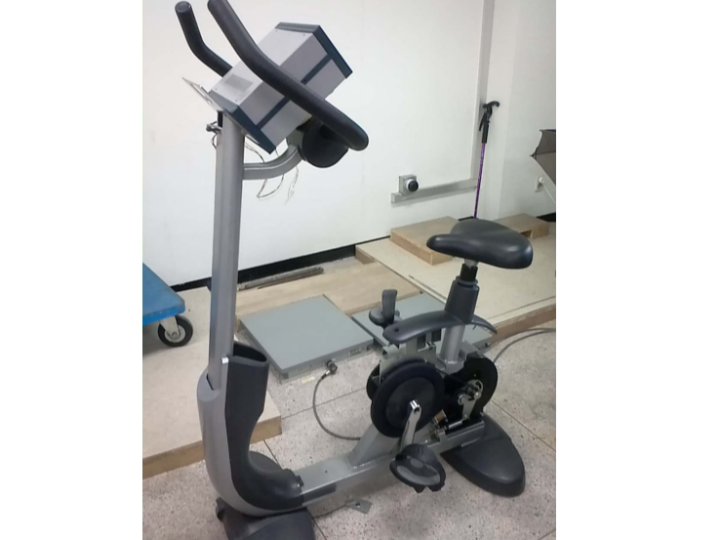
Overview
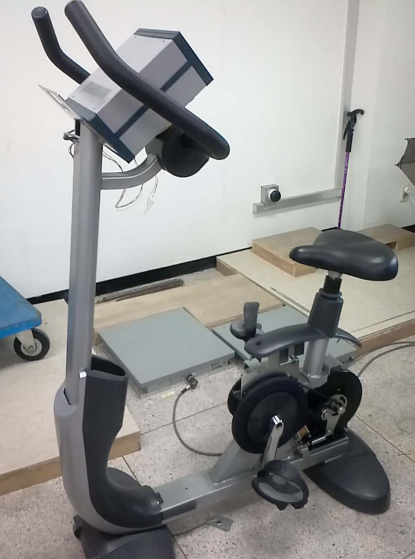
Rehabilitation systems are becoming more intelligent, connected, and data-driven. In particular, Functional Electrical Stimulation, or FES, is an important technology for supporting rehabilitation exercise by applying controlled electrical stimulation to muscles.
The ScienceON report Development of Health Exercise System for Physical Disability Treatment describes the development of an FES Cycling system, including an FES controller, real-time control hardware, stimulation modules, user interface, data visualization, and performance validation through cycling experiments.
In such a system, reliable data communication is essential. Sensor data, stimulation parameters, cycling speed, patient-specific control values, and exercise logs must be transferred consistently between the controller, user interface, and monitoring system.
This is where WIZnet’s W5300 becomes highly valuable.
The W5300 is a high-performance embedded Ethernet controller with a hardwired TCP/IP stack, integrated Ethernet MAC and PHY, 128KB internal buffer memory, and support for up to 8 hardware sockets. It is designed for embedded systems that require stable and efficient Ethernet connectivity.
Background
FES Cycling is a rehabilitation exercise method that uses electrical stimulation to activate muscles while the user performs cycling motion.
According to the ScienceON report, the project focused on several key objectives:
- Development of an FES Cycling system
- Verification of FES controller performance through cycling
- Development and testing of a complete FES cycling system
- Implementation of user interface and data visualization
- Research to improve practicality and efficiency of FES Cycling systems
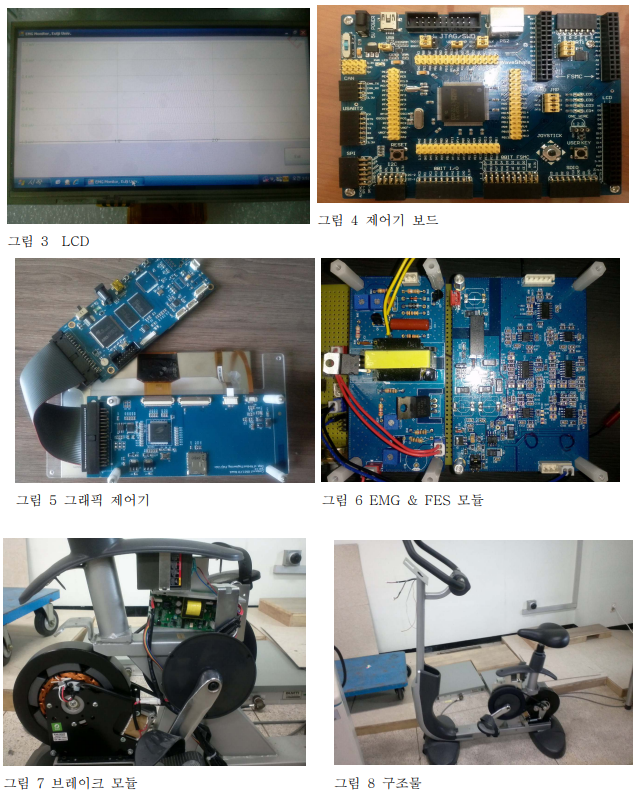
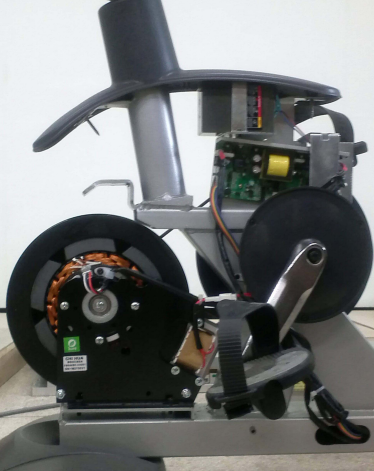
The report also describes hardware and software development including a real-time controller, stimulation device, ergometer feedback system, musculoskeletal model, EMG/FES module, brake module, and graphical user interface.
These elements make the system more than a simple exercise machine. It becomes a closed-loop rehabilitation platform where sensing, stimulation, control, feedback, and visualization must work together in real time.
Challenge
A rehabilitation exercise system must handle multiple types of data:
- Muscle stimulation parameters
- Cycling speed and angle feedback
- EMG or bio-signal data
- Controller status
- Patient-specific configuration values
- Exercise duration and performance logs
- UI and monitoring data
In a clinical or home rehabilitation environment, unstable communication can reduce system reliability. If the controller and monitoring system cannot exchange data consistently, real-time feedback and patient-specific control become difficult.
For this reason, wired Ethernet is a strong candidate for rehabilitation equipment that requires stable operation.
Solution
By integrating the W5300 into an FES Cycling rehabilitation system, the controller can communicate with a PC, local server, monitoring terminal, or hospital network through Ethernet.
The W5300 provides a hardware TCP/IP network engine, which means that TCP/IP processing is handled inside the chip rather than entirely by the host MCU. This reduces firmware complexity and allows the main controller to focus on real-time stimulation control, sensor processing, and motor or brake control.
A possible system flow is:
FES / EMG Modules → Main Controller → W5300 Ethernet → Monitoring PC / Server / UI
In this architecture, the embedded controller manages real-time rehabilitation control, while the W5300 provides stable Ethernet communication for data logging, remote monitoring, parameter update, and visualization.
Why Ethernet for Rehabilitation Systems?
1. Stable Communication
Medical and rehabilitation devices often operate continuously for long periods. Ethernet provides a stable wired connection that is less affected by wireless interference or signal attenuation.
2. Real-Time Data Transfer
FES Cycling systems rely on feedback such as cycling angle, speed, stimulation timing, and user response. Ethernet enables reliable transfer of this data between the embedded controller and the monitoring system.
3. Reduced MCU Workload
Because the W5300 includes a hardwired TCP/IP stack, the host MCU does not need to process the entire network protocol stack in software. This helps preserve MCU resources for control algorithms and signal processing.
4. Easy Integration with Embedded Controllers
The W5300 supports an 8/16-bit parallel bus interface, making it suitable for embedded systems that require higher throughput than SPI-based Ethernet controllers.
5. Suitable for High-Performance Data Applications
The W5300 supports up to 80Mbps network performance using DMA and includes 128KB internal memory for TCP/IP packet processing.
Role of W5300
The W5300 acts as the dedicated Ethernet communication engine in the rehabilitation system.
Key features include:
- Hardwired TCP/IP protocols: TCP, UDP, ICMP, IPv4, ARP, IGMP, PPPoE
- 8 independent hardware sockets
- 128KB internal TX/RX socket buffer
- 8/16-bit parallel host bus interface
- Integrated 10Base-T / 100Base-TX Ethernet PHY
- Auto-negotiation and Auto-MDIX support
- 3.3V operation with 5V I/O signal tolerance
- Maximum network performance up to 80Mbps by DMA
For an FES Cycling system, these features are especially useful because the device may need to transmit exercise data, receive control parameters, and maintain multiple communication channels at the same time.
For example:
- One socket can be used for real-time monitoring
- One socket can be used for configuration
- One socket can be used for data logging
- One socket can be used for firmware or diagnostic communication
This makes the W5300 suitable for embedded rehabilitation systems that require both performance and reliability.
System Architecture
A W5300-based FES Cycling rehabilitation system can be structured as follows:
[EMG Sensor / Bio-signal Input]
              ↓
[FES Controller MCU]
              ↓
[Stimulation Output Module] → [Muscle Stimulation]
              ↓
[Ergometer / Cycling Feedback]
              ↓
[W5300 Ethernet Controller]
              ↓
[PC UI / Data Visualization / Server / Hospital Network]
The ScienceON report describes a complete system including FES stimulation, EMG-related hardware, real-time control, ergometer feedback, user interface, and data visualization.
By adding W5300 Ethernet connectivity, this system can be extended into a connected rehabilitation platform.
Application Scenario
A patient uses an FES Cycling device for rehabilitation exercise.
During the session:
- The controller receives cycling angle or speed feedback from the ergometer.
- The FES controller calculates stimulation timing and intensity.
- The stimulation module applies electrical stimulation to the target muscles.
- Exercise data is transmitted through W5300 Ethernet.
- A PC or server visualizes the session in real time.
- Clinicians or therapists review the collected data and adjust parameters.
This approach enables more systematic rehabilitation management.
Benefits
By combining FES Cycling rehabilitation technology with W5300 Ethernet connectivity, the system can achieve:
- Stable wired network communication
- Real-time data monitoring
- Reduced MCU networking burden
- Easier integration with hospital or laboratory systems
- Support for data logging and visualization
- Better scalability for connected rehabilitation equipment
- Higher reliability compared to wireless-only communication
The ScienceON report notes that the developed system successfully linked stimulation output, ergometer feedback, and controller operation, and cycling tests of approximately 30–40 minutes were performed with subjects.
With Ethernet connectivity, such experimental and clinical data can be collected, monitored, and analyzed more effectively.
Using WIZ830MJ for Easier Development
For developers who want to evaluate W5300 more easily, WIZnet provides the WIZ830MJ module.
The WIZ830MJ includes the W5300, MAG-JACK, and required interface logic, allowing developers to implement high-performance Ethernet connectivity without designing the full Ethernet hardware from scratch.
This makes it useful for prototyping medical, rehabilitation, industrial, or data acquisition systems.
Conclusion
FES Cycling rehabilitation systems require precise control, reliable feedback, and consistent data communication. The ScienceON report demonstrates the development of a complete FES Cycling platform involving stimulation control, real-time feedback, user interface, and data visualization.
By integrating WIZnet’s W5300 Ethernet controller, such a system can be enhanced with stable wired connectivity and hardware TCP/IP processing.
The W5300 is especially suitable for this type of embedded rehabilitation application because it provides high network performance, 128KB internal buffer memory, 8 hardware sockets, and an 8/16-bit parallel bus interface.
As rehabilitation devices continue to evolve into connected healthcare platforms, W5300-based Ethernet communication can play an important role in improving system reliability, data accessibility, and long-term usability.
Q1: Why is Ethernet useful in an FES Cycling rehabilitation system?
A1:
Ethernet provides stable wired communication between the embedded controller and the monitoring system.
In an FES Cycling system, data such as stimulation parameters, cycling speed, feedback signals, and exercise logs must be transferred reliably. Ethernet helps reduce communication instability and supports continuous monitoring.
Q2: What role does W5300 play in this system?
A2:
The W5300 acts as the Ethernet communication controller.
It handles TCP/IP processing in hardware and provides Ethernet connectivity between the rehabilitation controller and external systems such as a PC, server, or hospital network.
Q3: Why use W5300 instead of a software TCP/IP stack?
A3:
Using W5300 reduces the networking workload of the host MCU.
Because TCP/IP is processed by the W5300 hardware engine, the MCU can focus on real-time tasks such as FES control, sensor processing, and feedback control.
Q4: Is W5300 suitable for real-time monitoring?
A4:
Yes. The W5300 supports high-performance Ethernet communication, 8 hardware sockets, and 128KB internal buffer memory.
These features make it suitable for applications that require real-time monitoring, data logging, and parameter communication.
Q5: What is a practical development option for W5300 evaluation?
A5:
Developers can use the WIZ830MJ module.
WIZ830MJ integrates the W5300, RJ45 MAG-JACK, and related interface logic, making it easier to prototype W5300-based Ethernet applications.