



EX-D16A3-RO8
EX-D16A3-RO8
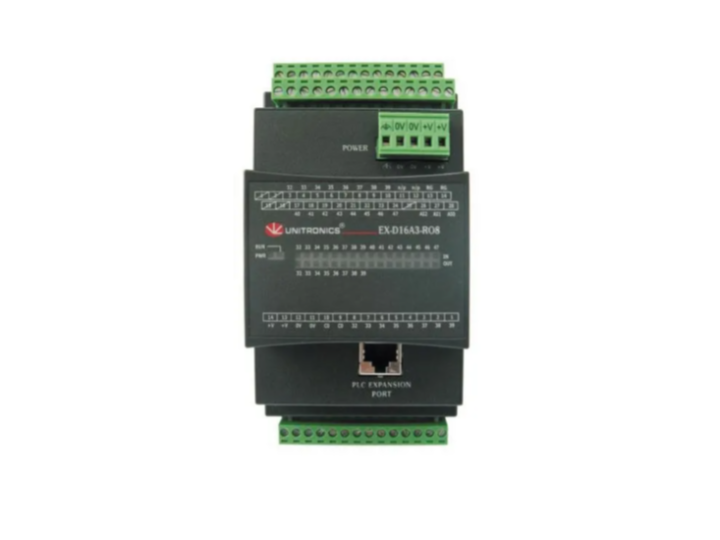
Overview
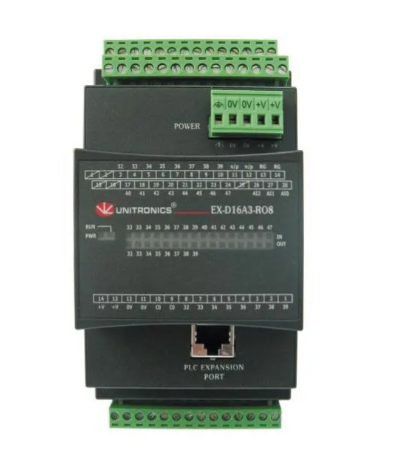
Industrial automation systems often require flexible I/O expansion to connect sensors, switches, actuators, relays, and analog field devices to a PLC system.
The Unitronics EX-D16A3-RO8 is an XL I/O expansion module designed for use with compatible Unitronics controllers, including Vision and M91 series PLCs. It provides a practical combination of digital inputs, analog inputs, and relay outputs in a compact DIN-rail mounted module.
This module includes:
- 16 digital inputs
- 3 analog inputs
- 8 relay outputs
- Built-in adapter for PLC communication
- 24VDC power input
- DIN-rail mounting
- Detachable I/O connectors
From a WIZnet perspective, this product is especially interesting because it uses W5500 Ethernet connectivity inside an industrial I/O module application.
The W5500 is a hardwired TCP/IP Ethernet controller that integrates a TCP/IP stack, 10/100 Ethernet MAC, and PHY into a single chip. By using W5500, industrial devices can add stable wired Ethernet connectivity through a simple SPI interface while reducing the software burden on the host MCU.
The EX-D16A3-RO8 is a good example of how W5500 can be applied beyond general IoT devices and used in real industrial automation equipment.
Background
In industrial control systems, PLCs are commonly used to monitor input signals and control output devices.
However, the number of built-in I/O points in a PLC is often limited. When an application requires more sensors, switches, counters, analog signals, or relay outputs, an I/O expansion module is needed.
Typical use cases include:
- Factory automation
- Machine control
- Process monitoring
- Pump and motor control
- Sensor signal collection
- Relay-based actuator control
- Industrial panel systems
- Remote equipment monitoring
For these applications, an I/O module must provide reliable signal handling, stable communication with the controller, and robust operation in industrial environments.
The EX-D16A3-RO8 addresses this requirement by combining digital inputs, analog inputs, and relay outputs in one expansion module.
Product Summary
The Unitronics EX-D16A3-RO8 is an XL I/O expansion module with a built-in adapter.
It is designed to work with compatible Unitronics PLC controllers and provides expanded I/O capacity for industrial automation systems.
The module includes 16 digital inputs, including high-speed counter capability, 3 analog current inputs, and 8 relay outputs.
This makes it suitable for applications where both signal monitoring and relay control are required.
The built-in adapter allows the module to communicate with the PLC and also provide power to additional expansion modules in the system. According to the Unitronics user guide, up to 7 I/O expansion modules can be connected to this module, depending on the modules used.
Main Features
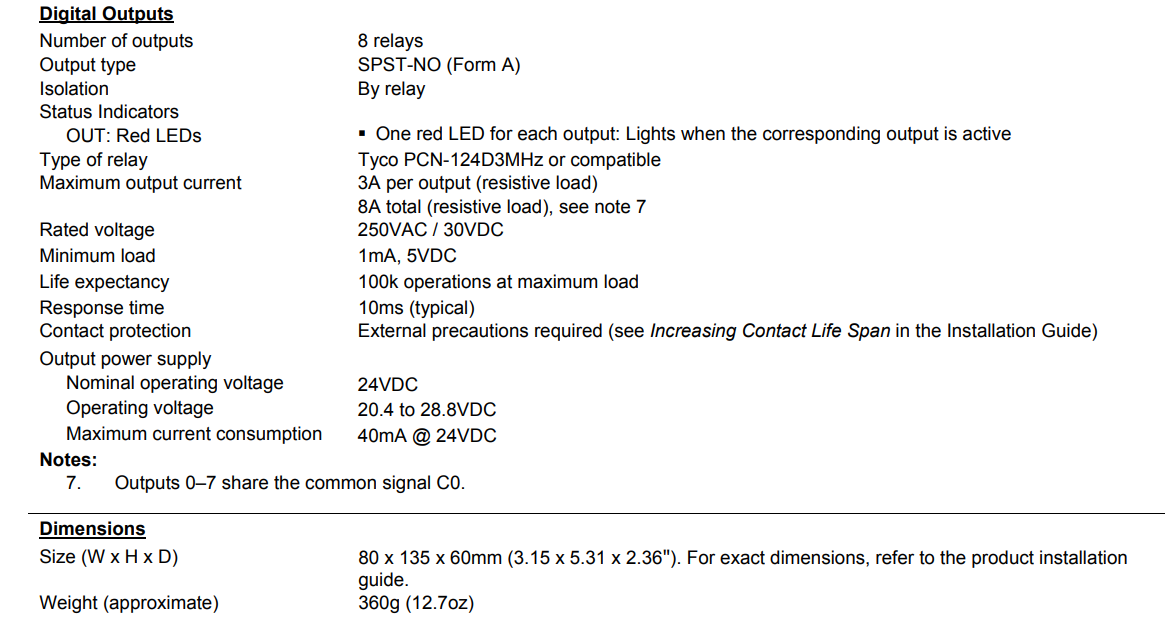
The EX-D16A3-RO8 provides the following main features:
- XL I/O expansion module
- Built-in adapter for PLC communication
- 16 digital inputs
- 2 high-speed counter inputs
- 3 analog current inputs
- 8 relay outputs
- 24VDC power supply
- DIN-rail mounting
- Detachable I/O connectors
- Status LEDs for power, communication, inputs, and outputs
- Support for additional I/O expansion modules
This combination makes the module useful for industrial systems that require mixed I/O expansion in a compact form factor.
I/O Configuration
The EX-D16A3-RO8 provides a balanced I/O configuration for industrial control applications.
Digital Inputs
The module includes 16 digital inputs in a single group.
The digital inputs support both PNP and NPN wiring configurations depending on the wiring method.
This flexibility allows the module to be used with different types of industrial sensors and control signals.
Two of the inputs can also be used as high-speed counter inputs or frequency measurement inputs. This is useful for applications such as encoder counting, pulse counting, speed measurement, or production counting.
Analog Inputs
The module includes 3 analog inputs.
These analog inputs support current input signals such as:
- 0–20mA
- 4–20mA
Current loop signals are widely used in industrial environments because they are robust against electrical noise and suitable for long-distance signal transmission.
This makes the analog inputs useful for sensors such as pressure transmitters, flow meters, level sensors, and temperature transmitters with current output.
Relay Outputs
The module includes 8 relay outputs.
Relay outputs are useful when controlling external devices that require isolated switching.
Typical applications include:
- Lamps
- Alarms
- Contactors
- Solenoids
- Pumps
- Fans
- Motor starters
- Other relay-driven loads
Because relay outputs provide dry-contact switching, they are suitable for many industrial control applications.
Why W5500?
The W5500 Ethernet controller is a strong fit for industrial I/O modules because it provides reliable wired Ethernet connectivity with a simple host interface.
Industrial devices often need stable communication, long-term reliability, and predictable behavior. Ethernet is commonly used in industrial systems because it provides fast, robust, and widely supported wired communication.
However, implementing Ethernet directly in an embedded device can increase hardware and firmware complexity.
W5500 helps solve this problem.
The W5500 integrates:
- Hardwired TCP/IP stack
- 10/100 Ethernet MAC
- Ethernet PHY
- SPI interface
- Internal packet buffer
- Multiple hardware sockets
This allows the host MCU to communicate over Ethernet without running a full software TCP/IP stack.
For an industrial I/O module, this is a major advantage because the MCU can focus on I/O processing, signal monitoring, relay control, diagnostics, and communication logic while W5500 handles the Ethernet protocol processing.
Advantages of W5500 in Industrial I/O Modules
1. Stable Wired Ethernet Connectivity
Industrial control systems often prefer wired communication because it is more stable and predictable than wireless communication.
W5500 provides 10/100 Ethernet connectivity and is designed for embedded systems that require reliable network communication.
For I/O modules, this reliability is important because input and output data must be transmitted consistently.
2. Reduced Firmware Complexity
Without a hardware TCP/IP controller, the host MCU may need to run a software TCP/IP stack.
This increases:
- Firmware size
- RAM usage
- CPU load
- Debugging complexity
- Long-term maintenance effort
With W5500, TCP/IP processing is handled by the chip’s hardwired TCP/IP engine.
This simplifies firmware development and allows the embedded system to remain lightweight.
3. Simple SPI Interface
W5500 communicates with the host MCU through SPI.
SPI is widely supported by most microcontrollers, making W5500 easy to integrate into embedded hardware designs.
This is useful for industrial I/O products because the system designer can choose an MCU based on I/O control requirements while using W5500 for Ethernet connectivity.
4. Integrated MAC and PHY
W5500 includes both Ethernet MAC and PHY.
This reduces the need for additional Ethernet controller components and simplifies the hardware design.
For compact DIN-rail industrial modules, reducing component count and board complexity is especially valuable.
5. Suitable for Real-Time Industrial Monitoring
Industrial I/O modules need to monitor field signals and update output states efficiently.
By offloading Ethernet processing to W5500, the host MCU can spend more time handling real-time I/O tasks instead of managing low-level network protocol operations.
This separation of responsibilities improves system efficiency.
System Architecture
The EX-D16A3-RO8 can be understood as a combination of three main functional blocks:
- Field I/O interface
- Main control logic
- Ethernet communication interface
The field I/O section handles digital inputs, analog current inputs, and relay outputs.
The main control logic processes the input and output states, manages module operation, and communicates with the PLC system.
The Ethernet communication section, based on W5500, provides wired network connectivity and handles TCP/IP communication.
In this architecture, W5500 acts as the Ethernet communication engine.
The host MCU does not need to implement a complex network stack. Instead, it can exchange data with W5500 through SPI and focus on industrial I/O control.
Industrial Use Cases
The EX-D16A3-RO8 can be used in many industrial automation applications.
Examples include:
- Machine input and output expansion
- Production line monitoring
- Sensor and actuator interface systems
- Relay control panels
- Pump and valve control systems
- Alarm and status monitoring systems
- Factory equipment control
- Industrial process monitoring
- Remote I/O systems
- PLC-based automation panels
The combination of digital inputs, analog inputs, and relay outputs makes the module flexible for many types of control systems.
With W5500 Ethernet connectivity, this type of module can also be integrated into networked industrial environments where stable wired communication is required.
Benefits for Industrial Automation
Using W5500 in an industrial I/O module provides several benefits:
- Reliable wired Ethernet communication
- Reduced MCU networking workload
- Simplified firmware development
- Compact hardware design
- Integrated TCP/IP, MAC, and PHY
- SPI-based MCU interface
- Suitable for DIN-rail industrial devices
- Stable communication for PLC and remote I/O systems
- Easier implementation of network-enabled I/O products
These advantages make W5500 suitable for industrial devices where Ethernet communication must be reliable, compact, and easy to implement.
Why This Product Is a Good W5500 Example
The EX-D16A3-RO8 is a meaningful example because it shows W5500 being used in an industrial I/O expansion product.
Many W5500 examples focus on maker boards, IoT sensors, or small embedded prototypes. However, industrial automation is one of the areas where wired Ethernet is especially important.
In this type of product, Ethernet is not just a convenience feature. It is part of the system infrastructure.
The module must communicate reliably, operate continuously, and support field wiring in real control environments.
W5500 is suitable for this role because it provides hardware-based Ethernet communication while keeping the host system simple.
This makes the EX-D16A3-RO8 a useful reference when considering W5500 for industrial control devices, remote I/O products, PLC accessories, and embedded automation modules.
Conclusion
The Unitronics EX-D16A3-RO8 is an industrial I/O expansion module that combines digital inputs, analog inputs, relay outputs, and PLC communication capability in a compact DIN-rail form factor.
From a WIZnet perspective, the important point is its use of W5500 Ethernet connectivity.
The W5500 provides a hardwired TCP/IP stack, integrated 10/100 Ethernet MAC and PHY, and an SPI interface for easy MCU integration. This allows industrial embedded devices to add reliable wired Ethernet communication without the burden of a full software TCP/IP stack.
For an I/O module, this architecture is highly practical. The host MCU can focus on field signal processing, relay output control, status monitoring, and PLC communication, while W5500 handles Ethernet networking.
This product demonstrates how W5500 can be used not only in IoT prototypes, but also in industrial automation equipment where stability, simplicity, and long-term reliability are important.
The EX-D16A3-RO8 is therefore a strong example of W5500 being applied in a real industrial I/O module.
Q1: What is the Unitronics EX-D16A3-RO8?
A1:
The EX-D16A3-RO8 is an XL I/O expansion module for compatible Unitronics PLC controllers.
It provides:
- 16 digital inputs
- 3 analog inputs
- 8 relay outputs
- Built-in adapter for PLC communication
- 24VDC operation
- DIN-rail mounting
It is used to expand the I/O capacity of industrial control systems.
Q2: Why is W5500 useful in this type of I/O module?
A2:
W5500 is useful because it provides Ethernet connectivity with a hardwired TCP/IP stack.
This reduces the networking workload of the host MCU and simplifies firmware design.
Key advantages include:
- Hardware TCP/IP processing
- Integrated Ethernet MAC and PHY
- SPI interface
- Stable wired Ethernet communication
- Reduced firmware complexity
This makes W5500 suitable for industrial embedded devices.
Q3: What kind of signals can the EX-D16A3-RO8 handle?
A3:
The module can handle mixed industrial I/O signals.
It supports:
- Digital input signals
- High-speed counter inputs
- Analog current inputs
- Relay outputs
This makes it useful for monitoring sensors and controlling external devices in automation systems.
Q4: What are the analog input types?
A4:
The analog inputs support current signals.
Supported input ranges include:
- 0–20mA
- 4–20mA
These signal types are commonly used in industrial sensors and transmitters.
Q5: What are typical applications for this module?
A5:
Typical applications include:
- PLC I/O expansion
- Machine control
- Sensor monitoring
- Relay control
- Industrial automation panels
- Process monitoring
- Remote I/O systems
- Factory equipment control
The module is suitable for systems that require a combination of digital inputs, analog inputs, and relay outputs.
Q6: Why is wired Ethernet important in industrial systems?
A6:
Wired Ethernet provides stable and predictable communication.
In industrial environments, reliable communication is important because equipment often operates continuously and must exchange control data accurately.
W5500 helps embedded devices implement wired Ethernet communication in a compact and efficient way.