



Ethernet I/O Module with W5500
Ethernet I/O Module with W5500
Overview
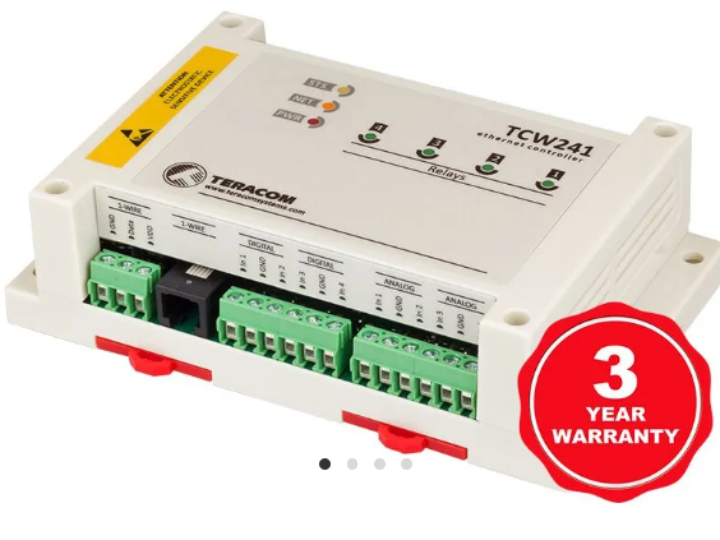
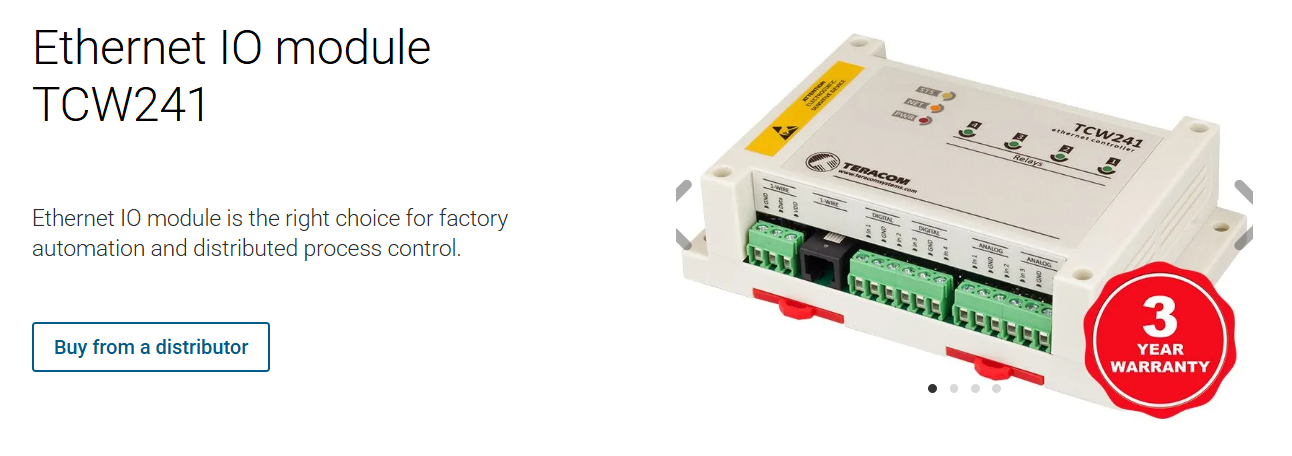
TCW241 is an Ethernet I/O module developed by Teracom for remote monitoring and control.
It is designed for applications such as factory automation, distributed process control, industrial monitoring, building automation, and remote equipment management.
The device provides:
- 4 digital inputs
- 4 analog inputs
- 4 relay outputs
- 1-Wire sensor support
- Modbus TCP/IP
- SNMP v2
- HTTP API
- Web-based monitoring and configuration
According to Teracom, TCW241 is intended for general remote Ethernet I/O monitoring and control, especially in factory automation and distributed process control applications.
In this product, WIZnet W5500 is used as the Ethernet controller, providing reliable wired network connectivity for the I/O module.
Background
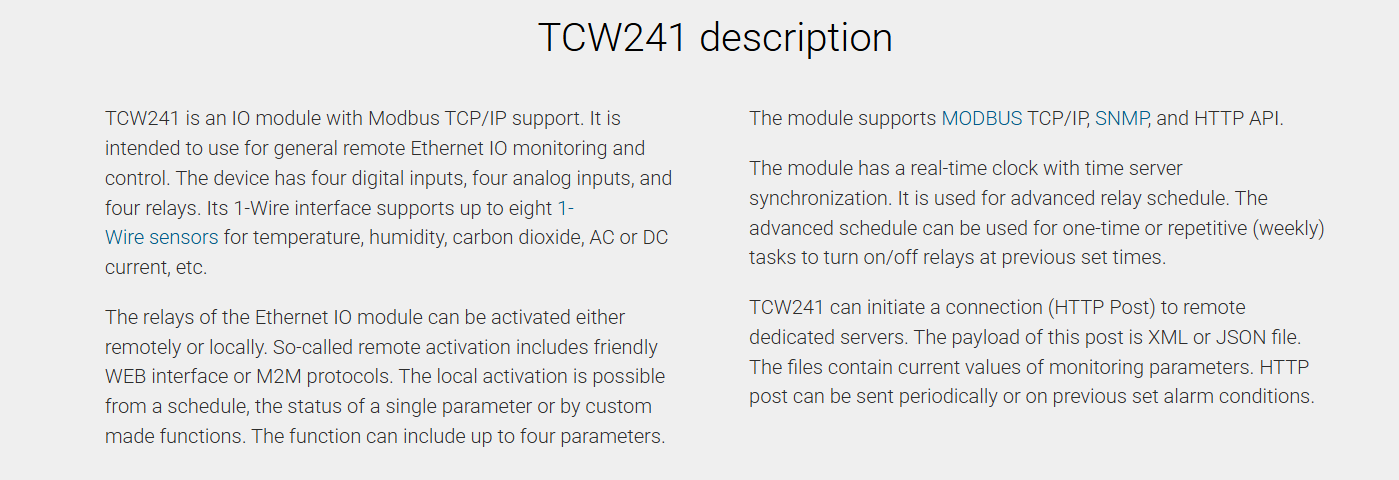
In industrial automation, many systems need to monitor field signals and control equipment remotely.
Typical signals include:
- Switch status
- Alarm contacts
- Sensor outputs
- Analog voltage or current signals
- Temperature
- Humidity
- CO₂
- Relay-controlled loads
Traditionally, these signals are connected directly to a PLC or local controller. However, in distributed systems, the I/O points may be located far away from the main control panel.
This creates several challenges:
- Long signal wiring
- Higher installation cost
- Harder maintenance
- Limited remote access
- Difficult integration with SCADA or monitoring software
Ethernet I/O modules solve this problem by placing I/O close to the field device and sending the data over the network.
TCW241 is designed for this type of application.
Solution
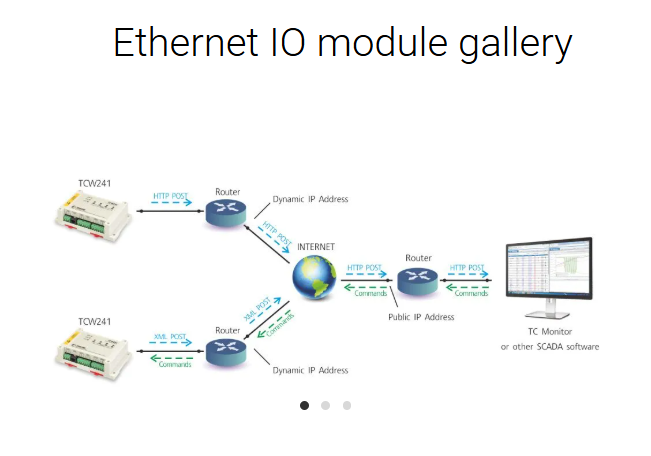
Teracom TCW241 uses Ethernet communication to connect field I/O signals to remote monitoring and control systems.
The basic architecture can be described as follows:
Sensors / Switches / Field Devices
        |
 Digital Inputs / Analog Inputs / 1-Wire
        |
     TCW241
        |
  WIZnet W5500 Ethernet Controller
        |
 Ethernet Network
        |
SCADA / PLC / Server / Web Browser
The TCW241 collects digital input status, analog input values, and 1-Wire sensor data.
Then, using Ethernet communication, the data can be accessed through web interface, Modbus TCP/IP, SNMP, or HTTP API.
Relay outputs can also be controlled remotely through the network or locally based on schedules, input status, sensor values, or custom functions. Teracom describes relay activation through web interface and M2M protocols such as Modbus TCP/IP, SNMP, and HTTP API.
Why W5500?
The W5500 is a hardwired TCP/IP Ethernet controller from WIZnet.
It integrates:
- Ethernet MAC
- Ethernet PHY
- Hardwired TCP/IP stack
- SPI host interface
For an Ethernet I/O module like TCW241, W5500 is a strong fit because it allows the main MCU to add reliable Ethernet communication without implementing a full software TCP/IP stack.
1. Reliable Wired Ethernet
Industrial I/O modules need stable communication.
W5500 provides wired Ethernet connectivity, which is suitable for factory automation, building automation, and distributed control systems.
2. Hardwired TCP/IP Stack
W5500 processes TCP/IP in hardware.
This reduces the processing burden on the host MCU and helps simplify firmware development.
For an I/O module that must handle inputs, relays, sensor readings, web interface, and industrial protocols, reducing network stack load is a practical advantage.
3. SPI Interface
W5500 communicates with the host MCU through SPI.
This makes it easy to integrate Ethernet into compact embedded products without requiring an MCU with built-in Ethernet MAC.
4. Suitable for Industrial Protocols
TCW241 supports Ethernet-based industrial and M2M protocols such as Modbus TCP/IP, SNMP, and HTTP API.
W5500 provides the Ethernet foundation needed for these network services.
Main Features of TCW241
1. Digital Inputs
TCW241 has four digital inputs.
These can be used to monitor:
- Dry contacts
- Switches
- Alarm outputs
- Door sensors
- Equipment status signals
- Limit switches
Digital input status can be monitored remotely over Ethernet.
2. Analog Inputs
TCW241 has four analog inputs.
These are useful for monitoring analog signals from field sensors, such as:
- Voltage sensors
- Current sensors
- Pressure sensors
- Level sensors
- Environmental measurement devices
The analog values can be read remotely through supported network protocols.
3. Relay Outputs
TCW241 provides four relay outputs with normally open and normally closed contacts.
The relays can be used to control:
- Alarms
- Fans
- Pumps
- Lights
- Heaters
- Door locks
- External control circuits
Relay control can be performed remotely or locally based on configured logic.
4. 1-Wire Sensor Support
TCW241 supports up to eight Teracom 1-Wire sensors. These sensors can measure parameters such as temperature, humidity, CO₂, current, 4–20 mA, and galvanically isolated analog voltage.
This expands the module from simple I/O monitoring into environmental and process monitoring.
5. Modbus TCP/IP
TCW241 supports Modbus TCP/IP, making it easy to integrate with PLC, SCADA, HMI, and industrial software systems.
This is one of the most important features for industrial automation.
6. SNMP and HTTP API
In addition to Modbus TCP/IP, TCW241 supports SNMP v2 and HTTP API.
This allows the device to be used not only in factory automation but also in network monitoring, data acquisition, and remote management systems.
7. Web Interface
TCW241 can be monitored and configured through a web interface.
This is useful because users can check device status, input values, relay states, and configuration without installing dedicated software.
8. Scheduled and Local Control
TCW241 includes RTC with NTP time synchronization for relay scheduling. Relay outputs can be controlled by schedule, monitored parameter status, or custom functions.
This means the device can operate even without constant server commands.
System Architecture
A typical TCW241-based system can be structured like this:
Field Side
------------------------------------------------
Digital Input 1~4     Switches / Contacts / Alarms
Analog Input 1~4      Voltage or Current Sensors
1-Wire Sensors        Temperature / Humidity / CO₂
Relay Output 1~4      Loads / Alarms / Actuators

Control Side
------------------------------------------------
TCW241
  |
W5500 Ethernet Controller
  |
Ethernet
  |
SCADA / PLC / HMI / Server / Web Browser
In this system, TCW241 acts as a distributed I/O node.
The W5500 enables the Ethernet communication path, while the TCW241 firmware provides monitoring, control, protocol handling, and user configuration.
Benefits
Using W5500 in TCW241 provides several benefits for an Ethernet I/O product.
Hardware Benefits
- Compact Ethernet implementation
- SPI-based MCU interface
- Integrated MAC and PHY
- Reduced external network component complexity
- Suitable for embedded industrial devices
Firmware Benefits
- Hardware TCP/IP processing
- Reduced MCU network workload
- Easier implementation of TCP/IP-based services
- Stable communication foundation for Modbus TCP/IP, SNMP, HTTP API, and web interface
System Benefits
- Remote monitoring over Ethernet
- Distributed I/O installation
- Reduced field wiring
- SCADA and PLC integration
- Local relay control logic
- Sensor expansion through 1-Wire
- Suitable for factory and building automation
Applications
TCW241 can be used in many industrial and remote monitoring applications, including:
- Factory automation
- Distributed process control
- Remote I/O monitoring
- Building automation
- Environmental monitoring
- Pump and fan control
- Alarm monitoring
- Server room monitoring
- Utility monitoring
- Greenhouse control
- SCADA-connected field I/O
- Industrial data acquisition
The same W5500-based Ethernet architecture can also be applied to other products that require reliable wired network communication.
Conclusion
Teracom TCW241 is a practical example of an industrial Ethernet I/O module using WIZnet W5500.
By combining digital inputs, analog inputs, relay outputs, 1-Wire sensor support, and Ethernet-based protocols such as Modbus TCP/IP, SNMP, and HTTP API, TCW241 provides a flexible platform for remote monitoring and control.
W5500 plays an important role as the Ethernet controller, helping the device provide stable wired network communication while reducing the burden on the host MCU.
This case shows how WIZnet Ethernet solutions can be used in real industrial automation products, especially remote I/O modules, distributed control systems, and SCADA-connected monitoring devices.
Q1: What is TCW241?
A1:
TCW241 is an Ethernet I/O module from Teracom for remote monitoring and control. It is intended for applications such as factory automation and distributed process control.
Q2: Which WIZnet chip is used in TCW241?
A2:
TCW241 uses WIZnet W5500 as its Ethernet controller.
Q3: What I/O does TCW241 provide?
A3:
TCW241 provides four digital inputs, four analog inputs, and four relay outputs. It also supports up to eight Teracom 1-Wire sensors.
Q4: What network protocols does TCW241 support?
A4:
TCW241 supports Modbus TCP/IP, SNMP v2, HTTP API, and web-based monitoring/configuration.
Q5: Why is W5500 suitable for this product?
A5:
W5500 provides hardwired TCP/IP Ethernet communication through SPI. This helps TCW241 implement reliable Ethernet connectivity while reducing firmware complexity and MCU workload.