



ZMPT101B SCT013 ESP32 W5500 V2.0
ZMPT101B SCT013 ESP32 W5500 V2.0
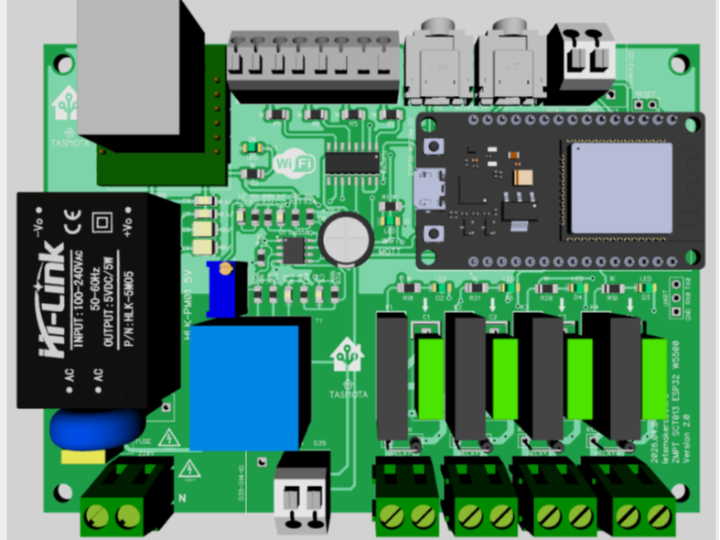
Overview
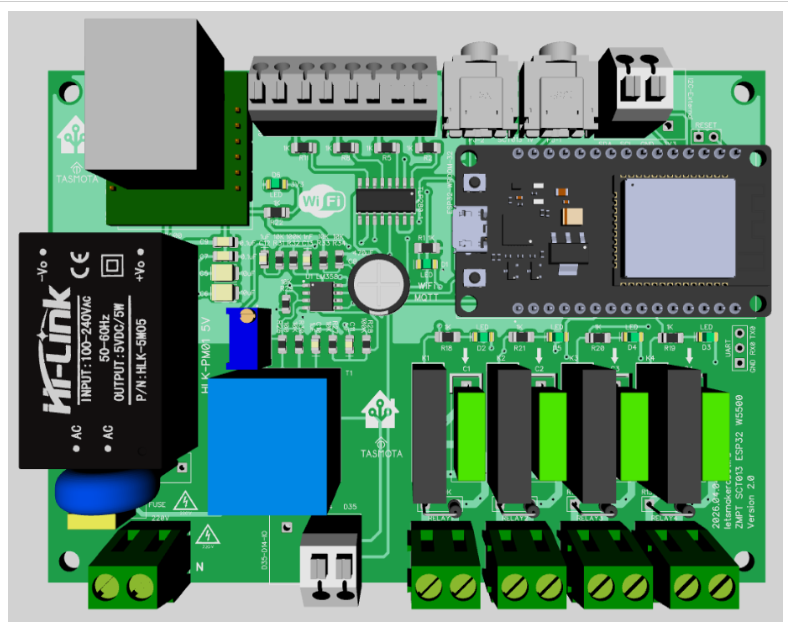
This project introduces an Ethernet-enabled power monitoring and control system based on ESP32, WIZnet W5500, ZMPT101B, and SCT-013 sensors.
The system is designed to measure AC voltage and current while also providing relay outputs, dry contact inputs, and an external I2C sensor interface.
By using W5500 Ethernet, the device can transmit monitoring data through a reliable wired network connection.
This makes the project useful for applications such as:
- Energy monitoring
- Remote equipment monitoring
- Electrical panel supervision
- Automation control
- Industrial IoT systems
Background
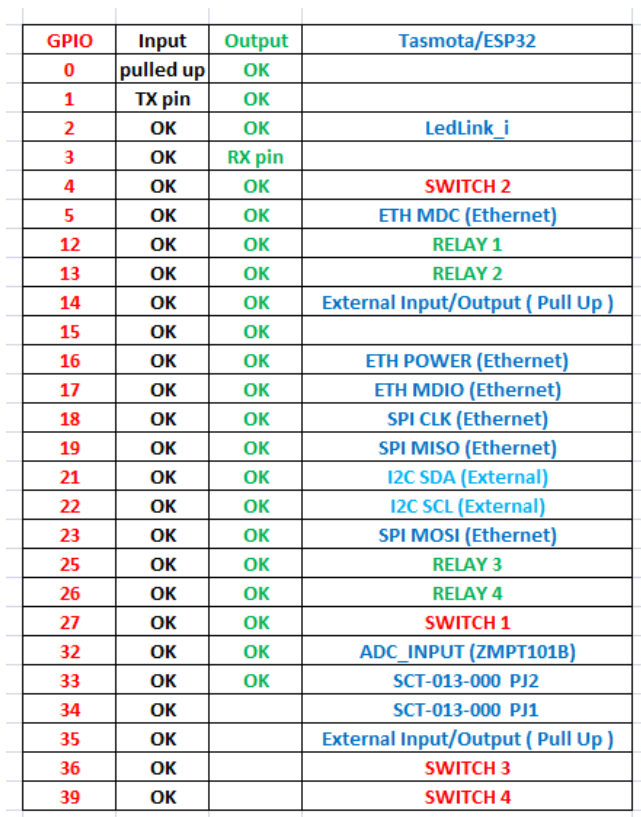
Power monitoring systems often need to measure voltage, current, and device status continuously.
In many installations, Wi-Fi may not be the best communication option because the device may be installed inside an electrical panel, industrial cabinet, utility room, or remote equipment enclosure.
These environments can have poor wireless signal quality or require a more stable communication method.
For this reason, wired Ethernet is a strong choice for power monitoring and automation systems.
By combining ESP32 with WIZnet W5500, this project adds stable Ethernet connectivity to a sensor and relay control system.
Solution
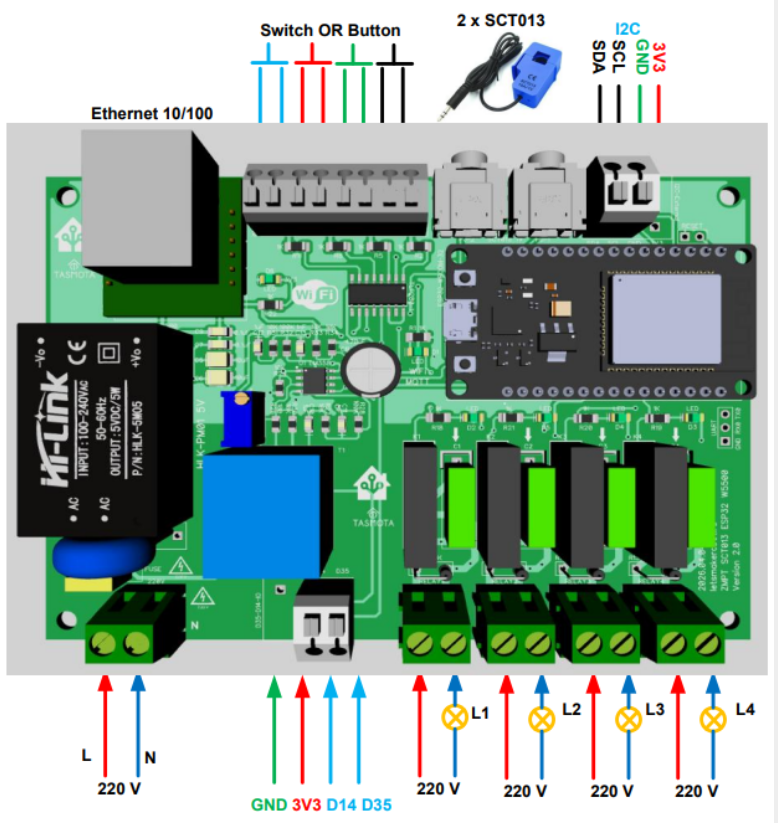
The system uses ESP32 as the main controller and W5500 as the Ethernet interface.
The basic architecture can be described as follows:
AC Voltage Sensor      ZMPT101B
Current Sensors        2 x SCT-013
Dry Contact Inputs     4 channels
Relay Outputs          4 x NO relays
External Sensor Port   I2C, 3.3V
        |
        |
      ESP32
        |
      SPI
        |
   WIZnet W5500
        |
     Ethernet
        |
Monitoring Server / Web Interface / Local Network
ESP32 collects sensor data and input status, controls relay outputs, and communicates with the network through W5500.
W5500 provides the wired Ethernet connection, allowing the device to send measured data to a local server, monitoring system, dashboard, or other network application.
Why W5500?
W5500 is a hardwired TCP/IP Ethernet controller from WIZnet.
It is well suited for this project because it allows ESP32 to use wired Ethernet through a simple SPI interface.
1. Stable Wired Communication
Power monitoring devices are often installed in fixed locations.
For these systems, wired Ethernet can provide more stable communication than Wi-Fi, especially in electrical cabinets, industrial sites, and building automation environments.
2. SPI-Based Ethernet Expansion
ESP32 communicates with W5500 through SPI.
This makes the hardware structure simple and allows Ethernet to be added without requiring an ESP32 variant with built-in Ethernet MAC or PHY.
3. Hardwired TCP/IP Stack
W5500 includes a hardwired TCP/IP stack.
This helps reduce the network processing burden on the ESP32 and makes Ethernet communication easier to implement in embedded applications.
4. Suitable for Monitoring Systems
This project needs to send voltage, current, input status, and relay state information over the network.
W5500 provides a reliable Ethernet foundation for this type of monitoring and control system.
Main Hardware Components
ESP32 Main Controller
The ESP32 acts as the main controller of the system.
It handles:
- Sensor data acquisition
- Relay control
- Dry contact input monitoring
- I2C sensor interface
- Communication with W5500 over SPI
- Application logic
ESP32 is suitable for this type of project because it provides enough GPIO, ADC capability, SPI, I2C, and firmware flexibility.
WIZnet W5500 Ethernet Controller
W5500 provides the Ethernet interface.
It connects to ESP32 through SPI and allows the system to communicate over a wired Ethernet network.
The W5500 block is important because it turns the ESP32-based monitoring board into a network-connected device suitable for remote monitoring and industrial IoT applications.
ZMPT101B AC Voltage Sensor
The project includes one ZMPT101B AC voltage sensor input.
This sensor is used to measure AC voltage. In a power monitoring system, voltage measurement is necessary for checking supply status and calculating electrical parameters.
The measured voltage data can be processed by ESP32 and transmitted through Ethernet.
SCT-013 Current Sensor Inputs
The project includes two inputs for SCT-013 current sensors.
SCT-013 sensors are commonly used as current transformer sensors for AC current measurement.
With two SCT-013 inputs, the system can monitor current from two separate lines, circuits, or loads.
This is useful for:
- Load current monitoring
- Energy usage tracking
- Equipment status detection
- Overload monitoring
- Power analysis
Relay Outputs
The board includes four normally open relay outputs.
These relay outputs can be used to control external devices such as:
- Alarms
- Contactors
- Lamps
- Fans
- Pumps
- Electrical loads
- Control circuits
The original design also mentions spark suppression for the relays, which is important when switching inductive or noisy loads.
Dry Contact Inputs
The system includes four dry contact inputs.
Dry contact inputs can be used to monitor external switch or contact status.
Example use cases include:
- Door contact
- Alarm contact
- Breaker auxiliary contact
- Limit switch
- Equipment run/stop contact
- Fault signal contact
This allows the board to monitor not only electrical values, but also external device states.
External I2C Sensor Connection
The design includes an external I2C sensor connection with 3.3V power.
This allows additional sensors to be connected to the board.
Possible external I2C sensors include:
- Temperature sensors
- Humidity sensors
- Pressure sensors
- Environmental sensors
- Display modules
- Expansion modules
This makes the system more flexible for monitoring and automation applications.
System Operation
The system can operate as a wired Ethernet monitoring node.
A typical operation flow is:
- ESP32 reads AC voltage from the ZMPT101B sensor.
- ESP32 reads AC current from the SCT-013 sensor inputs.
- ESP32 checks the status of the dry contact inputs.
- ESP32 controls relay outputs according to firmware logic or remote commands.
- ESP32 communicates with W5500 through SPI.
- W5500 sends data to the Ethernet network.
- A server, dashboard, or local application receives the monitoring data.
The same Ethernet connection can also be used to send commands back to the device, such as relay control commands or configuration updates.
Application Architecture
A complete system based on this design can be structured as follows:
Electrical Panel / Field Equipment
---------------------------------
AC Line Voltage  → ZMPT101B
Load Current     → SCT-013
Switch Contacts  → Dry Contact Inputs
Controlled Loads → Relay Outputs

Embedded Controller
---------------------------------
ESP32
WIZnet W5500 Ethernet

Network Side
---------------------------------
Ethernet Switch / Router
Monitoring Server
Web Dashboard
SCADA / Local PC
This architecture makes the board suitable for distributed monitoring systems.
Each device can be installed near the electrical equipment and connected to the network through Ethernet.
Benefits
Using W5500 in this ESP32-based power monitoring system provides several benefits.
Hardware Benefits
- Simple SPI connection between ESP32 and W5500
- Reliable wired Ethernet interface
- Suitable for fixed installations
- Compact embedded system architecture
- Easy integration with sensor and relay circuits
Firmware Benefits
- Hardware TCP/IP processing by W5500
- Reduced network stack burden on ESP32
- Easier TCP/UDP or web-based communication
- Suitable for remote monitoring and control applications
System Benefits
- Stable network communication
- Real-time voltage and current monitoring
- Relay-based control capability
- Dry contact status monitoring
- External I2C sensor expansion
- Suitable for industrial and building automation systems
Applications
This project can be used as a reference for many applications, including:
- Power monitoring systems
- Energy monitoring devices
- Electrical panel monitoring
- Remote equipment monitoring
- Building automation
- Industrial IoT gateways
- Relay control systems
- Load monitoring systems
- Smart distribution panels
- Ethernet-based sensor nodes
The same architecture can also be expanded for data logging, alarm notification, web dashboard monitoring, or SCADA integration.
WIZnet Maker Angle
For WIZnet Maker, this project is a good example of how W5500 can add reliable Ethernet connectivity to an ESP32-based monitoring and control system.
The key points are:
- ESP32 is used as the main controller.
- W5500 provides wired Ethernet connectivity.
- ZMPT101B is used for AC voltage measurement.
- SCT-013 sensors are used for current measurement.
- Relay outputs provide control capability.
- Dry contact inputs provide external status monitoring.
- I2C expansion allows additional sensors to be connected.
Recommended wording:
This project demonstrates how WIZnet W5500 can be used with ESP32 to build a wired Ethernet power monitoring and control system using voltage sensors, current sensors, relay outputs, and dry contact inputs.
Conclusion
This project shows a practical example of an ESP32-based power monitoring and control system using WIZnet W5500.
By combining ZMPT101B voltage sensing, SCT-013 current sensing, relay outputs, dry contact inputs, and Ethernet communication, the system can monitor electrical parameters and control external devices over a wired network.
W5500 plays an important role by providing stable Ethernet connectivity through SPI, making the device suitable for fixed installations, industrial monitoring, building automation, and remote power supervision systems.
This is a strong reference design for developers who want to build Ethernet-connected energy monitoring and automation devices with ESP32 and W5500.
Q1: What is this project about?
A1:
This project is an ESP32-based power monitoring and control system using W5500 Ethernet, ZMPT101B voltage sensing, SCT-013 current sensing, relay outputs, and dry contact inputs.
Q2: Which WIZnet product is used?
A2:
The project uses WIZnet W5500 as the Ethernet controller.
Q3: Why is W5500 used in this project?
A3:
W5500 provides stable wired Ethernet connectivity through SPI. This allows the ESP32-based system to send monitoring data over a wired network.
Q4: What sensors are used?
A4:
The project uses ZMPT101B for AC voltage measurement and SCT-013 sensors for AC current measurement.
Q5: What can the relay outputs be used for?
A5:
The relay outputs can be used to control external devices such as alarms, lamps, fans, pumps, contactors, or other control circuits.
Q6: What are dry contact inputs used for?
A6:
Dry contact inputs are used to monitor external switch or contact signals, such as door contacts, alarm contacts, limit switches, or equipment status outputs.
Q7: What applications can use this design?
A7:
This design can be used for power monitoring, energy monitoring, electrical panel supervision, building automation, industrial IoT, remote equipment monitoring, and Ethernet-based control systems.