



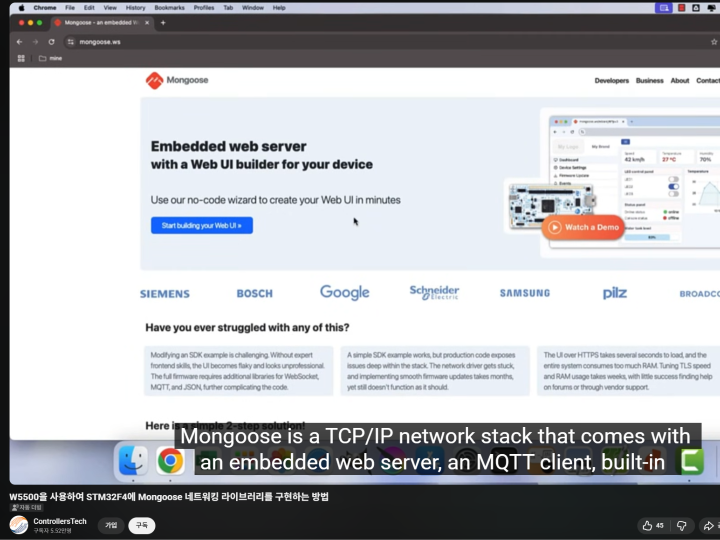
W5500을 사용하여 STM32F4에 Mongoose 네트워킹 라이브러리를 구현하는 방법
W5500을 사용하여 STM32F4에 Mongoose 네트워킹 라이브러리를 구현하는 방법
Overview
ControllersTech is a popular embedded systems learning platform that provides practical tutorials for microcontroller-based development.
The channel and website cover many embedded topics, including STM32, ESP32, AVR, sensors, displays, communication interfaces, RTOS, and real hardware projects. Among these materials, ControllersTech also provides a useful tutorial series focused on the WIZnet W5500 Ethernet module.
For developers who want to add stable wired Ethernet connectivity to microcontroller projects, the ControllersTech W5500 tutorials are a valuable learning resource.
The W5500 series mainly demonstrates how to use the WIZnet W5500 Ethernet controller with STM32 through SPI. The tutorials cover practical networking topics such as DHCP, static IP, ping test, TCP server, TCP client, DNS, HTTP web server, CGI, MQTT, and FreeRTOS integration.
Although the example platform is STM32, the basic concept is also useful for other MCU platforms such as ESP32, Raspberry Pi Pico, Arduino-compatible boards, and custom embedded systems because W5500 uses a simple SPI interface.
About ControllersTech
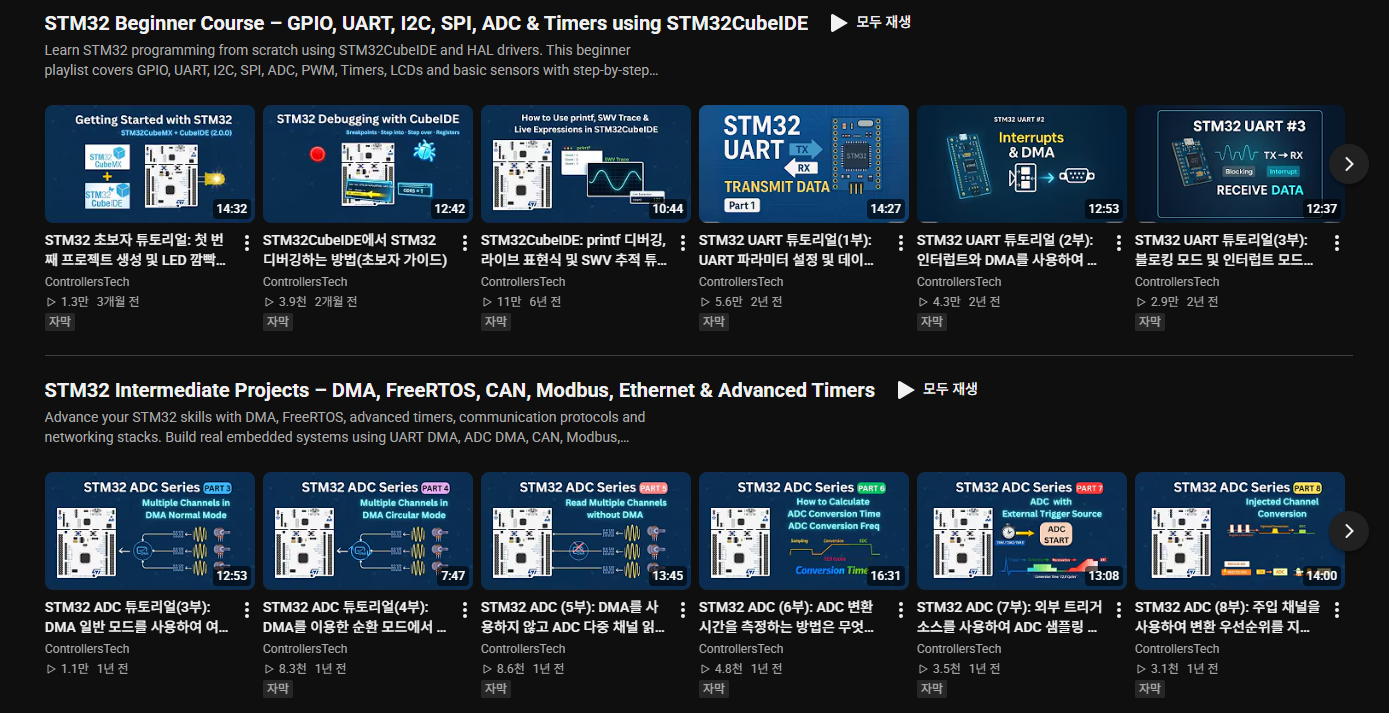
ControllersTech is an embedded systems tutorial platform that provides step-by-step guides for developers, students, makers, and engineers.
The content is focused on practical implementation rather than only theory. Most tutorials explain how to configure the MCU, connect hardware, write firmware, test communication, and verify the result on real devices.
This makes ControllersTech useful for developers who want to quickly understand how a peripheral or module works in a real embedded environment.
The platform provides both video tutorials and written articles, so users can follow the explanation in video format and also refer to source code or setup details from the website.
For WIZnet users, this is especially helpful because Ethernet development often requires both hardware setup and firmware configuration.
WIZnet W5500 Tutorial Series
One of the most useful parts of ControllersTech for WIZnet developers is the STM32 W5500 Ethernet Series.
This series explains how to bring wired Ethernet connectivity to STM32 projects using the WIZnet W5500 module. The series starts from basic hardware setup and network configuration, then gradually expands to application-level examples.
The tutorial series includes topics such as:
- W5500 hardware connection with STM32
- SPI configuration
- WIZnet ioLibrary integration
- DHCP configuration
- Static IP configuration
- Ping test
- TCP server
- TCP client
- DNS-based connection
- HTTP web server
- CGI-based dynamic web page
- MQTT client
- FreeRTOS integration
This structure is useful because it follows a natural learning path.
Developers can first confirm that the W5500 hardware and network configuration are working correctly. After that, they can move on to socket communication, web server implementation, MQTT communication, and RTOS-based applications.
Why This Resource Is Useful for WIZnet Developers
The W5500 is widely used in embedded Ethernet applications because it integrates a hardwired TCP/IP stack, Ethernet MAC, and Ethernet PHY. It communicates with the host MCU through SPI, which makes it easy to use with many microcontrollers.
However, beginners can still face several practical questions when starting Ethernet development.
For example:
- How should the W5500 be connected to the MCU?
- How should SPI be configured?
- Which files from the WIZnet ioLibrary are needed?
- How can DHCP or static IP be configured?
- How can socket communication be tested?
- How can the MCU act as a TCP server or client?
- How can HTTP, MQTT, or DNS be implemented?
ControllersTech addresses many of these questions through real examples.
In the first part of the W5500 series, the tutorial explains hardware setup, STM32CubeIDE configuration, SPI communication, IP configuration, and basic ping testing. It also explains that the WIZnet ioLibrary is used for SPI communication, IP configuration, and socket management.
This is valuable because many embedded Ethernet issues happen during the early setup stage. If SPI, reset, chip select, or network configuration is incorrect, higher-level applications will not work correctly.
By following a basic setup and ping test first, developers can verify the foundation before building more complex applications.
Practical Ethernet Examples
The ControllersTech W5500 series does not stop at basic initialization.
After the initial setup, the series introduces practical Ethernet applications.
For example, one tutorial explains how to create a TCP server using STM32 and W5500. The example receives data, echoes data, and controls an LED over Ethernet.
Another tutorial explains how to use STM32 and W5500 as a TCP client with static IP and DNS-based connection.
The HTTP web server tutorial shows how to serve web pages through the W5500 module and control STM32 GPIO directly from a browser. The written article explains static web pages, URL handling, LED control, socket usage inside the WIZnet HTTP library, and testing from another device on the same network.
These examples are very practical for embedded product development.
Many real-world embedded Ethernet devices need similar functions, such as:
- Receiving commands from a PC or server
- Sending sensor data to a host
- Providing a local web configuration page
- Controlling GPIO through a network
- Publishing data to an MQTT broker
- Operating reliably with RTOS tasks
Because the tutorials are based on real firmware examples, developers can use them as a reference when building their own WIZnet-based products.
W5500 and Embedded Ethernet Education
The W5500 is a good chip for learning embedded Ethernet because it simplifies many network implementation details.
Instead of requiring the MCU to run a full software TCP/IP stack, the W5500 handles TCP/IP processing internally. This allows the MCU firmware to communicate through socket-level APIs and reduces the load on the host processor.
This is especially useful for resource-constrained microcontrollers.
ControllersTech also emphasizes this benefit in its W5500-related content. The W5500 module is introduced as a compact Ethernet solution for embedded systems, using the WIZnet W5500 chip with a hardware TCP/IP protocol stack and 10/100 Mbps Ethernet connectivity.
For education, this is important.
Students and developers can focus on practical Ethernet communication concepts such as IP address configuration, sockets, TCP server/client behavior, HTTP request handling, and MQTT communication without being overwhelmed by the full internal complexity of TCP/IP stack implementation.
Applicable Beyond STM32
Although the ControllersTech W5500 tutorial series is based on STM32, the knowledge is not limited to STM32.
The W5500 communicates with the host MCU using SPI. Therefore, the same basic architecture can be applied to many other platforms.
For example:
- ESP32 + W5500
- Raspberry Pi Pico + W5500
- Arduino + W5500
- RP2040 + W5500
- STM32 + W5500
- Custom MCU board + W5500
The MCU-specific initialization code may be different, but the core concepts remain similar.
These include:
- SPI communication with W5500
- Chip select control
- Reset control
- Network information configuration
- Socket creation
- TCP server/client operation
- UDP communication
- HTTP or MQTT application layer implementation
This means that developers using ESP32 or other MCUs can still learn many important W5500 concepts from the ControllersTech STM32 examples.
Why It Matters for WIZnet Community
The WIZnet ecosystem becomes stronger when developers can easily find practical examples and learning materials.
ControllersTech contributes to this ecosystem by providing accessible W5500 tutorials that help developers move from basic hardware setup to real network applications.
For new users, these tutorials can reduce the learning curve.
For experienced developers, they can serve as a quick reference for implementing TCP server, TCP client, HTTP server, MQTT client, and RTOS-based Ethernet examples.
For product developers, they can provide a starting point for building wired Ethernet features into embedded devices.
This makes ControllersTech a useful external learning resource for the WIZnet community.
Recommended Learning Path
For developers who are new to W5500, the following learning path is recommended:
- Start with the W5500 hardware setup tutorial.
- Configure SPI, CS, RESET, and network parameters.
- Test basic communication using DHCP, static IP, and ping.
- Build a TCP server example.
- Build a TCP client example.
- Try DNS-based connection.
- Build a simple HTTP web server.
- Add CGI for dynamic web control.
- Try MQTT communication.
- Integrate the Ethernet application with FreeRTOS.
This step-by-step approach helps developers understand both the low-level hardware interface and the high-level network application structure.
Conclusion
ControllersTech is a valuable learning resource for developers interested in embedded Ethernet development with WIZnet chips.
Its STM32 W5500 Ethernet tutorial series provides practical examples covering hardware setup, SPI communication, DHCP, static IP, ping test, TCP server, TCP client, DNS, HTTP web server, CGI, MQTT, and FreeRTOS integration.
Even though the tutorials are mainly based on STM32, the concepts are useful for many other MCU platforms because the W5500 uses a simple SPI interface and provides a hardwired TCP/IP stack.
For developers who want to build reliable wired Ethernet products using WIZnet W5500, ControllersTech provides a clear and practical starting point.
It is a recommended resource for students, makers, embedded developers, and engineers who want to understand how to use WIZnet Ethernet chips in real projects.