



Reliable ESPHome Bluetooth Proxy Using W5500 Ethernet Connectivity
Reliable ESPHome Bluetooth Proxy Using W5500 Ethernet Connectivity
Overview
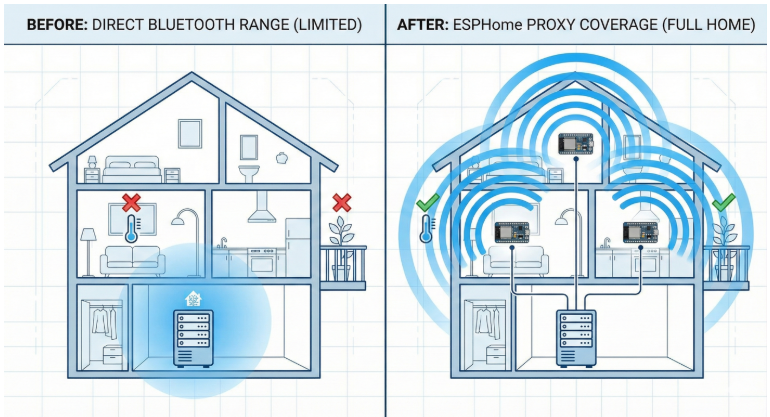
As smart home environments grow more complex, reliable communication between devices becomes increasingly important. In particular, Bluetooth-based sensors often suffer from limited range and unstable connections when deployed across larger spaces.
To address these challenges, ESPHome introduces the concept of a Bluetooth Proxy, which extends Bluetooth coverage by distributing ESP32-based nodes throughout the environment.
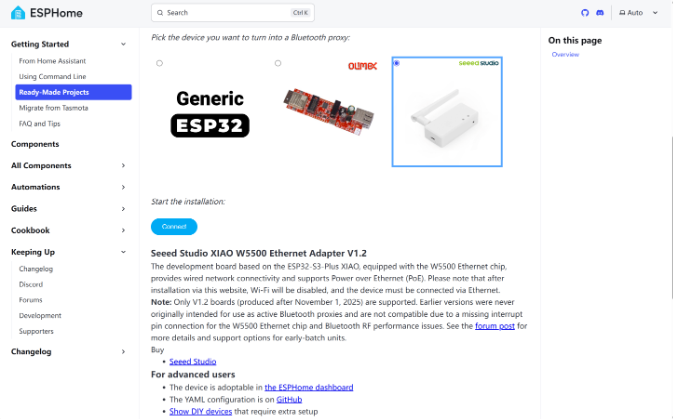
Among various implementation methods, using Ethernet connectivity with WIZnet’s W5500—such as the Seeed Studio W5500 Ethernet Adapter V1.2—has emerged as a highly reliable solution for building stable and scalable Bluetooth proxy networks.
Background
Bluetooth Low Energy (BLE) devices are widely used in smart homes for applications such as:
- Temperature and humidity sensing
- Presence detection
- Smart locks and lighting control
However, BLE has inherent limitations:
- Short communication range
- Signal attenuation through walls and floors
- Unstable connections in large environments
As a result, many users experience issues such as intermittent connectivity or missing sensor data.
To overcome these limitations, ESPHome introduced the Bluetooth Proxy, which allows ESP32-based devices to act as distributed Bluetooth receivers and forward data to a central Home Assistant system.
Solution
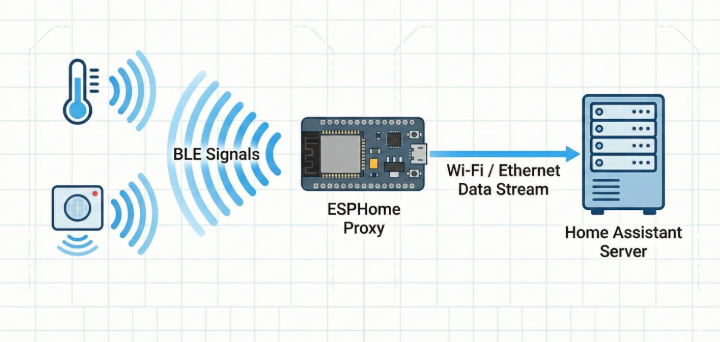
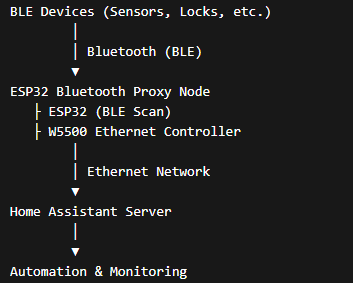
A Bluetooth proxy works by placing small ESP32-based nodes near Bluetooth devices and forwarding the collected data to a central server over the network.
While these nodes can use Wi-Fi, Ethernet-based implementations provide a more reliable alternative.
Using solutions such as the Seeed Studio XIAO ESP32-S3 combined with the W5500 Ethernet Adapter, the system can:
- Scan nearby BLE signals
- Collect sensor data
- Forward data to Home Assistant via Ethernet
The W5500 enables stable wired communication, ensuring consistent data delivery regardless of wireless conditions.
Why Ethernet Over Wi-Fi?
In Bluetooth proxy systems, both Wi-Fi and Ethernet can be used as the backhaul network. However, Ethernet provides several key advantages:
1️⃣ Eliminates Wireless Interference
Wi-Fi and Bluetooth both operate in the 2.4GHz band, which can cause interference. Ethernet removes this contention entirely.
2️⃣ Improves Stability
Wired connections provide consistent performance without packet loss or signal fluctuations.
3️⃣ Frees ESP32 Resources
By using Ethernet, the ESP32 can dedicate its radio fully to Bluetooth scanning instead of sharing it with Wi-Fi.
Role of W5500
The W5500 Ethernet controller plays a key role in enabling this architecture.
Key advantages include:
- Hardware TCP/IP stack offload
- Stable wired Ethernet connectivity
- Simple SPI interface with ESP32
- Reduced MCU workload
This allows ESP32-based devices to efficiently handle BLE scanning while relying on the W5500 for network communication.
System Architecture
Benefits
By combining ESPHome Bluetooth Proxy with W5500 Ethernet connectivity, the system achieves:
- Extended Bluetooth coverage across large environments
- Stable and interference-free communication
- Improved sensor reliability and responsiveness
- Scalable deployment using multiple proxy nodes
- Simplified installation with PoE support (optional)
This makes it possible to eliminate Bluetooth dead zones and ensure consistent smart home performance.
Conclusion
ESPHome Bluetooth Proxy provides a powerful way to extend Bluetooth connectivity in smart environments. However, the choice of network infrastructure plays a critical role in system performance.
By adopting Ethernet-based connectivity using WIZnet’s W5500, developers and users can build more reliable and scalable Bluetooth proxy systems compared to traditional Wi-Fi-based setups.
This approach highlights how embedded Ethernet solutions can significantly enhance the performance of modern IoT and smart home applications.
Q1: Why should I use Ethernet for a Bluetooth Proxy?
A1:
Ethernet provides a more stable and reliable connection compared to Wi-Fi.
Key benefits:
- No 2.4GHz interference with Bluetooth
- Lower latency and packet loss
- Consistent network performance
- Ideal for always-on IoT systems
This makes Ethernet the preferred choice for reliable Bluetooth Proxy deployments.
Q2: What role does Ethernet play in a Bluetooth Proxy system?
A2:
Ethernet acts as the backhaul network, transmitting data from the Bluetooth Proxy (ESP32) to the central system (e.g., Home Assistant).
Flow:
- BLE devices → ESP32 (Proxy) → Ethernet → Server
It ensures stable and continuous data delivery.
Q3: Why is W5500 a good solution for Ethernet connectivity?
A3:
The W5500 is a hardware TCP/IP Ethernet controller designed for embedded systems.
Advantages:
- Hardware TCP/IP offload
- Stable wired Ethernet communication
- Simple SPI interface with MCU (ESP32)
- Reduced CPU load
This makes it ideal for Ethernet-based IoT applications.
Q4: How does Ethernet improve Bluetooth performance?
A4:
Using Ethernet frees the ESP32 from handling Wi-Fi tasks.
As a result:
- The radio is dedicated to Bluetooth only
- Less interference between Wi-Fi and BLE
- More stable connections with multiple devices
This significantly improves overall Bluetooth performance.
Q5: How many devices can an Ethernet-based proxy handle?
A5:
With Ethernet, the system can support more devices compared to Wi-Fi.
- Passive devices: Dozens
- Active devices: Typically 5–10+
Ethernet increases both stability and scalability.