



Particle Ethernet FeatherWing PoE
Particle Ethernet FeatherWing PoE
Overview
Ethernet is still one of the most reliable communication methods for embedded IoT devices, especially in industrial environments, factories, smart buildings, and network installations.
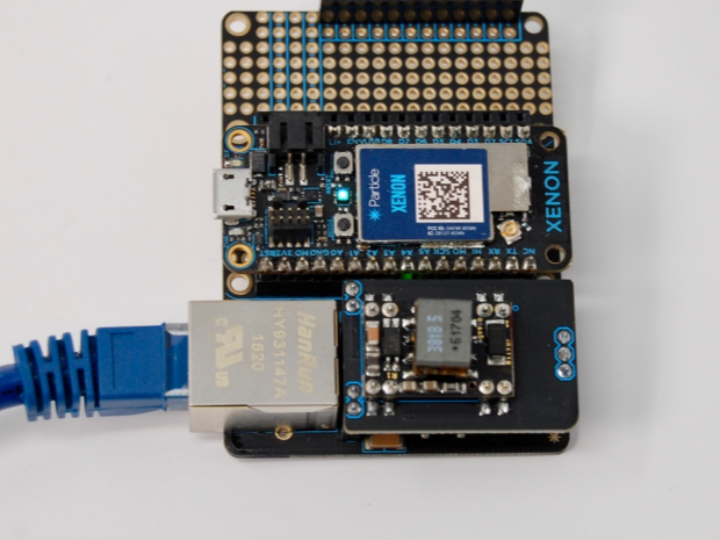
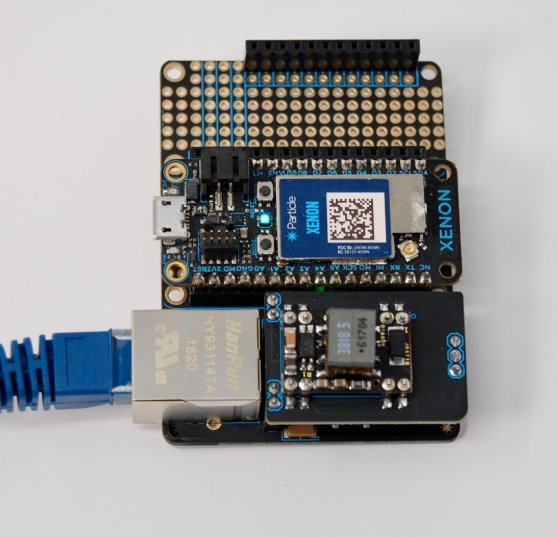
The Particle Ethernet FeatherWing provides a simple way to add wired Ethernet connectivity to Particle Gen 3 devices such as Argon and Boron. It allows a Particle device to connect to the Internet through Ethernet instead of relying only on Wi-Fi or cellular communication.
The key component of this board is the WIZnet W5500 Ethernet controller.
By using W5500, the Ethernet FeatherWing can provide stable 10/100 Ethernet connectivity through a simple SPI interface while keeping the host device design compact and practical. Particle also describes the board as a fast way to add wired connectivity to Argon or Boron devices and turn them into Ethernet gateways.
This makes the Ethernet FeatherWing useful when a device needs:
- More stable network connectivity than Wi-Fi
- Wired communication in industrial or factory environments
- Ethernet gateway functionality
- Simple integration with Particle Gen 3 hardware
- Optional Power over Ethernet support
Background
Many IoT devices use Wi-Fi or cellular networks because they are easy to deploy. However, wireless communication is not always the best option.
In industrial sites, factories, server rooms, and building automation systems, wired Ethernet is often preferred because it provides stable communication, predictable latency, and better reliability in environments where wireless signals may be weak or noisy.
Particle devices such as Argon and Boron already support wireless connectivity, but some applications require a wired network connection. The Ethernet FeatherWing solves this problem by adding Ethernet to Particle Gen 3 devices through a FeatherWing-style expansion board.
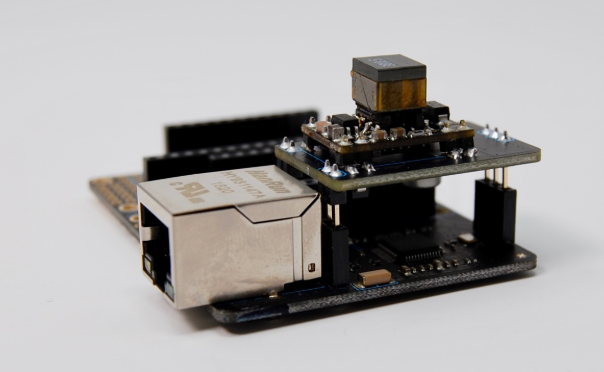
The board uses a form factor based on the Adafruit FeatherWing Tripler, allowing a Particle Gen 3 device and an additional FeatherWing accessory to be connected together.
Example accessories may include:
- Display modules
- Sensors
- Relay boards
- Other FeatherWing-compatible expansion boards
Solution
The Particle Ethernet FeatherWing adds wired Ethernet connectivity to Particle Gen 3 devices using the WIZnet W5500 chip.
The host Particle device communicates with the W5500 through SPI. The W5500 handles Ethernet communication and TCP/IP processing, while the Particle device focuses on the main application logic.
This architecture makes the design simple and efficient:
- Particle device handles application firmware
- W5500 handles Ethernet communication
- RJ45 connector provides wired network access
- Optional PoE module can provide power through the Ethernet cable
This is especially useful for IoT devices installed in locations where Wi-Fi is unavailable, unstable, or not preferred.
Why W5500?
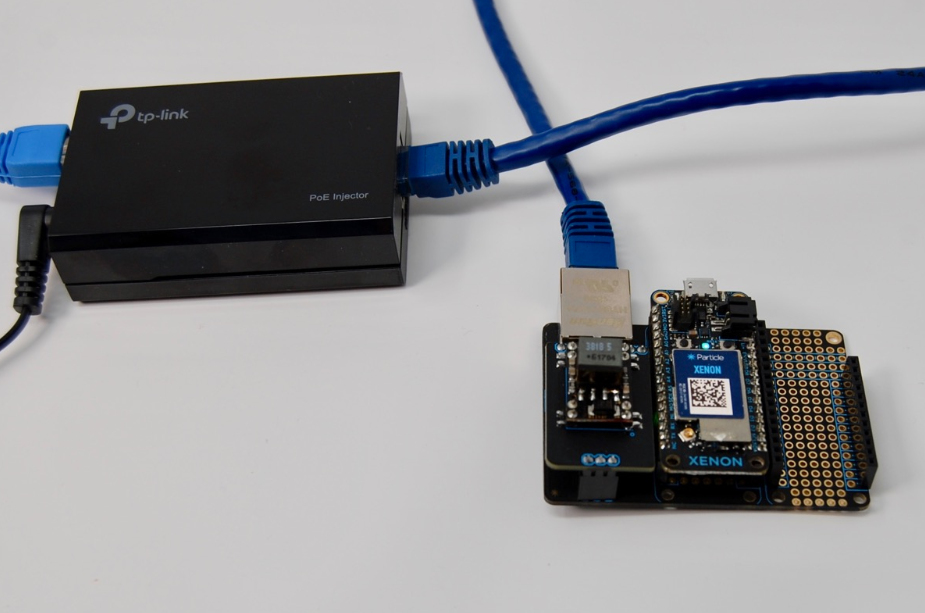
The W5500 is the central component of the Particle Ethernet FeatherWing.
W5500 is a hardwired TCP/IP Ethernet controller from WIZnet. It integrates the TCP/IP stack, Ethernet MAC, and Ethernet PHY into a single chip. This allows embedded systems to add Ethernet connectivity without implementing a full TCP/IP stack in software.
1. Simple SPI Interface
The W5500 communicates with the host MCU through SPI.
This makes it easy to connect Ethernet to embedded platforms that do not include a built-in Ethernet peripheral. For Particle Gen 3 devices, the W5500 provides a straightforward hardware path to wired Ethernet.
2. Hardware TCP/IP Stack
One of the key advantages of W5500 is its hardwired TCP/IP stack.
Instead of requiring the host MCU to process the full TCP/IP stack in firmware, W5500 handles major network protocol operations internally.
This helps reduce:
- Firmware complexity
- MCU workload
- RAM usage
- Network implementation effort
3. Integrated Ethernet MAC and PHY
W5500 integrates both Ethernet MAC and PHY.
This simplifies hardware design because the board does not need a separate Ethernet MAC or external PHY device. For compact FeatherWing-style hardware, this integration is especially useful.
4. Reliable Wired Connectivity
For IoT gateways and industrial devices, stable network communication is important.
By using W5500, the Ethernet FeatherWing provides reliable wired Ethernet connectivity for Particle devices in environments where Wi-Fi may not be suitable.
System Architecture
The system can be divided into three main parts:
- Particle Gen 3 device
- WIZnet W5500 Ethernet controller
- Ethernet connector and optional PoE module
The Particle device acts as the main controller. It runs the application firmware and communicates with the W5500 over SPI.
The W5500 provides Ethernet connectivity. It manages wired network communication and handles TCP/IP operations using its hardwired TCP/IP engine.
The Ethernet connector provides the physical wired network interface. When used with a compatible PoE module, the same Ethernet cable can also provide power to the system.
Typical operation flow:
- Particle device initializes the Ethernet interface
- W5500 establishes Ethernet link
- Device obtains network configuration
- Application communicates through wired Ethernet
- Optional PoE module supplies power through the Ethernet cable
This structure clearly separates the roles of the host device and the Ethernet controller.
The Particle device handles application behavior, while the W5500 handles Ethernet communication.
Hardware Components
The Ethernet FeatherWing system is based on the following components:
- Particle Gen 3 device such as Argon or Boron
- Particle Ethernet FeatherWing
- WIZnet W5500 Ethernet controller
- RJ45 Ethernet connector
- Optional Particle PoE module
- Optional additional FeatherWing accessory
The Ethernet FeatherWing is designed to add wired Ethernet connectivity while maintaining the FeatherWing expansion concept.
Particle notes that the Ethernet FeatherWing has been deprecated and is no longer available for sale, and that the Adafruit Ethernet FeatherWing can be used as an alternative.
PoE Support
The Ethernet FeatherWing can also be used with a PoE module.
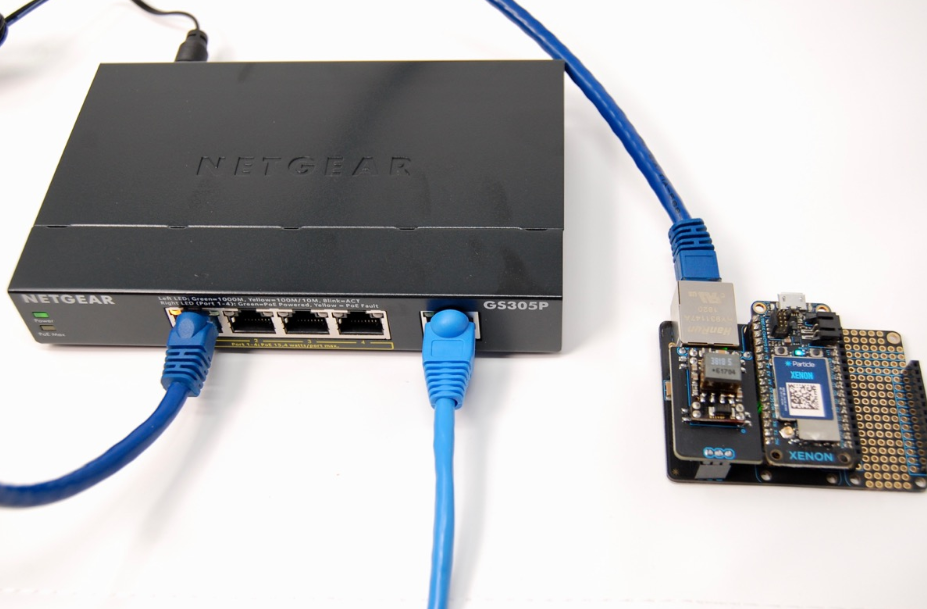
PoE, or Power over Ethernet, allows both data and power to be delivered through the same Ethernet cable. Particle’s PoE module plugs into the Ethernet FeatherWing and can power a Particle Gen 3 device such as Argon or Boron.
The PoE module uses the Silvertel Ag9905M and can supply up to 1800 mA to the Particle device and Feather accessories. It is a Class 0 IEEE 802.3af device.
This is useful when the device is installed far from a USB power adapter or wall power source.
Important notes:
- Use an IEEE 802.3af-compliant PoE switch or injector
- Do not power the board from both PoE and USB at the same time
- Cat 6 cable is recommended for PoE
- The maximum recommended cable length is 100 meters
- A connected LiPo battery on Argon or Boron can be charged through PoE
Main Features
The Particle Ethernet FeatherWing provides the following features:
- Wired Ethernet connectivity for Particle Gen 3 devices
- WIZnet W5500 Ethernet controller
- SPI-based host interface
- 10/100 Ethernet communication
- Gateway use case for Particle devices
- FeatherWing-style expansion
- Additional FeatherWing accessory support
- Optional Power over Ethernet support
- Suitable for industrial and factory environments
- Useful when Wi-Fi is unavailable or unreliable
These features make the Ethernet FeatherWing a practical reference design for embedded IoT devices that require stable wired network connectivity.
How It Works
The Ethernet FeatherWing works by connecting the Particle device to the W5500 Ethernet controller through SPI.
When the system starts, the Particle device initializes the Ethernet interface. The W5500 manages the Ethernet link and network communication. Once the Ethernet cable is connected to a valid network, the device can communicate with the Internet or local network through the wired Ethernet connection.
If the PoE module is installed, power can also be supplied through the Ethernet cable. This reduces the need for a separate USB power adapter and makes installation cleaner, especially in fixed or industrial deployments.
The basic operation is:
- Connect Particle device to Ethernet FeatherWing
- Connect Ethernet cable
- Initialize Ethernet in firmware or setup process
- W5500 handles wired Ethernet communication
- Device communicates through Ethernet instead of Wi-Fi or cellular
- Optional PoE module supplies power
This makes it possible to build Particle-based wired IoT devices with a simple and compact hardware structure.
Benefits
By combining Particle Gen 3 hardware with the WIZnet W5500 Ethernet controller, this design provides several benefits:
- Stable wired network communication
- Reduced dependence on Wi-Fi
- Simple SPI-based Ethernet integration
- Lower firmware complexity through W5500 hardwired TCP/IP
- Compact FeatherWing-style hardware
- Optional centralized power using PoE
- Suitable for industrial and fixed installations
- Easy expansion with additional FeatherWing accessories
The result is a practical Ethernet solution for Particle-based IoT systems.
Applications
The Particle Ethernet FeatherWing can be used in various applications, including:
- Industrial IoT devices
- Factory monitoring systems
- Smart building controllers
- Wired sensor gateways
- Remote monitoring equipment
- Ethernet-connected data loggers
- Networked relay controllers
- IoT gateway prototypes
- Devices installed in Wi-Fi-limited environments
- PoE-powered embedded systems
The same W5500-based architecture can also be reused in other embedded products that require reliable Ethernet connectivity.
Conclusion
The Particle Ethernet FeatherWing is a useful example of how WIZnet W5500 can add wired Ethernet connectivity to compact embedded IoT hardware.
By using W5500, Particle Gen 3 devices such as Argon and Boron can communicate over Ethernet through a simple SPI interface. The W5500 handles Ethernet and TCP/IP processing, allowing the host device to focus on the main application.
The optional PoE module further improves installation flexibility by allowing both power and data to be delivered through a single Ethernet cable.
Although Particle states that the original Ethernet FeatherWing has been deprecated, the design remains a strong reference for developers who want to build reliable wired IoT devices, Ethernet gateways, industrial controllers, or PoE-powered embedded systems using WIZnet Ethernet technology.
Q1: What is the Particle Ethernet FeatherWing?
A1:
The Particle Ethernet FeatherWing is an expansion board that adds wired Ethernet connectivity to Particle Gen 3 devices such as Argon and Boron.
It uses the WIZnet W5500 Ethernet controller to provide Ethernet communication through SPI.
Q2: Why does the Ethernet FeatherWing use W5500?
A2:
W5500 provides a simple and reliable way to add Ethernet to embedded systems.
Key benefits include:
- SPI interface
- Hardwired TCP/IP stack
- Integrated Ethernet MAC and PHY
- Reduced MCU workload
- Stable wired Ethernet connectivity
Q3: What is PoE used for in this design?
A3:
PoE allows the device to receive both power and network connectivity through a single Ethernet cable.
This is useful for fixed installations, industrial systems, and remote devices where using a separate USB power adapter is inconvenient.
Q4: Can the Ethernet FeatherWing be used where Wi-Fi is unavailable?
A4:
Yes.
The Ethernet FeatherWing is useful in environments where Wi-Fi is unavailable, unreliable, or not preferred. Particle specifically describes industrial situations and factories as example environments where wired Ethernet can be useful.
Q5: Is the Particle Ethernet FeatherWing still available?
A5:
According to Particle’s documentation, the Ethernet FeatherWing has been deprecated and is no longer available for sale. Particle notes that the Adafruit Ethernet FeatherWing can be used as an alternative.