


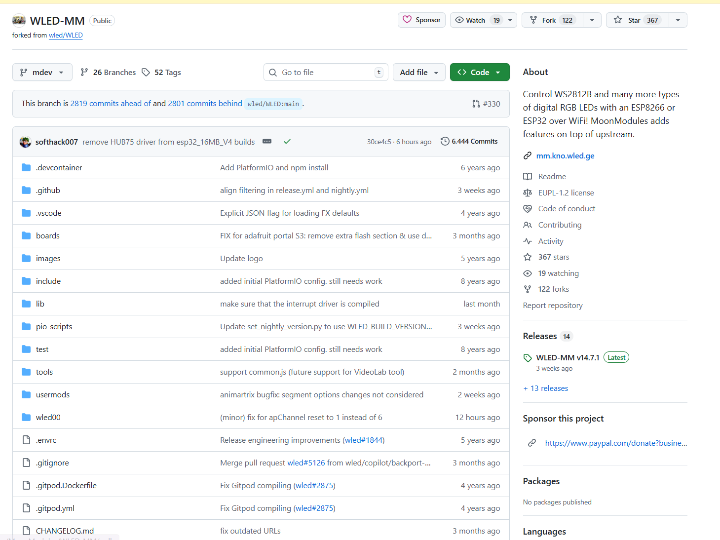
WLED-MM
A project for controlling various digital RGB LEDs such as the WS2812B.
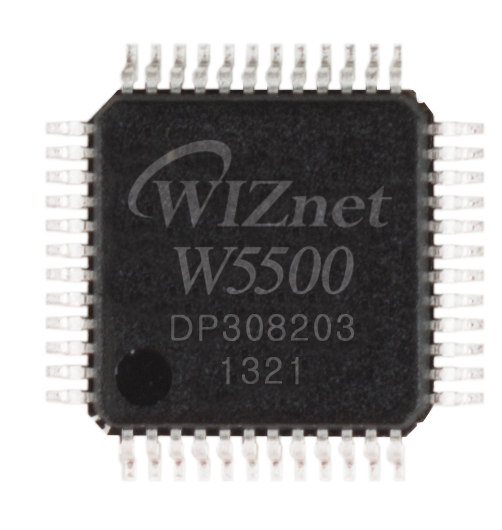
WIZnet - W5500
x 1

📌 Overview
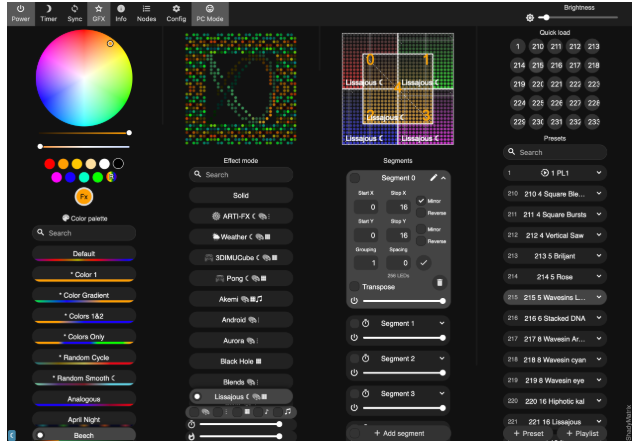
WLED-MM은 ESP32 기반 주소지정 RGB LED 제어 오픈소스인 WLED를 확장한 프로젝트로, 보다 다양한 하드웨어 환경과 실사용 시나리오를 지원하는 데 초점을 맞추고 있습니다. 기본적인 LED 제어와 웹 기반 UI는 유지하면서, 보드 선택의 자유도와 설정 유연성을 높여 Maker와 개발자가 다양한 환경에 적용할 수 있도록 발전해 왔습니다. 특히 Wi-Fi 중심 구조의 한계를 보완하기 위한 네트워크 확장이 주요 방향 중 하나입니다.
이번 UCC의 핵심인 PR #320은 WIZnet W5500(SPI Ethernet 컨트롤러)을 활용해 여러 ESP32 보드에서 유선 LAN 기반 LED 제어를 가능하게 하는 내용을 담고 있습니다. 보드 종속적인 구현을 피하고자 핀 관리, 설정 UI, 초기화 구조까지 함께 정비했으며, Wi-Fi 사용이 어렵거나 안정성이 요구되는 환경에서도 WLED-MM을 활용할 수 있도록 실질적인 확장 방안을 제시하고 있습니다.
📌 Features
W5500(SPI) 이더넷 지원 확대
- ESP32, ESP32-S2, ESP32-S3, ESP32-C3, ESP32-Pico 전 계열에서 W5500 사용 가능
- RMII 이더넷이 없는 보드에도 유선 확장 가능
SPI 핀 동적 할당 및 충돌 방지
- MOSI/MISO/SCLK/CS/INT/RST 핀을 사용자 지정 가능
- Pin Manager를 통한 사전 검증 및 충돌 감지
안정성 강화 및 실시간 성능
- Art-Net, DDP 프로토콜에서 WiFi 대비 지연 감소 (45+ FPS @ 64x64 매트릭스)
- 네트워크 연결/해제 이벤트 로깅 (링크 속도, Duplex, MAC 주소)
- 실패 시 자동 핀 해제 및 에러 처리 루틴
📌 System Architecture
구성 요소
- MCU/SoC: ESP32 계열(일반 ESP32, ESP32-S3, ESP32-C3 등)
- Ethernet: WIZnet W5500
- LED 출력: WS2812B 등 디지털 LED 스트립/매트릭스
- 제어 클라이언트: 스마트폰/PC 브라우저(웹 UI), 그리고 경우에 따라 UDP 기반 제어(Art-Net 등)
📌 Role and Application of the WIZnet's Chip
사용 칩: WIZnet W5500
네트워크에서의 역할
- TCP/IP 하드웨어 스택 오프로드: ESP32는 SPI 통신만 담당, TCP/UDP/ICMP 처리는 W5500이 독립 수행
- 프로토콜 지원:
- UDP (Art-Net, DDP, E1.31/sACN 실시간 픽셀 스트리밍)
- TCP (HTTP Web UI, WebSocket, API)
- MQTT (IoT 통합)
- 8개 독립 소켓 활용으로 동시 연결 처리
PR #320 W5500 적용
https://github.com/MoonModules/WLED-MM/pull/320 (troyhacks)
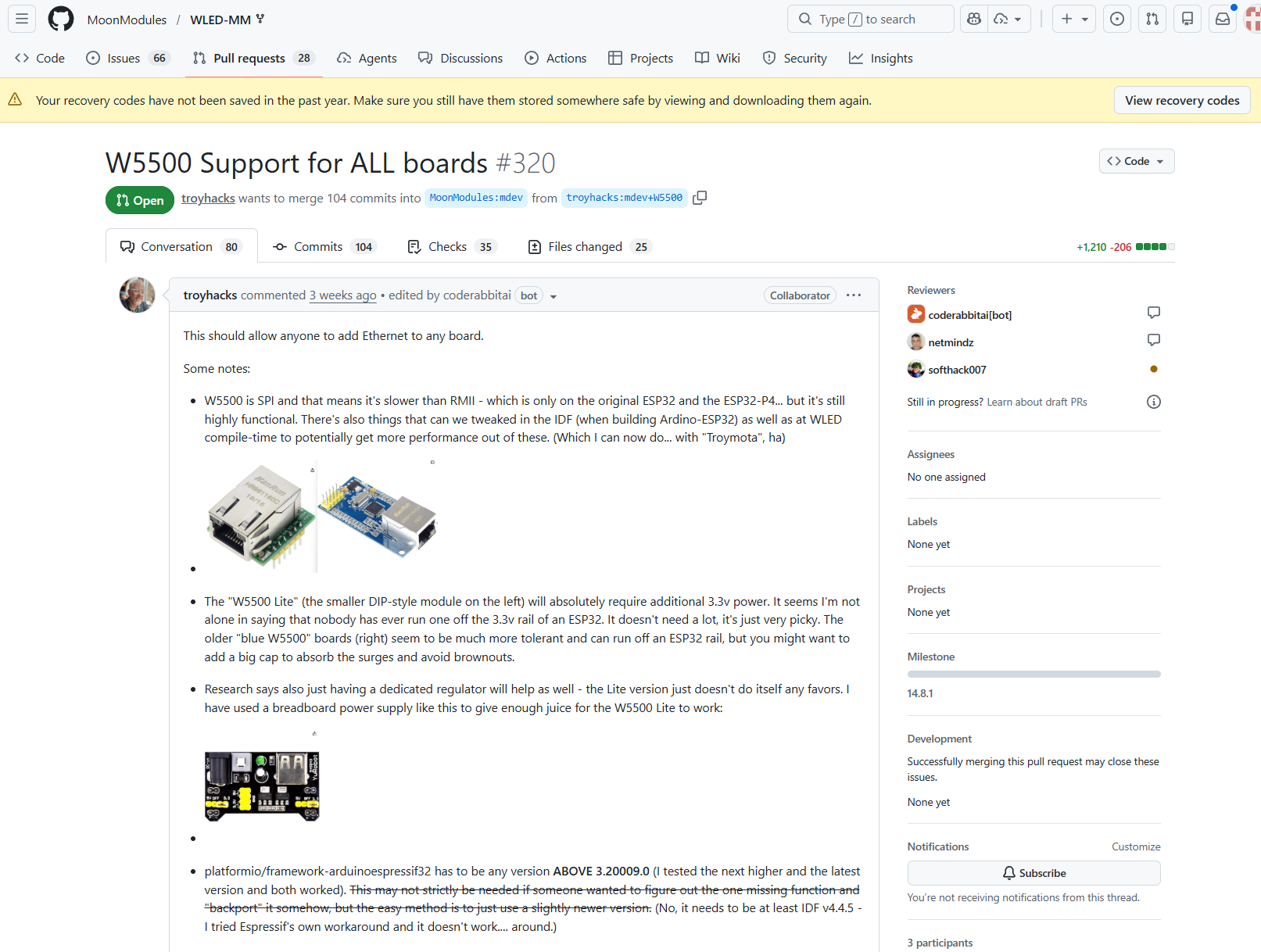
해당 PR은 W5500을 RMII 기반 이더넷의 대안으로 통합하면서, 보드 자동 감지, 동적 핀 할당, 설정 UI 확장, 전원 안정성 고려 등 실사용 환경에서 발생하는 문제를 함께 해결합니다. 특히 ESP32, ESP32-C3, ESP32-S3 등 다양한 보드에서 W5500이 정상적으로 초기화되고 100Mbps Full-Duplex 링크로 동작함이 로그와 테스트를 통해 검증되었으며, Wi-Fi 비활성화 후 Ethernet 중심으로 안정적인 네트워크 운용이 가능함을 확인합니다. 이를 통해 W5500은 WLED-MM 환경에서 특정 보드에 종속되지 않는 범용 유선 네트워크 솔루션으로 활용될 수 있음을 명확히 보여줍니다.
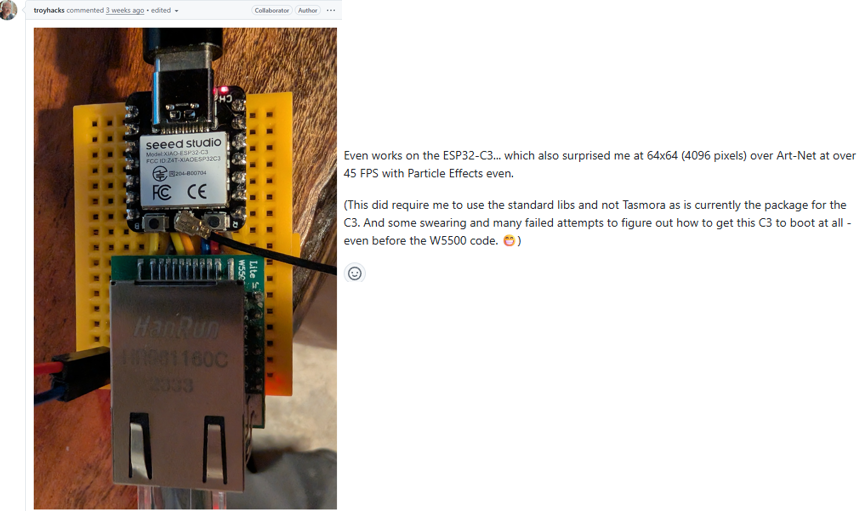
ESP32-C3 보드에 WIZnet W5500(SPI Ethernet)을 연결해 실제로 WLED-MM이 동작하는 테스트 내용입니다.
특히 Art-Net 환경에서 64×64(4096픽셀) LED 매트릭스에 파티클 효과를 적용하고도 45FPS 이상의 성능을 유지한 점은, SPI 기반 Ethernet임에도 LED 제어 용도로 충분한 처리 성능을 제공함을 의미합니다. 이 과정에서 표준 라이브러리 사용, 부팅 및 전원 안정성 확보 등 시행착오가 있었으나, 결과적으로 W5500이 다양한 ESP32 계열에서 실사용 가능한 범용 Ethernet 솔루션임을 입증하는 사례로 볼 수 있습니다.
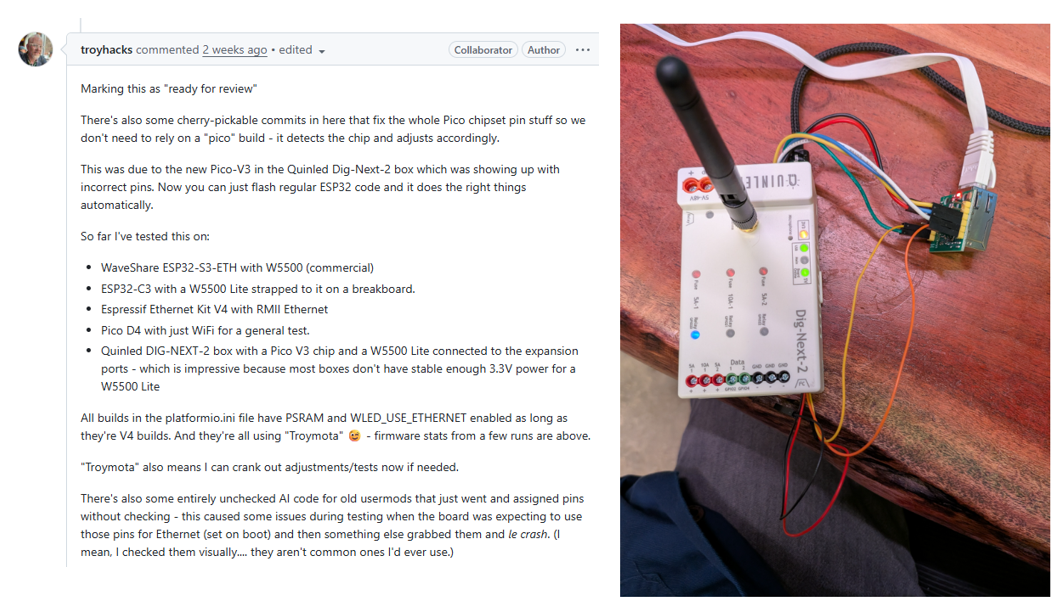
다양한 ESP32 계열 보드와 실제 상용 제품 환경에서 WIZnet W5500을 안정적으로 적용하기 위해 검증·조정되는 과정을 보여줍니다. W5500은 ESP32-S3 Ethernet 보드, ESP32-C3 + W5500 Lite 조합, RMII 기반 키트, 그리고 Quinled DIG-NEXT-2와 같은 상용 컨트롤러 환경에서도 테스트되었으며, 보드 자동 감지와 핀 처리 개선을 통해 별도 빌드 없이 정상 동작함이 확인되었습니다. 특히 전원 조건이 까다로운 W5500 Lite 모듈이 실제 제품 박스 환경에서도 동작했다는 점은, W5500이 실험적 선택이 아닌 현실적인 Ethernet 확장 수단임을 보여줍니다.
📌 Market & Application Value
(by ChatGPT)
적용 가능 산업
- 무대/공연 조명
- Art-Net/sACN 표준 프로토콜 사용, 조명 콘솔과 직접 연동
- 수백 개 픽셀 동기화 필요 → WiFi 지연 허용 불가
- 건축 조명 (Architectural Lighting)
- 상업 빌딩, 호텔, 쇼핑몰의 영구 설치
- 유선 네트워크 인프라 활용 가능
- 전시/이벤트
- 임시 설치 환경에서 WiFi 혼잡 회피
- PoE 스위치로 전원+통신 일체화
- 스마트 홈/IoT
- 대면적 LED 월(Wall) 제어
- Home Assistant, Node-RED 통합
📌 External Indicators
GitHub(프로젝트 규모/활동성)
- MoonModules/WLED-MM: Stars 368, Forks 123, Watchers 19, 커밋 히스토리 6,472
- 최신 릴리스 표시: WLED-MM v14.7.1 (Jan 13, 2026)
PR(이번 UCC 핵심 기여)
- PR #320 “W5500 Support for ALL boards”: Open 상태, 104 commits를 머지 제안(작성일 표기: Jan 15, 2026)
- 변경 요약에 W5500(SPI) 지원, UI/설정/핀 관리/ETHClass2 도입 등이 명확히 문서화되어 있음
MoonModules Documents
WIZnet Maker UCC와의 간접적 연관 사례
https://maker.wiznet.io/Grace_Koo/projects/looking%2Dfor%2Dcontributing%2Dbeta%2Dtesters/
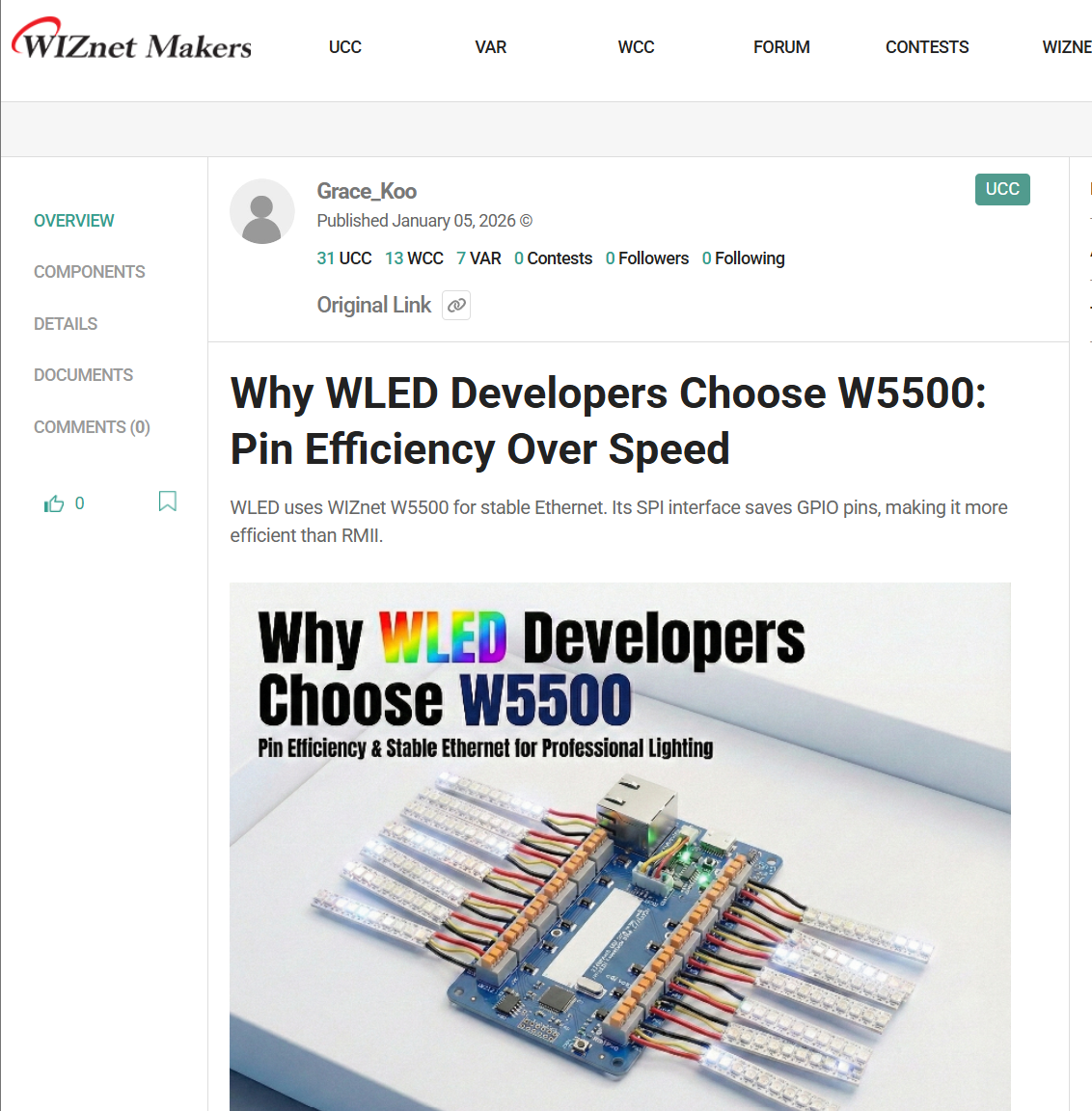
WIZnet Maker 사이트에 등록된 “Looking for Contributing Beta Testers” UCC는 WLED를 기반으로 LED 컨트롤러를 개발하는 과정에서 WIZnet W5500을 선택한 기술적 이유를 설명하는 콘텐츠이다. 해당 UCC는 WLED-MM 자체를 직접 활용한 프로젝트 사례는 아니지만, WLED 계열 프로젝트에서 W5500(SPI Ethernet)이 왜 현실적인 선택지로 고려되는지를 설명하는 참고 자료로서 의미가 있다. 이를 통해 WLED-MM에서 제안하는 W5500 Ethernet 확장이 특정 개인의 실험이 아니라, 실제 사용자 관점에서도 공감대를 형성할 수 있는 방향임을 간접적으로 뒷받침한다.
📌 Summary
WLED-MM은 ESP32 기반 WLED 프로젝트를 확장한 오픈소스 LED 제어 프로젝트로, 본 UCC에서는 WIZnet W5500(SPI Ethernet 컨트롤러)을 활용해 여러 ESP32 보드에서 유선 LAN 기반 LED 제어를 가능하게 하려는 PR #320을 중심으로 분석했다. 이 기여는 Wi-Fi 사용이 어렵거나 안정성이 중요한 환경에서도 LED 컨트롤러를 운용할 수 있도록 네트워크 선택지를 넓히며, 핀 설정과 UI, 보드 추상화까지 고려한 구조적 개선을 포함한다는 점에서 실사용성과 재현성이 높다. 아직 병합 전 단계라는 한계는 있으나, WLED라는 대형 생태계와 결합된 W5500의 범용적 활용 사례로서 WIZnet Maker 관점에서 의미 있는 기술 레퍼런스로 평가된다.
📌 FAQ
Q1. 왜 WLED-MM에 WIZnet W5500 이더넷 컨트롤러를 사용하나요?
A: W5500은 하드웨어 TCP/IP 스택을 내장한 이더넷 컨트롤러로, ESP32나 MCU에서 LwIP 같은 소프트웨어 스택을 사용하지 않아도 됩니다.
WLED-MM처럼 LED 실시간 제어와 네트워크 통신을 동시에 처리해야 하는 환경에서, CPU 부하와 지연(jitter)을 최소화하여 더 안정적인 프레임 업데이트를 보장합니다.
Q2. WLED-MM에서 W5500은 어떤 역할을 하나요?
A: W5500은 WLED-MM의 네트워크 전송 계층(Ethernet Transport) 역할을 담당합니다.
LED 제어 명령, Web UI 요청, 실시간 상태 데이터가 Wi-Fi 대신 유선 이더넷을 통해 전송되며, MCU는 LED 효과 계산과 타이밍 제어에 집중할 수 있습니다.
Q3. Wi-Fi 대신 Ethernet(W5500)을 쓰면 어떤 점이 달라지나요?
A: Wi-Fi는 무선 간섭과 환경 변화로 인해 지연 시간이 불규칙해질 수 있지만, Ethernet은 결정론적인 지연 시간을 제공합니다.
특히 대형 LED 매트릭스나 다중 컨트롤러 환경에서 W5500 기반 이더넷은 프레임 드랍 감소, 동기화 안정성 향상이라는 실질적인 차이를 만듭니다.
Q4. W5500은 WLED-MM에 어떻게 연결되나요?
A: W5500은 SPI 인터페이스로 MCU에 연결됩니다.
MISO, MOSI, SCK, CS의 4개 기본 신호선만 필요하며, PR에서는 WLED-MM 네트워크 추상화 계층에 W5500 드라이버가 추가되어 기존 Wi-Fi 코드와 병렬로 선택 가능하도록 구성되었습니다.
Q5. ENC28J60 같은 다른 이더넷 칩 대신 W5500을 선택한 이유는 무엇인가요?
A: ENC28J60은 MAC/PHY만 제공하기 때문에 **소프트웨어 TCP/IP 스택(LwIP)**이 필수이며, 이로 인해 RAM 사용량과 CPU 부하가 크게 증가합니다.
반면 W5500은 TCP/UDP를 하드웨어에서 처리하여 약 30KB 이상의 RAM 절감과 더 안정적인 네트워크 성능을 제공하므로, WLED-MM과 같은 실시간 LED 제어 프로젝트에 더 적합합니다.
📌 Overview
WLED-MM is a project that extends WLED, an open-source ESP32-based addressable RGB LED control platform, with a focus on supporting a wider range of hardware environments and real-world use cases. While retaining the core LED control functionality and web-based UI, it has evolved to increase flexibility in board selection and configuration, enabling makers and developers to apply it across diverse environments. In particular, network expansion to overcome the limitations of a Wi-Fi-centric architecture has been one of its key directions.
PR #320, the core of this UCC, introduces wired LAN-based LED control on multiple ESP32 boards by utilizing the WIZnet W5500 (SPI Ethernet controller). To avoid board-dependent implementations, it includes refinements to pin management, the configuration UI, and the initialization structure. It presents a practical expansion approach that allows WLED-MM to be used even in environments where Wi-Fi is difficult to use or where high stability is required.
📌 Features
Expanded W5500 (SPI) Ethernet support
- W5500 can be used across the entire ESP32 family, including ESP32, ESP32-S2, ESP32-S3, ESP32-C3, and ESP32-Pico
- Wired network expansion is possible even on boards without RMII Ethernet
Dynamic SPI pin assignment and conflict prevention
- User-configurable MOSI/MISO/SCLK/CS/INT/RST pins
- Pre-validation and conflict detection via the Pin Manager
Enhanced stability and real-time performance
- Reduced latency compared to Wi-Fi in Art-Net and DDP protocols (45+ FPS @ 64×64 matrix)
- Network connection/disconnection event logging (link speed, duplex, MAC address)
- Automatic pin release and error handling routines on failure
📌 System Architecture
Components
- MCU/SoC: ESP32 family (standard ESP32, ESP32-S3, ESP32-C3, etc.)
- Ethernet: WIZnet W5500
- LED output: Digital LED strips/matrices such as WS2812B
- Control clients: Smartphone/PC browsers (web UI), and in some cases UDP-based control (Art-Net, etc.)
📌 Role and Application of the WIZnet's Chip
Chip used: WIZnet W5500
Role in the network
- TCP/IP hardware stack offload: the ESP32 handles only SPI communication, while TCP/UDP/ICMP processing is independently handled by the W5500
- Protocol support:
- UDP (Art-Net, DDP, E1.31/sACN real-time pixel streaming)
- TCP (HTTP web UI, WebSocket, API)
- MQTT (IoT integration)
- Concurrent connection handling using 8 independent sockets
PR #320 W5500 integration
https://github.com/MoonModules/WLED-MM/pull/320
This PR integrates the W5500 as an alternative to RMII-based Ethernet, while also addressing real-world issues such as automatic board detection, dynamic pin assignment, configuration UI expansion, and power stability considerations. In particular, logs and tests verify that the W5500 is properly initialized and operates with a 100 Mbps full-duplex link across various boards, including ESP32, ESP32-C3, and ESP32-S3. It also confirms that stable, Ethernet-centric network operation is possible after disabling Wi-Fi. Through this, the PR clearly demonstrates that the W5500 can be used as a general-purpose wired networking solution in the WLED-MM environment without being tied to specific boards.
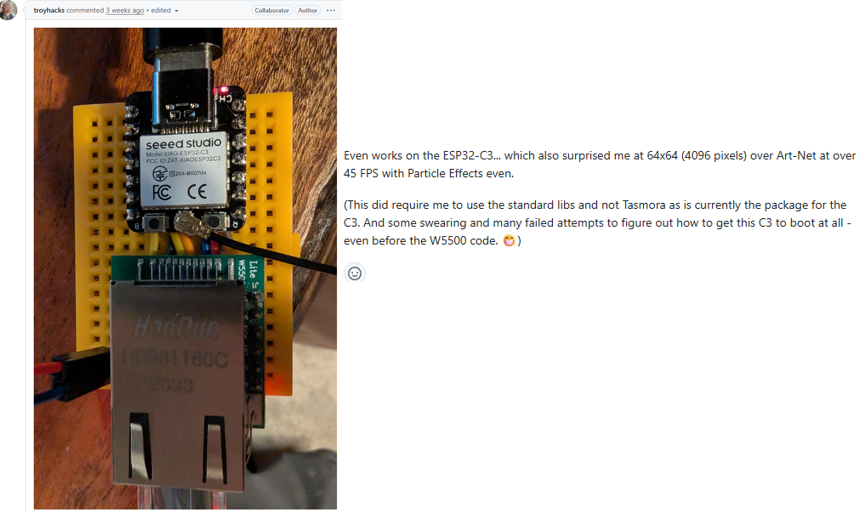
This is a test demonstrating WLED-MM running in a real setup with a WIZnet W5500 (SPI Ethernet) connected to an ESP32-C3 board.
In particular, maintaining performance of over 45 FPS while applying particle effects to a 64×64 (4,096-pixel) LED matrix in an Art-Net environment indicates that, despite being SPI-based Ethernet, it provides sufficient processing performance for LED control applications. During this process, there were some trial and error steps involving the use of standard libraries, boot behavior, and power stability, but ultimately it can be seen as a case that proves the W5500 to be a practical, general-purpose Ethernet solution usable across various ESP32 family devices.
It shows the process of validation and tuning carried out to apply the WIZnet W5500 stably across various ESP32 family boards and real commercial product environments. The W5500 was tested on an ESP32-S3 Ethernet board, an ESP32-C3 + W5500 Lite combination, RMII-based kits, and commercial controller environments such as the QuinLED DIG-NEXT-2. Through improvements in automatic board detection and pin handling, normal operation was confirmed without requiring separate builds. In particular, the fact that the power-sensitive W5500 Lite module operated successfully even in an actual product enclosure demonstrates that the W5500 is not an experimental choice but a practical Ethernet expansion solution.
📌 Market & Application Value
(by ChatGPT)
Applicable industries
- Stage and performance lighting
- Use of standard Art-Net/sACN protocols, enabling direct integration with lighting consoles
- Synchronization of hundreds of pixels required → Wi-Fi latency is unacceptable
- Architectural lighting
- Permanent installations in commercial buildings, hotels, and shopping malls
- Ability to leverage existing wired network infrastructure
- Exhibitions and events
- Avoidance of Wi-Fi congestion in temporary installation environments
- Unified power and communication via PoE switches
- Smart home / IoT
- Control of large-scale LED walls
- Integration with Home Assistant and Node-RED
📌 External Indicators
GitHub (project scale / activity)
- MoonModules/WLED-MM: Stars 368, Forks 123, Watchers 19, Commit history 6,472
Latest release: WLED-MM v14.7.1 (Jan 13, 2026)
PR (core contribution of this UCC)
- PR #320 “W5500 Support for ALL boards”: Open status, proposes merging 104 commits (date noted: Jan 15, 2026)
- The change summary clearly documents W5500 (SPI) support, along with the introduction of UI, configuration, pin management, and ETHClass2
MoonModules Documents
Indirect relevance to WIZnet Maker UCC
https://maker.wiznet.io/Grace_Koo/projects/looking%2Dfor%2Dcontributing%2Dbeta%2Dtesters/
The “Looking for Contributing Beta Testers” UCC registered on the WIZnet Maker site is content that explains the technical reasons for choosing the WIZnet W5500 during the development of an LED controller based on WLED. Although this UCC is not a project case that directly uses WLED-MM itself, it is meaningful as a reference that explains why the W5500 (SPI Ethernet) is considered a practical option in WLED-related projects. Through this, it indirectly supports the idea that the W5500 Ethernet expansion proposed in WLED-MM is not an experiment by an individual, but a direction that can gain agreement from real users’ perspectives.
📌 Summary
WLED-MM is an open-source LED control project that extends the ESP32-based WLED project, and this UCC analyzes PR #320, which aims to enable wired LAN-based LED control on multiple ESP32 boards using the WIZnet W5500 (SPI Ethernet controller). This contribution broadens network options, allowing LED controllers to be operated even in environments where Wi-Fi is difficult to use or where stability is critical, and includes structural improvements that consider pin configuration, UI, and board abstraction, resulting in high practicality and reproducibility. Although it is still at a pre-merge stage, it is evaluated as a meaningful technical reference from the WIZnet Maker perspective, representing a versatile use case of the W5500 combined with the large WLED ecosystem.
📌 FAQ
Q1. Why is the WIZnet W5500 Ethernet controller used in WLED-MM?
A: The W5500 is an Ethernet controller with a built-in hardware TCP/IP stack, eliminating the need to use software stacks such as LwIP on the ESP32 or other MCUs.
In environments like WLED-MM, where real-time LED control and network communication must be handled simultaneously, it minimizes CPU load and latency (jitter), ensuring more stable frame updates.
Q2. What role does the W5500 play in WLED-MM?
A: The W5500 serves as the network transport layer (Ethernet Transport) in WLED-MM.
LED control commands, Web UI requests, and real-time status data are transmitted over wired Ethernet instead of Wi-Fi, allowing the MCU to focus on LED effect computation and timing control.
Q3. What changes when using Ethernet (W5500) instead of Wi-Fi?
A: Wi-Fi can suffer from variable latency due to wireless interference and environmental changes, whereas Ethernet provides deterministic latency.
Especially in large LED matrix setups or multi-controller environments, W5500-based Ethernet makes a tangible difference by reducing frame drops and improving synchronization stability.
Q4. How is the W5500 connected to WLED-MM?
A: The W5500 is connected to the MCU via the SPI interface.
Only four basic signal lines are required: MISO, MOSI, SCK, and CS. In this PR, the W5500 driver is added to the WLED-MM network abstraction layer, allowing it to be selected in parallel with the existing Wi-Fi code.
Q5. Why choose the W5500 over other Ethernet chips such as the ENC28J60?
A: The ENC28J60 provides only MAC/PHY functionality, making a software TCP/IP stack (LwIP) mandatory, which significantly increases RAM usage and CPU load.
In contrast, the W5500 processes TCP/UDP in hardware, saving more than approximately 30 KB of RAM and delivering more stable network performance, making it a better fit for real-time LED control projects like WLED-MM.