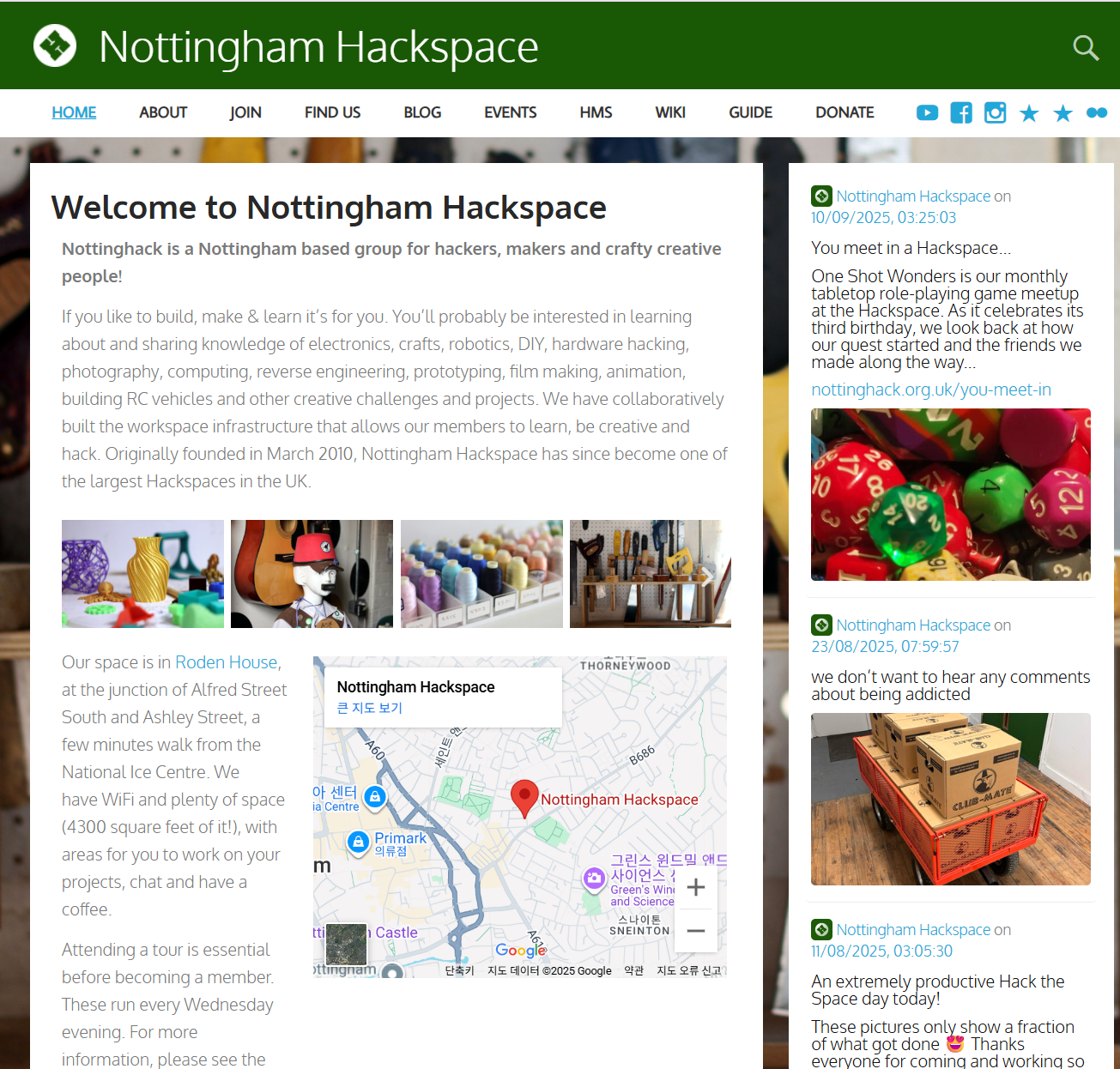
It is a non-profit hackerspace located in Nottingham, UK — a community-centered workspace where makers, engineers, and DIY creators come together.
The 4,300 ft² (around 400 m²) space is equipped with woodworking, metalworking, and electronics tools, as well as CNC machines, laser cutters, 3D printers, and more.
Through regular workshops and open hacking nights, anyone can participate, and after becoming a member and completing equipment induction sessions, members can make full use of the facilities.
The space is run by volunteers and member self-governance, with active knowledge sharing and networking.
Simply put, it’s a creative and making community where people share tools and expertise that would be difficult to maintain individually.
영국의 노팅엄에 있는 비영리 단체로, 메이커/엔지니어/ DIY 제작자들이 모이는 커뮤니티 중심의 작업공간입니다.
4300ft² (약 400m²)규모의 공간에 목공·금속·전자 장비, CNC, 레이저 커터, 3D 프린터 등 다양한 시설을 갖추고 있습니다. 정기 워크숍과 오픈 해킹 나이트를 통해 누구나 참여 가능하며, 멤버십 가입 후 장비 사용 교육(induction)을 거쳐 활용할 수 있어요. 운영은 자원봉사자와 멤버 자치로 이루어지며, 기술 공유와 네트워킹이 활발합니다. 쉽게 말해, 개인이 갖추기 힘든 장비와 지식을 함께 나누는 창작·제작 공동체라고 볼 수 있습니다.
Project Overview
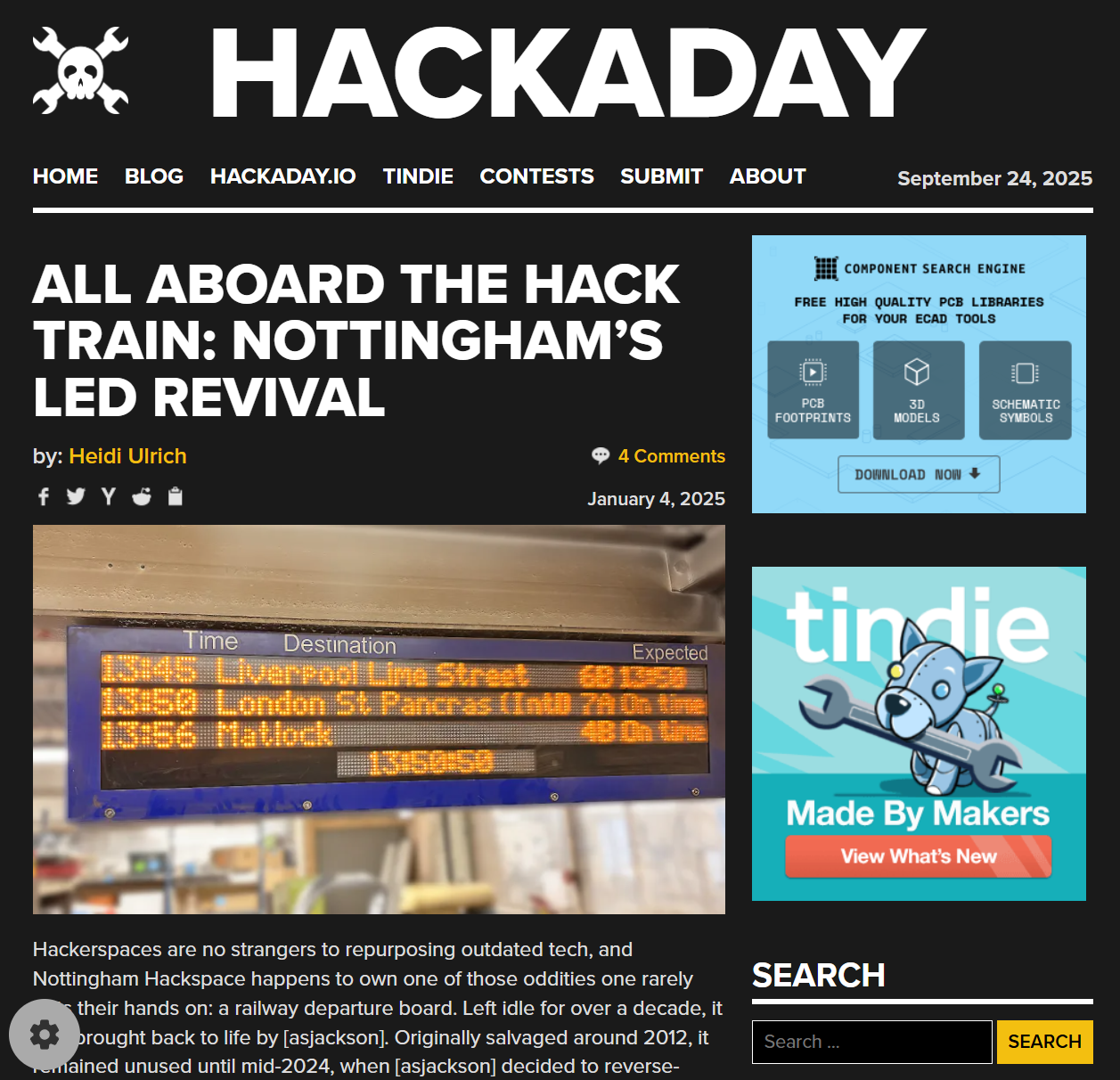
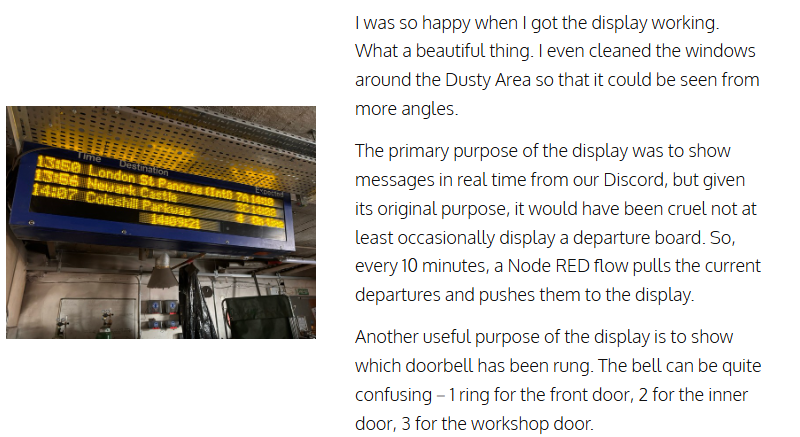
At Nottingham Hackspace, there was an old train station departure board. To revive this long-idle display, a developer redesigned its control system in two stages.
In the first project, Discord messages were displayed in real time via MQTT, and live train departure information was shown every 10 minutes. However, using the Arduino Uno R4 WiFi caused occasional connection drops, and only one side of the display worked.
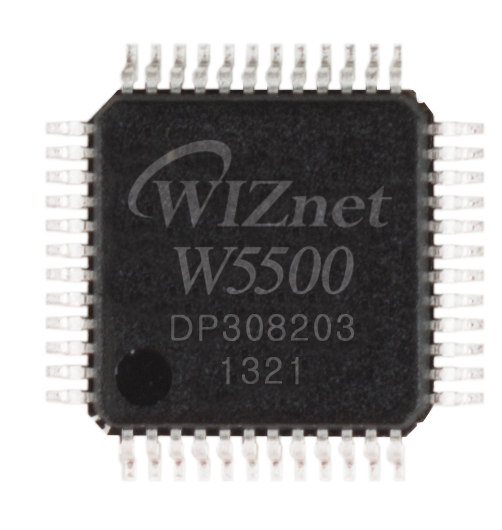
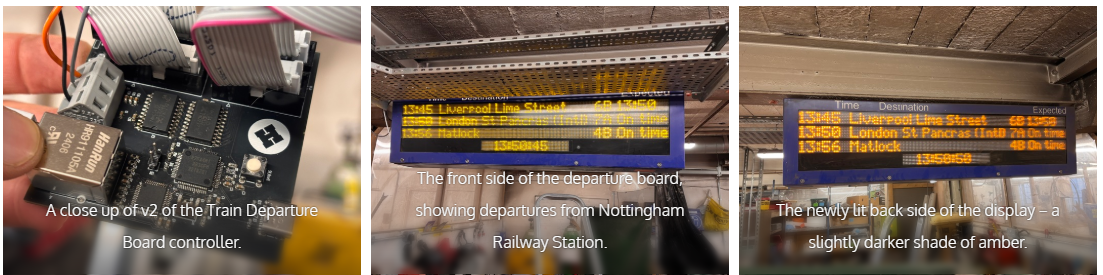
In the second project, the system was redesigned with the W5500 Ethernet chip, and buffers were added so that both sides of the display could be driven successfully.
노팅엄 해커스페이스(Nottingham Hackspace)에는 오래된 기차역 출발 안내판(Departure Board)이 있었습니다. 오랫동안 동작하지 않던 이 안내판을 다시 살리기 위해 두 차례에 걸쳐 새로운 제어 방식을 설계했습니다.
첫 번째 단계에서는 MQTT를 통해 서버(Discord) 메시지를 실시간으로 표시하고, 10분마다 실제 열차 출발 정보를 디스플레이에 띄우도록 구현했습니다. 그러나 Arduino Uno R4 WiFi를 사용하면서 연결이 가끔 끊기는 문제가 있었고, 디스플레이도 한쪽 면만 표시되는 한계가 있었습니다.
두 번째 단계에서는 W5500 칩을 사용해 WiFi를 이더넷 기반으로 재설계했으며, 디스플레이에 버퍼를 추가해 양쪽 면이 모두 표시되도록 개선했습니다.
Hardware Structure
LED Array: Each side of the board contains 4,480 LEDs arranged in two parallel chains.
Signal Requirements: Analysis revealed that while most control signals operated at logic level, one “mystery pin” required a higher voltage (~7–8V), necessitating custom driver circuitry.
Buffering: To ensure stable operation, 74HC541D buffer chips were introduced so both LED chains could be reliably driven in parallel.
LED 배열: 안내판은 한쪽 면에 4,480개의 LED가 있으며, 두 개의 병렬 체인으로 구성되어 있습니다.
신호 분석: 각 LED 체인을 제어하기 위한 신호 체계를 분석하는 과정에서, 일부 제어 핀은 예상보다 높은 전압(약 7~8V)을 필요로 한다는 점이 밝혀졌습니다. 이를 위해 별도의 전압 드라이버와 레벨 변환 회로가 추가되었습니다.
버퍼 회로: 신호 안정성을 확보하기 위해 74HC541D 버퍼 칩을 사용하여 양쪽 체인을 동시에 안정적으로 구동할 수 있도록 설계했습니다.
Control Board Design
Microcontroller: A custom board was designed using an Arduino Uno R4 variant as the main controller.
Networking: In version 2, an Ethernet interface was integrated directly onto the board, providing stable, wired connectivity for data updates.
Bootloader Setup: Pin configurations were adjusted to support DFU mode, and a custom board variant definition was created for firmware development.
MCU 선택: Arduino Uno R4 기반의 마이크로컨트롤러를 사용하여 새로운 제어 보드를 제작했습니다.
네트워크 통신: 최신 버전(v2)에서는 보드에 Ethernet 모듈이 직접 통합되어, 유선 연결을 통해 안정적으로 데이터를 수신할 수 있도록 구성되었습니다.
부트로더 관리: 보드가 DFU 모드로 진입할 수 있도록 핀 구성을 조정하고, 커스텀 보드 변형(variant)을 정의하여 펌웨어 개발 환경을 세팅했습니다.
Software Operation
Data Acquisition:
Discord messages are received over MQTT and displayed instantly.
At set intervals, the board queries a railway API for the latest departure times and platform information.
Display Output:
Incoming data is mapped to the LED matrix and rendered on the board.
The display alternates between Discord messages and train departure information, creating a dynamic information hub inside the hackspace.