


Plum-ESPHome-RfBridge
Plum-ESPHome-RfBridge
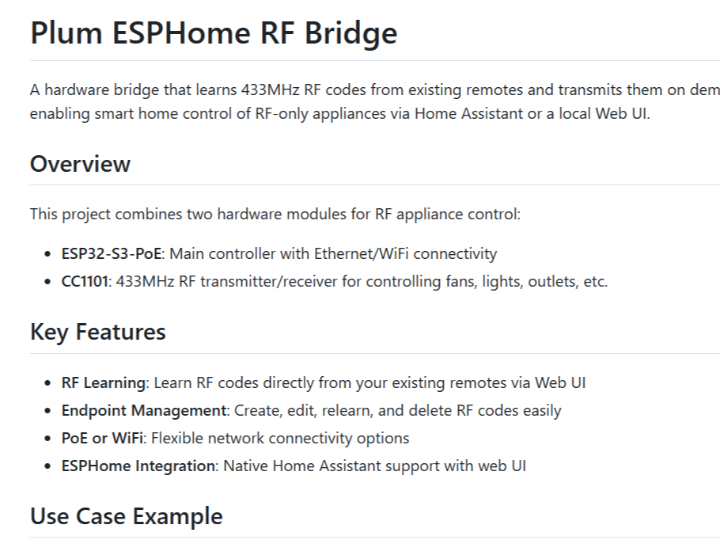
WIZnet - W5500
x 1

📌 Overview
Plum ESPHome RF Bridge는 433MHz RF 기반 기존 리모컨 장치를 네트워크 기반 스마트홈 시스템으로 통합하는 브리지 장치입니다.
기존 RF(라디오 주파수) 리모컨은 인터넷 연결이 없어 자동화·원격 제어가 어려운 문제가 있습니다.
이 프로젝트는 이를 해결하기 위해:
- RF 신호를 학습(Learning)하고
- 네트워크를 통해 재전송하며
- Home Assistant와 연동하여 자동화 가능
하도록 설계되었습니다.
즉, **“비연결형 RF 기기를 IP 기반 IoT 환경으로 전환하는 게이트웨이”**가 핵심입니다.
📌 Features
RF 신호 학습 및 재전송
- 기존 리모컨 신호를 직접 캡처 후 저장
- 필요 시 동일 신호 재전송
- 별도 프로토콜 분석 없이 사용 가능
Web UI 기반 관리
- RF 코드 등록/수정/삭제/테스트 기능 제공
- 사용자 친화적인 운영 구조
ESPHome + Home Assistant 연동
- 자동화 시나리오 구성 가능
- 로컬 기반 제어 (클라우드 의존성 낮음)
PoE + Wi-Fi 네트워크 선택 구조
- 유선 Ethernet (W5500 기반)
- 무선 Wi-Fi 모두 지원
범용 RF 디바이스 제어
- 선풍기, 조명, 콘센트 등 다양한 433MHz 기기 지원
📌 System Architecture
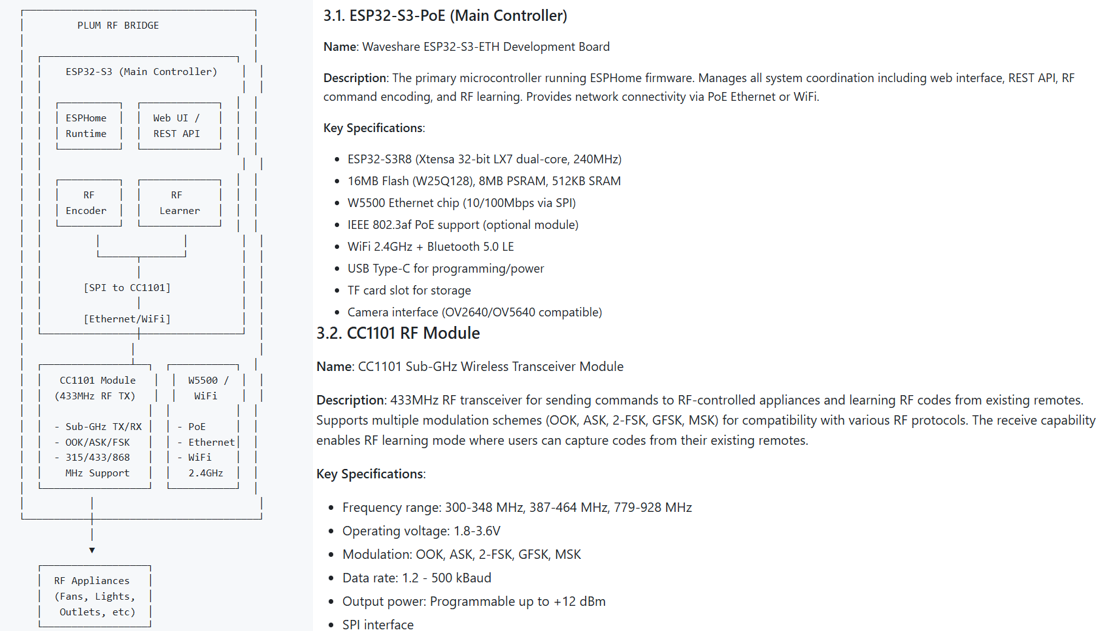
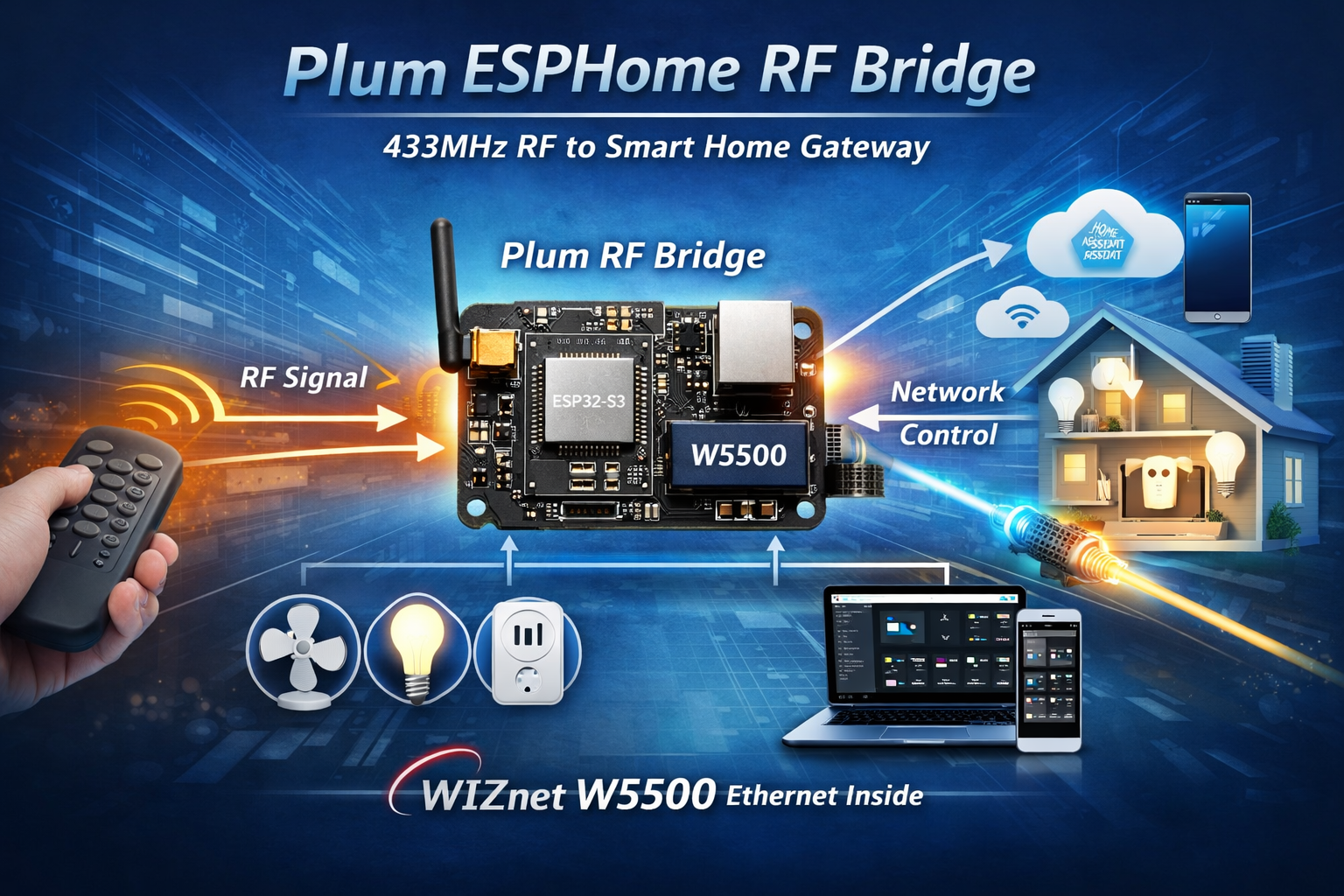
시스템은 하나의 통합 디바이스 내부에서 다음 기능을 동시에 수행합니다:
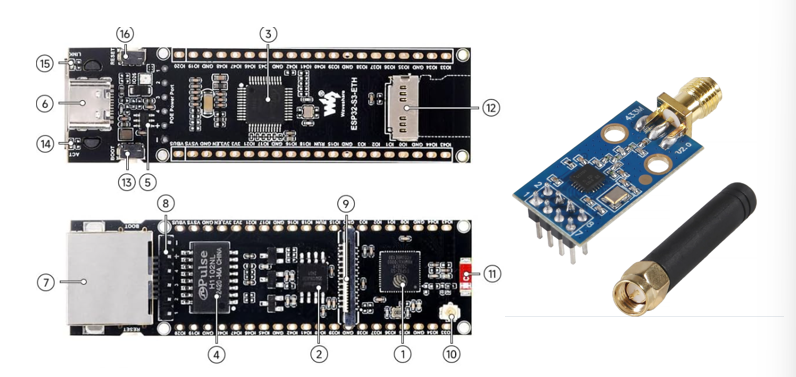
- RF 신호 수신 및 송신 (CC1101)
- RF 코드 분석 및 저장 (ESP32-S3)
- Web UI 및 API 제공 (ESPHome 기반)
- 네트워크 통신 (W5500 Ethernet / Wi-Fi)
👉 즉, **“RF ↔ IP 변환을 단일 MCU에서 처리하는 Edge Gateway 구조”**입니다.
📌 Role and Application of the WIZnet's Chip
사용 칩: W5500
역할
- SPI 기반 하드웨어 TCP/IP 오프로드
- ESP32와 결합하여 안정적인 유선 네트워크 제공
- Home Assistant와의 통신 처리
적용 프로토콜: TCP/IP 기반 HTTP / ESPHome API 통신
선택 이유 및 장점
- 하드웨어 TCP/IP 오프로드
- MCU 부하 감소
- RF 처리와 네트워크 병렬 처리 가능
- PoE 기반 안정적 설치
- 전원 + 네트워크 단일 케이블
- 스마트홈 인프라에 적합
- Wi-Fi 대비 안정성
- RF 제어 시스템에서 중요한 저지연/고신뢰성 확보
👉 결론적으로 W5500은 “RF → IP 브리지 구조의 안정성을 확보하는 핵심 네트워크 엔진” 역할을 수행합니다.
📌 Market & Application Value
적용 시장
| 분야 | 활용 |
|---|---|
| 스마트홈 | RF 가전 제어 |
| 홈 자동화 | 기존 리모컨 장치 통합 |
| 산업 IoT | 저가 RF 장치 네트워크화 |
📌 Summary
Plum ESPHome RF Bridge는 RF 기반 레거시 장치를 IoT 시스템으로 통합하는 실용적인 브리지 구조입니다.
- 기술적으로는 ESPHome + RF + Ethernet의 결합
- WIZnet은 안정적인 네트워크 핵심 역할 수행
- 시장적으로는 스마트홈 리트로핏 수요에 부합
다만 현재는 초기 개발 단계로 외부 확산성과 제품 완성도는 향후 개선이 필요합니다.
📌 FAQ
Q. Plum ESPHome RF Bridge는 어떤 문제를 해결하나요?
A. 인터넷 연결이 없는 433MHz RF 리모컨 장치를 네트워크 기반으로 전환하여, 원격 제어 및 자동화를 가능하게 합니다.
Q. RF 신호는 어떻게 처리되나요?
A. CC1101 모듈이 RF 신호를 수신하고, ESP32-S3가 이를 학습 및 저장한 후 필요 시 동일 신호를 재전송합니다.
Q. 별도의 RF 프로토콜 분석이 필요한가요?
A. 필요 없습니다. 신호를 그대로 캡처하고 재전송하는 방식이기 때문에 별도 분석 없이 사용할 수 있습니다.
Q. 어떤 종류의 RF 기기를 지원하나요?
A. 433MHz 대역을 사용하는 선풍기, 조명, 콘센트 등 대부분의 RF 리모컨 기반 장치를 지원합니다.
Q. W5500은 어떤 역할을 하나요?
A. W5500은 하드웨어 TCP/IP 오프로드 기능을 제공하여 ESP32의 부담을 줄이고 안정적인 Ethernet 통신을 담당합니다.
Q. Wi-Fi 대신 Ethernet을 사용하는 이유는 무엇인가요?
A. Ethernet은 더 낮은 지연과 높은 안정성을 제공하여 RF 제어와 같은 실시간성이 중요한 환경에 적합합니다.
Q. PoE는 어떤 장점이 있나요?
A. 전원과 네트워크를 하나의 케이블로 해결할 수 있어 설치가 간편하고 스마트홈 인프라에 적합합니다.
Q. Home Assistant와 어떻게 연동되나요?
A. ESPHome을 통해 Home Assistant와 통신하며, 자동화 시나리오 및 원격 제어가 가능합니다.
Q. Web UI에서는 어떤 기능을 제공하나요?
A. RF 코드 등록, 수정, 삭제 및 테스트 기능을 제공하여 사용자 친화적인 관리가 가능합니다.
Q. 이 프로젝트는 상용 제품인가요?
A. 현재는 초기 개발 단계의 프로젝트로, 향후 기능 개선 및 확장성이 필요한 상태입니다.
📌 Overview
The Plum ESPHome RF Bridge is a device that integrates existing 433MHz RF-based remote control devices into a network-based smart home system.
Traditional RF (radio frequency) remotes lack internet connectivity, making automation and remote control difficult.
To solve this, the project is designed to:
- Learn RF signals
- Retransmit them over a network
- Enable automation by integrating with Home Assistant
In other words, the core concept is a “gateway that converts non-connected RF devices into an IP-based IoT environment.”
📌 Features
RF Signal Learning and Retransmission
- Captures and stores signals directly from existing remote controls
- Retrransmits the same signals when needed
- Usable without requiring protocol analysis
Web UI-Based Management
- Provides functions to register, edit, delete, and test RF codes
- Offers a user-friendly operational interface
ESPHome + Home Assistant Integration
- Enables the creation of automation scenarios
- Supports local control with low cloud dependency
PoE + Wi-Fi Network Options
- Supports wired Ethernet (based on W5500)
- Also supports wireless Wi-Fi
Universal RF Device Control
- Compatible with various 433MHz devices such as fans, lighting, and power outlets
📌 System Architecture
The system performs the following functions simultaneously within a single integrated device:
- RF signal reception and transmission (CC1101)
- RF code analysis and storage (ESP32-S3)
- Web UI and API provision (based on ESPHome)
- Network communication (W5500 Ethernet / Wi-Fi)
👉 In other words, it is an “edge gateway architecture that handles RF ↔ IP conversion within a single MCU.”
📌 Role and Application of the WIZnet's Chip
Chip Used: W5500
Role
- SPI-based hardware TCP/IP offload
- Provides stable wired network connectivity when combined with ESP32
- Handles communication with Home Assistant
Applied Protocols: TCP/IP-based HTTP / ESPHome API communication
Reasons for Selection and Advantages
Hardware TCP/IP Offload
- Reduces MCU workload
- Enables parallel processing of RF handling and network communication
Stable Deployment with PoE
- Single cable for both power and network
- Well-suited for smart home infrastructure
Higher Reliability Compared to Wi-Fi
- Ensures low latency and high reliability, which are critical for RF control systems
👉 In conclusion, the W5500 serves as a “core network engine that ensures the stability of the RF → IP bridge architecture.”
📌 Market & Application Value
Target Markets
| Field | Application |
|---|---|
| Smart Home | Control of RF-based home appliances |
| Home Automation | Integration of existing remote-controlled devices |
| Industrial IoT | Networking of low-cost RF devices |
📌 Summary
The Plum ESPHome RF Bridge is a practical bridge architecture that integrates RF-based legacy devices into IoT systems.
- Technically, it combines ESPHome + RF + Ethernet
- WIZnet plays a key role in providing stable networking
- From a market perspective, it aligns well with smart home retrofit demand
However, it is still in an early development stage, and further improvements are needed in terms of external adoption and product maturity.
📌 FAQ
Q. What problem does the Plum ESPHome RF Bridge solve?
A. It converts non-networked 433MHz RF remote devices into IP-based systems, enabling remote control and automation.
Q. How are RF signals handled?
A. The CC1101 module receives RF signals, and the ESP32-S3 learns, stores, and retransmits them when needed.
Q. Is RF protocol analysis required?
A. No. The system captures and replays signals directly, so no protocol decoding is necessary.
Q. What types of RF devices are supported?
A. Most 433MHz RF devices such as fans, lights, and smart plugs can be controlled.
Q. What is the role of the W5500?
A. The W5500 provides hardware TCP/IP offloading, reducing MCU load and enabling stable Ethernet communication.
Q. Why use Ethernet instead of Wi-Fi?
A. Ethernet offers lower latency and higher reliability, which is critical for RF control systems.
Q. What are the benefits of PoE?
A. Power and network are delivered via a single cable, simplifying installation and improving deployment efficiency.
Q. How does it integrate with Home Assistant?
A. It uses ESPHome API to connect with Home Assistant, enabling automation and centralized control.
Q. Is this a commercial product?
A. No, it is currently an early-stage project that requires further development and refinement.