


Batear
Batear is an open-source acoustic drone detection system using ESP32-S3, MEMS mic, and LoRa or wired Ethernet/PoE.
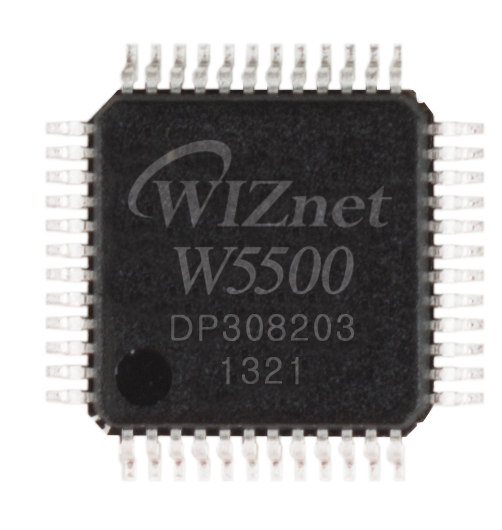
WIZnet - W5500
x 1

📌 Overview
Batear는 ESP32-S3, MEMS 마이크, LoRa 또는 유선 Ethernet/PoE 구성을 이용한 오픈소스 음향 기반 드론 감지 시스템입니다.
기존 드론 감지 시스템이 레이더, 카메라, 클라우드 분석, 고가 장비에 의존하는 경우가 많은 반면, Batear는 저가 MCU에서 드론 프로펠러 음향의 고조파 패턴을 로컬에서 분석해 경보를 생성하는 구조입니다. 공식 문서 기준으로 ESP32-S3와 ICS-43434 I2S MEMS 마이크를 사용하며, FFT 기반 고조파 분석으로 드론 로터 소리를 감지합니다.
📌 Background

Batear에 Ethernet 기능이 추가된 배경은 단순한 기능 확장이 아니라, 무선 통신이 신뢰성을 잃는 고간섭 환경에서도 드론 감지 시스템을 계속 운용하기 위한 구조적 전환입니다.
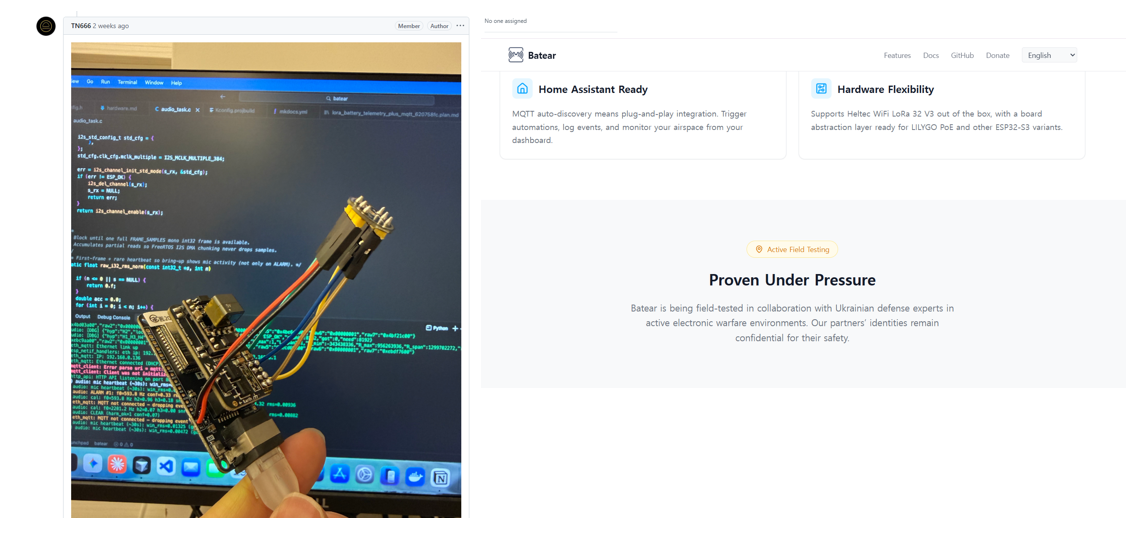
GitHub Issue #35에 따르면, Batear 프로젝트는 우크라이나 전방 현장 엔지니어들로부터 직접 요청을 받았고, 실제 분쟁 지역에서는 전자전(EW, Electronic Warfare) 재밍으로 인해 LoRa, Wi-Fi, Bluetooth 같은 무선 프로토콜이 완전히 불안정해질 수 있다고 설명합니다. 이 문제를 해결하기 위해 Batear는 기존 LoRa Mesh 기반 구조에서 벗어나, Ethernet 기반 TCP/IP 통신을 사용하는 “Batear Wired Edition” 기능을 추했습니다.
📌 Features
Edge-only Acoustic Detection
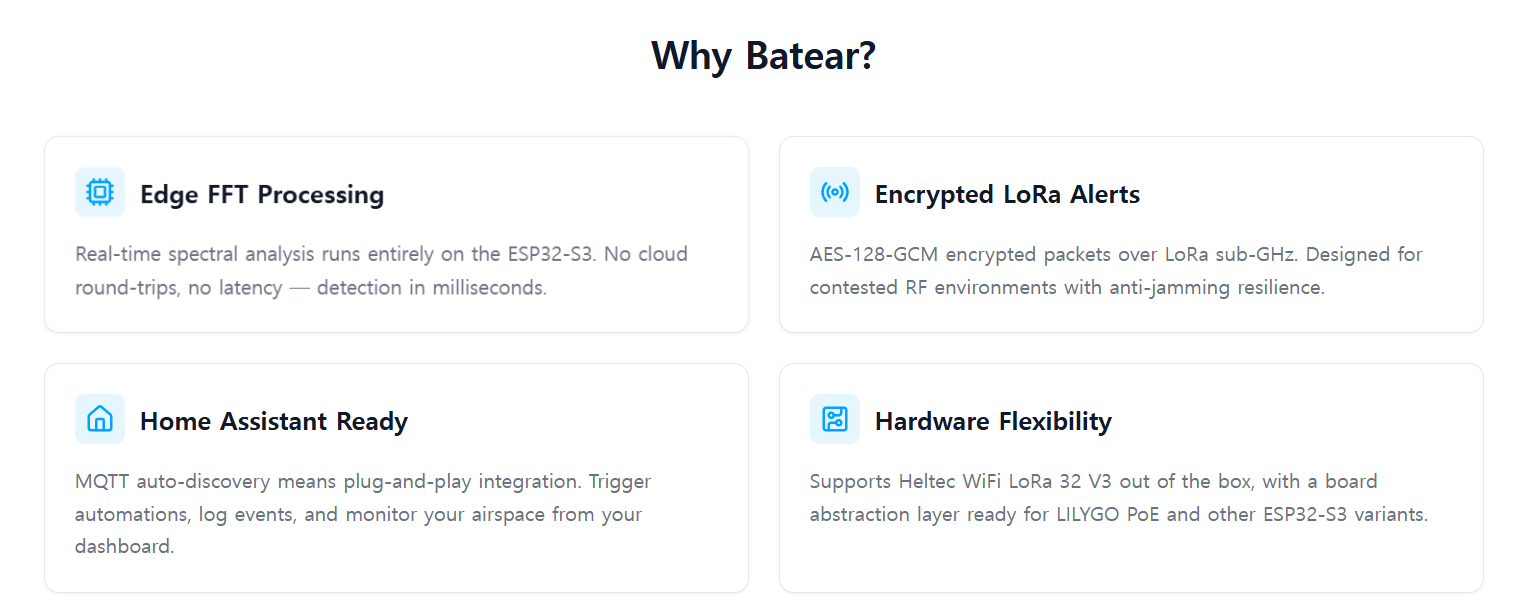
Batear는 오디오 데이터를 클라우드로 보내지 않고, ESP32-S3 내부에서 16 kHz 샘플링과 1024-point real FFT를 수행해 드론 로터의 기본 주파수와 2배·3배 고조파 패턴을 분석합니다. 공식 문서에는 FFT 결과가 15.625 Hz/bin 해상도를 제공한다고 설명되어 있습니다.
Wireless와 Wired 이중 배치 모델
기본 구조는 LoRa Detector가 경보를 Gateway로 보내고, Gateway가 MQTT로 Home Assistant에 전달하는 방식입니다. 동시에 Wired Detector는 W5500 Ethernet을 통해 LoRa와 Gateway를 우회하고 MQTT/JSON으로 직접 경보를 전송합니다.
Home Assistant 연동
MQTT auto-discovery를 지원하여 Home Assistant에서 감지 이벤트, 신호 상태, 경보 자동화를 사용할 수 있습니다. 사용자는 드론 감지 시 조명, 사이렌, 알림 같은 자동화를 구성할 수 있습니다.
저비용·오픈소스 구조
공식 문서와 외부 기사들은 Batear를 “under $15” 또는 “under $20 per node” 수준의 저비용 하드웨어로 설명합니다. 실제 BOM은 지역·보드·마이크·PoE 구성에 따라 달라질 수 있으므로, 양산 비용으로 그대로 해석하면 안 됩니다.
Wired Edition의 현장 대응성
GitHub Issue #35에서는 우크라이나 현장 엔지니어 요청과 RF 재밍 환경을 배경으로 LoRa/Wi-Fi/Bluetooth 대신 Ethernet TCP/IP 기반 Wired Edition으로 전환하는 요구가 제시되었습니다. 이는 유선 네트워크와 PoE 기반 현장 설치 가능성을 보여주는 중요한 전환점입니다.
📌 System Architecture
Batear는 크게 무선형 구조와 유선형 구조로 나뉩니다.
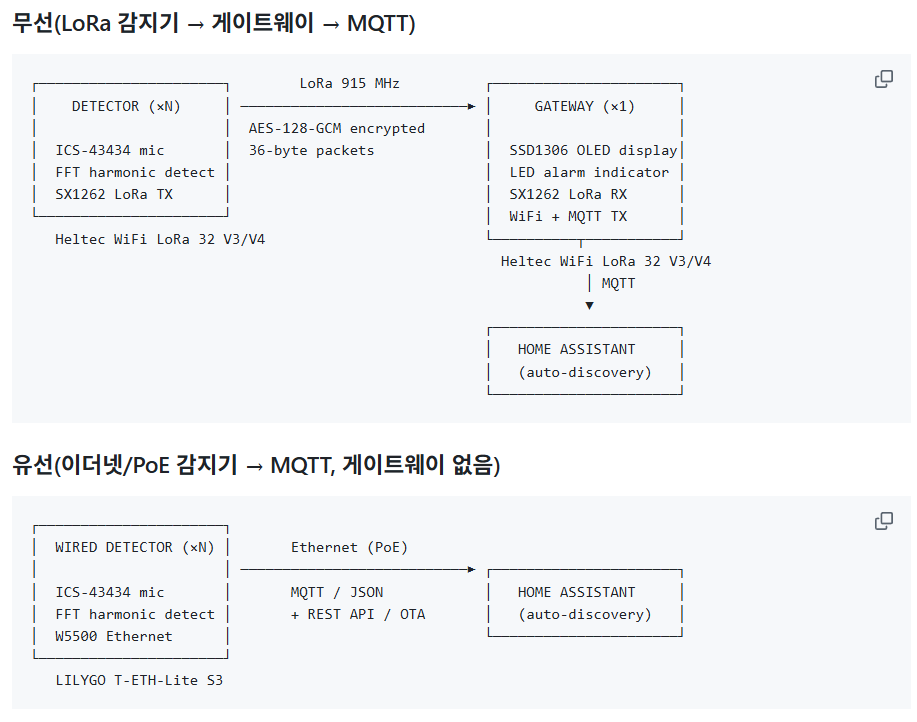
1. Wireless Model: LoRa Detector → Gateway → MQTT/Home Assistant
Detector 노드는 ICS-43434 I2S MEMS 마이크로 주변 소리를 수집하고, ESP32-S3에서 FFT 기반 고조파 분석을 수행합니다. 드론 음향 패턴이 감지되면 AES-128-GCM으로 암호화된 LoRa 패킷을 Gateway로 전송합니다. Gateway는 LoRa 패킷을 수신·복호화한 뒤 MQTT 메시지로 Home Assistant에 전달합니다. 공식 README는 이 구조를 “Detector, Gateway, Home Assistant” 흐름으로 설명합니다.
2. Wired Model: Ethernet/PoE Detector → MQTT/Home Assistant
Wired Detector는 LoRa와 Gateway를 사용하지 않습니다. LILYGO T-ETH-Lite S3 보드의 W5500 Ethernet 인터페이스를 통해 네트워크에 직접 연결되고, 감지 결과를 MQTT/JSON으로 브로커 또는 Home Assistant에 전달합니다. GitHub 문서에는 이 방식이 고정 설치 환경에 적합하며 Ethernet과 선택적 PoE 전원을 사용할 수 있다고 설명되어 있습니다.
📌 Role and Application of the WIZnet's Chip
사용된 WIZnet 칩: W5500
Batear의 Wired Detector 구성에서 사용된 WIZnet 칩은 W5500 Ethernet Controller입니다. GitHub README의 시스템 아키텍처에는 Wired Detector가 “W5500 Ethernet”을 통해 MQTT/JSON, REST API, OTA를 지원한다고 명시되어 있습니다.
W5500을 선택한 기술적 이유
- RF 재밍 회피
Issue #35는 LoRa, Wi-Fi, Bluetooth가 전자전 환경에서 불안정할 수 있어 Ethernet TCP/IP 기반 Wired Edition이 필요하다고 설명합니다. W5500은 이 요구에 맞는 유선 Ethernet 연결성을 제공합니다. - MCU 부담 감소와 구현 단순화
W5500은 Hardwired TCP/IP 구조를 제공하므로 MCU가 모든 네트워크 스택을 소프트웨어로 처리하는 부담을 줄일 수 있습니다. WIZnet 공식 문서도 W5500을 외부 MCU에 SPI 최대 80 MHz로 연결되는 Hardwired TCP/IP 인터넷 컨트롤러로 설명합니다. - PoE 기반 고정 설치 적합성
Batear Wired Edition은 Ethernet/PoE를 통해 데이터와 전원을 단일 케이블로 공급하는 현장 설치를 목표로 합니다. 이는 농장, 경계 시설, 산업 현장, 보안 구역처럼 장기간 고정 배치가 필요한 환경에 적합합니다. - 프로토콜 확장성
Batear는 MQTT, JSON, REST API, OTA를 유선 네트워크 위에 구성합니다. W5500은 TCP/UDP 기반 임베디드 네트워킹에 적합하며, WIZnet 공식 문서에서도 TCP, UDP, IPv4, ICMP, ARP, IGMP, PPPoE 지원을 확인할 수 있습니다.
📌 Market & Application Value
적용 가능한 시장
Batear의 1차 적용 시장은 저비용 드론 감지 및 경계 보안입니다. 공식 사이트와 문서에서는 homes, farms, communities, rooftops, fence line 같은 배치 시나리오를 언급합니다.
적용 가능 분야는 다음과 같습니다.
| 시장 | 적용 가치 |
|---|---|
| 농장·축산·시설 경계 | 저비용 감지 노드를 다수 배치하여 드론 접근 알림 |
| 스마트 팩토리·산업단지 | 카메라 사각지대 또는 RF 제한 구역의 보조 감지 |
| 민간 보안·프라이버시 | 클라우드 업로드 없이 로컬 감지 |
| 국경·전술·재난 대응 | RF 재밍 환경에서 유선형 감지 노드로 활용 가능성 |
| 스마트홈·홈 어시스턴트 | MQTT 기반 자동화와 알림 연동 |
기존 방식 대비 경쟁력
기존 드론 감지 솔루션은 레이더, RF 스캐너, 카메라 분석, 클라우드 AI 기반 접근이 많습니다. Batear는 고성능 감시 장비를 직접 대체하기보다는, 저비용 분산 센서 노드라는 보완 시장에 적합합니다. Hackaday는 ESP32-S3와 ICS-43434 마이크 중심의 BOM이 15달러 수준으로 드론 감지를 민주화할 수 있다고 평가했습니다.
https://hackaday.com/2026/03/23/acoustic-drone-detection-on-the-cheap-with-esp32/
📌 External Indicators
| 지표 | 확인 내용 | 평가 |
|---|---|---|
| GitHub Star | 2026년 5월 15일 공개 페이지 기준 212~213 stars로 확인됨 | 임베디드·보안 메이커 프로젝트로는 초기 관심도가 있음 (GitHub) |
| GitHub Fork | 25 forks | 재사용·파생 가능성이 보임 (GitHub) |
| GitHub Issue | 공개 페이지 기준 Issues 2~3건, Issue #35는 closed | Wired Edition 요구가 실제 기능 반영으로 이어진 것으로 해석 가능 (GitHub) |
| GitHub Release | 12 releases, 최신 v2.2.0은 2026년 5월 1일로 표시 | 단발성 코드 공개가 아니라 지속 업데이트가 있음 (GitHub) |
| Hackaday | 2026년 3월 23일 기사, 18 comments | 하드웨어 해커 커뮤니티에서 실질 토론 발생 (Hackaday) |
| Hackster.io | “The $15 Ear That Listens for Unwanted Drones” 기사 게재 | Avnet 계열 메이커 커뮤니티에서 소개됨 (Hackster) |
| Adafruit Blog | “sub-$15 acoustic drone detector”로 소개됨 | 메이커 부품·교육 커뮤니티 노출 확인 (Adafruit) |
| Hacker News | Show HN 게시물 6 points, 2 comments | 기술 커뮤니티 반응은 있었으나 규모는 제한적 (Hacker News) |
| OSRTOS | FreeRTOS/임베디드 프로젝트로 정리 | RTOS·임베디드 관점의 2차 소개 확인 (osrtos.com) |
| YouTube | 벤치 테스트 데모 영상 존재 확인 | 조회수·좋아요·댓글 수는 현재 공개 자료 기준으로 확인되지 않음 (YouTube) |
📌 WIZnet Strategic Value
1. W5500의 활용 범위를 “일반 IoT 연결”에서 “현장형 보안 센서 네트워크”로 확장
Batear Wired Detector는 W5500을 단순 HTTP 서버나 TCP 예제 수준이 아니라, 실시간 감지 이벤트를 MQTT로 발행하는 현장형 보안 노드에 적용한 사례입니다. 이는 WIZnet Maker 생태계에서 “W5500 = 안정적인 유선 IoT 연결”이라는 메시지를 구체적으로 보여줍니다.
2. RF가 불안정한 환경에서 Ethernet의 전략적 가치 부각
Issue #35는 RF 재밍 환경에서 LoRa, Wi-Fi, Bluetooth가 불안정할 수 있음을 명확히 언급하고, Ethernet TCP/IP 기반 Wired Edition을 요구했습니다. 이 부분은 WIZnet 제품군이 무선 대비 안정성, 설치 신뢰성, PoE 기반 전원 통합 측면에서 차별화될 수 있음을 보여줍니다.
3. Maker에서 산업용 PoC로 확장 가능한 구조
Batear는 초기에는 메이커 프로젝트 성격이 강하지만, W5500 기반 Wired Detector는 PoE, MQTT, REST API, OTA와 결합되면서 산업용 PoC에 가까워집니다. WIZnet 입장에서는 스마트 팩토리, 경계 보안, 농업 IoT, 공공 안전 분야 고객에게 “저비용 유선 센서 네트워크” 레퍼런스로 소개할 수 있습니다.
📌 Summary
Batear는 저비용 ESP32-S3 기반 음향 드론 감지 프로젝트이며, 단순한 메이커 데모를 넘어 LoRa 무선형과 W5500 Ethernet 유선형을 모두 지원하는 구조로 발전하고 있습니다. 공식 문서 기준으로 드론 로터의 고조파 패턴을 ESP32-S3에서 FFT로 분석하고, 감지 이벤트를 LoRa Gateway 또는 W5500 Ethernet/MQTT 경로로 전달합니다.
WIZnet 관점에서 가장 중요한 가치는 W5500이 RF 재밍이나 무선 불안정 환경에서 유선 감지 노드의 네트워크 핵심 칩으로 사용되었다는 점입니다. W5500의 Hardwired TCP/IP, 10/100 Ethernet MAC & PHY, TCP/UDP 지원, SPI 기반 MCU 연동성은 Batear Wired Detector의 안정적인 MQTT/REST/OTA 구조와 잘 맞습니다.
📌 FAQ
Q1. Batear는 무엇인가요?
Batear는 ESP32-S3와 MEMS 마이크를 사용해 드론 로터 소리를 감지하는 오픈소스 음향 기반 드론 감지 시스템입니다. 클라우드 분석 없이 MCU 내부에서 신호를 처리하고, LoRa 또는 Ethernet/MQTT로 경보를 전달합니다.
Q2. WIZnet W5500은 Batear에서 어떤 역할을 하나요?
W5500은 Wired Detector에서 ESP32-S3에 유선 Ethernet 연결을 제공하는 핵심 네트워크 칩입니다. 이를 통해 LoRa나 Wi-Fi 없이 MQTT/JSON, REST API, OTA 기능을 Ethernet 기반으로 직접 운용할 수 있습니다.
Q3. 이 프로젝트의 신규성은 무엇인가요?
신규성은 고가 레이더나 카메라 대신 저가 MCU와 마이크로 드론 감지를 시도하고, 이를 LoRa 무선형과 W5500 Ethernet 유선형으로 모두 확장했다는 점입니다. 특히 RF 재밍 환경을 고려해 Wired Edition을 추가한 점은 WIZnet 칩 활용 관점에서 의미가 큽니다.
Q4. 실제 제품화 가능성이 있나요?
제품화 가능성은 있습니다. 다만 현재 공개 자료 기준으로 방수 하우징, 내환경성, 인증, 장기 오탐률, 감지 거리 데이터는 충분히 확인되지 않습니다. 따라서 현재 단계는 완제품이라기보다, 산업용 유선 감지 노드로 발전 가능한 오픈소스 PoC에 가깝습니다.
Q5. Batear가 기존 드론 감지 시스템을 대체할 수 있나요?
고성능 레이더나 전문 RF 탐지 장비를 직접 대체한다고 보기는 어렵습니다. 그러나 저비용 분산 감지, 사각지대 보조 감시, 농장·주택·시설 경계 알림 용도로는 보완 가치가 있습니다.
📌 Overview
Batear is an open-source acoustic drone detection system based on ESP32-S3, a MEMS microphone, and either LoRa or wired Ethernet/PoE connectivity.
While many conventional drone detection systems rely on radar, cameras, cloud-based analysis, or expensive equipment, Batear is designed to analyze the harmonic patterns of drone propeller sounds locally on a low-cost MCU and generate alerts. According to the official documentation, it uses an ESP32-S3 and an ICS-43434 I2S MEMS microphone, detecting drone rotor sounds through FFT-based harmonic analysis.
📌 Background
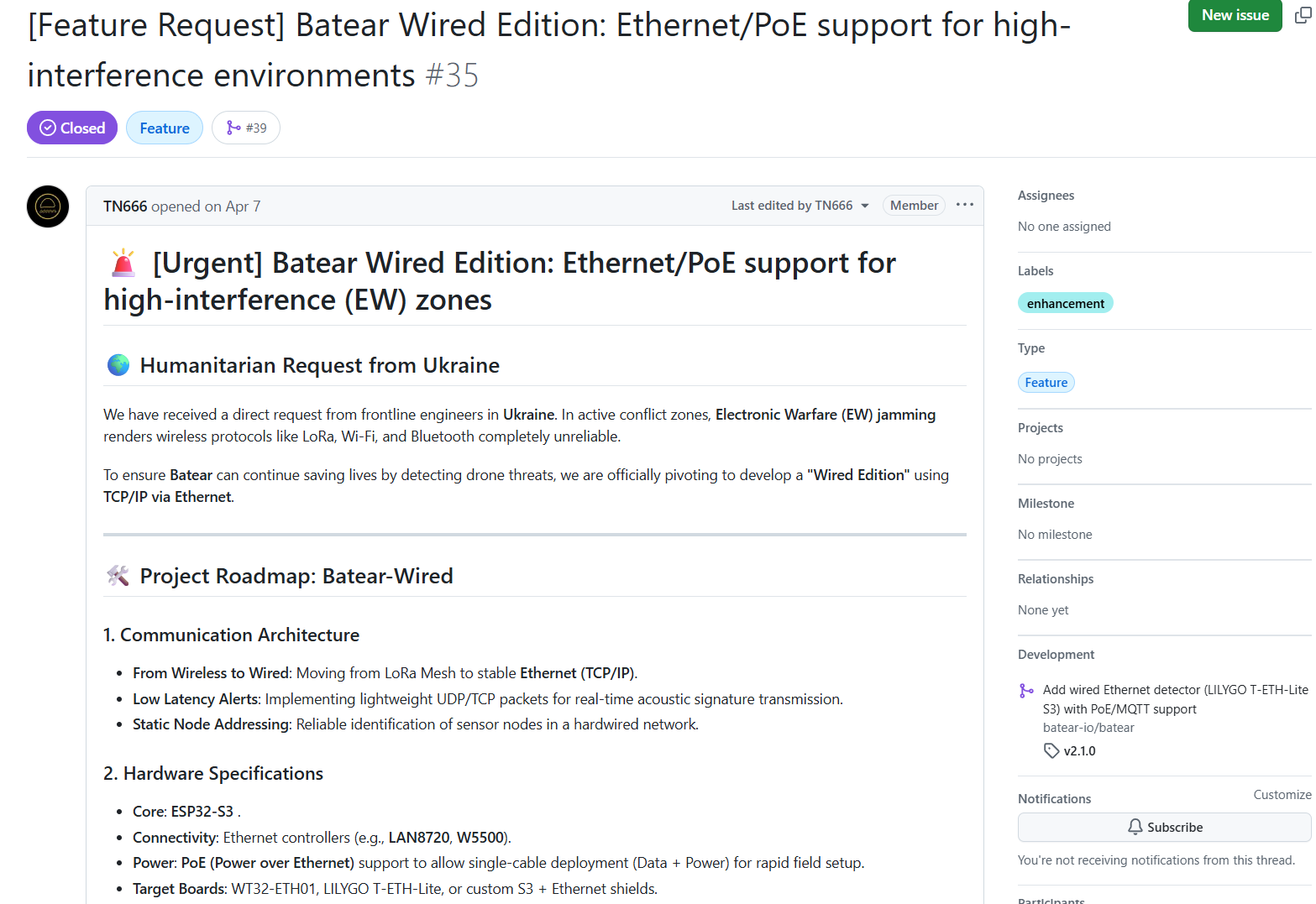
The addition of Ethernet support to Batear was not simply a feature expansion, but a structural transition intended to keep the drone detection system operational even in high-interference environments where wireless communication becomes unreliable.
According to GitHub Issue #35, the Batear project received direct requests from engineers on the front lines in Ukraine, who explained that in actual conflict zones, electronic warfare (EW) jamming can make wireless protocols such as LoRa, Wi-Fi, and Bluetooth completely unstable. To address this problem, Batear moved away from its original LoRa mesh-based architecture and pursued a “Batear Wired Edition” using Ethernet-based TCP/IP communication.
📌 Features
Edge-only Acoustic Detection
Batear does not send audio data to the cloud. Instead, it performs 16 kHz sampling and a 1024-point real FFT directly on the ESP32-S3 to analyze the fundamental frequency and second- and third-order harmonic patterns of drone rotors. The official documentation states that the FFT output provides a resolution of 15.625 Hz per bin.
Dual Deployment Model: Wireless and Wired
The default architecture uses a LoRa Detector to send alerts to a Gateway, which then forwards them to Home Assistant via MQTT. At the same time, the Wired Detector bypasses both LoRa and the Gateway by using W5500 Ethernet to transmit alerts directly through MQTT/JSON.
Home Assistant Integration
Batear supports MQTT auto-discovery, enabling detection events, signal status monitoring, and alarm automation within Home Assistant. Users can configure automations such as lights, sirens, and notifications when drone activity is detected.
Low-cost Open-source Architecture
Official documentation and external articles describe Batear as a low-cost hardware platform in the range of “under $15” or “under $20 per node.” However, the actual bill of materials (BOM) may vary depending on region, board type, microphone selection, and PoE configuration, so these figures should not be interpreted directly as mass-production costs.
Operational Advantages of the Wired Edition
GitHub Issue #35 introduced the need to transition from LoRa/Wi-Fi/Bluetooth to an Ethernet TCP/IP-based Wired Edition, based on requests from Ukrainian field engineers and the realities of RF jamming environments. This represents an important shift toward supporting wired networking and PoE-based field deployment.
📌 System Architecture
Batear is broadly divided into two architectures: a wireless model and a wired model.
1. Wireless Model: LoRa Detector → Gateway → MQTT/Home Assistant
The Detector node collects surrounding audio using an ICS-43434 I2S MEMS microphone and performs FFT-based harmonic analysis on the ESP32-S3. When a drone acoustic pattern is detected, it transmits an AES-128-GCM encrypted LoRa packet to the Gateway. The Gateway receives and decrypts the LoRa packet, then forwards it to Home Assistant as an MQTT message. The official README describes this architecture as a “Detector, Gateway, Home Assistant” workflow.
2. Wired Model: Ethernet/PoE Detector → MQTT/Home Assistant
The Wired Detector does not use LoRa or a Gateway. Instead, it connects directly to the network through the W5500 Ethernet interface on the LILYGO T-ETH-Lite S3 board and sends detection results to a broker or Home Assistant using MQTT/JSON. The GitHub documentation explains that this approach is intended for fixed-installation environments and can use Ethernet with optional PoE power delivery.
📌 Role and Application of the WIZnet's Chip
Technical Reasons for Choosing the W5500
- RF Jamming Resistance
Issue #35 explains that LoRa, Wi-Fi, and Bluetooth may become unreliable in electronic warfare environments, creating the need for a Wired Edition based on Ethernet TCP/IP communication. The W5500 provides the wired Ethernet connectivity required for this purpose. - Reduced MCU Load and Simpler Implementation
Because the W5500 provides a Hardwired TCP/IP architecture, it reduces the burden on the MCU by avoiding the need to process the entire network stack in software. Official WIZnet documentation describes the W5500 as a Hardwired TCP/IP Internet controller connected to an external MCU through SPI at up to 80 MHz. - Suitability for PoE-based Fixed Installations
The Batear Wired Edition is designed for field deployment using Ethernet/PoE, allowing both data and power to be delivered through a single cable. This makes it suitable for environments requiring long-term fixed installation, such as farms, perimeter facilities, industrial sites, and security zones. - Protocol Scalability
Batear builds MQTT, JSON, REST API, and OTA functionality on top of the wired network. The W5500 is well suited for TCP/UDP-based embedded networking, and official WIZnet documentation confirms support for TCP, UDP, IPv4, ICMP, ARP, IGMP, and PPPoE.
📌 Market & Application Value
Applicable Markets
The primary market for Batear is low-cost drone detection and perimeter security. The official website and documentation mention deployment scenarios such as homes, farms, communities, rooftops, and fence lines.
Potential application areas include the following:
| Market | Application Value |
|---|---|
| Farms, livestock facilities, and perimeter security | Deploying multiple low-cost detection nodes to provide drone intrusion alerts |
| Smart factories and industrial complexes | Supplemental detection in camera blind spots or RF-restricted areas |
| Civil security and privacy | Local detection without cloud audio uploads |
| Border security, tactical operations, and disaster response | Potential use as wired detection nodes in RF jamming environments |
| Smart homes and Home Assistant ecosystems | MQTT-based automation and alert integration |
Competitive Positioning Compared to Existing Approaches
Conventional drone detection solutions often rely on radar, RF scanners, camera analytics, or cloud AI-based systems. Rather than directly replacing high-end surveillance equipment, Batear is better positioned as a complementary low-cost distributed sensor node solution. Hackaday noted that the BOM centered around the ESP32-S3 and ICS-43434 microphone could democratize drone detection at a cost of around $15 per node.
https://hackaday.com/2026/03/23/acoustic-drone-detection-on-the-cheap-with-esp32/
📌 External Indicators
| Metric | Observed Information | Assessment |
|---|---|---|
| GitHub Stars | Confirmed at approximately 212–213 stars on the public page as of May 15, 2026 | Shows early interest for an embedded/security maker project (GitHub) |
| GitHub Forks | 25 forks | Indicates potential for reuse and derivative projects (GitHub) |
| GitHub Issues | 2–3 public issues, with Issue #35 marked as closed | Suggests that the Wired Edition request was reflected in actual implementation (GitHub) |
| GitHub Releases | 12 releases, with the latest version v2.2.0 dated May 1, 2026 | Indicates ongoing updates rather than a one-time code release (GitHub) |
| Hackaday | Article published on March 23, 2026 with 18 comments | Demonstrates active discussion within the hardware hacker community (Hackaday) |
| Hackster.io | Featured in the article “The $15 Ear That Listens for Unwanted Drones” | Introduced within the Avnet-affiliated maker community (Hackster) |
| Adafruit Blog | Introduced as a “sub-$15 acoustic drone detector” | Confirms exposure within maker parts and educational communities (Adafruit) |
| Hacker News | Show HN post with 6 points and 2 comments | Received some response from the technical community, though on a limited scale (Hacker News) |
| OSRTOS | Listed as a FreeRTOS/embedded project | Confirms secondary exposure from an RTOS and embedded systems perspective (osrtos.com) |
| YouTube | Bench test demo videos confirmed to exist | View counts, likes, and comments could not be verified from currently available public sources (YouTube) |
📌 WIZnet Strategic Value
1. Expanding the Role of the W5500 from General IoT Connectivity to Field-deployable Security Sensor Networks
The Batear Wired Detector applies the W5500 not merely as a simple HTTP server or TCP example, but as a field-deployable security node that publishes real-time detection events through MQTT. This provides a concrete demonstration within the WIZnet maker ecosystem that “W5500 = reliable wired IoT connectivity.”
2. Highlighting the Strategic Value of Ethernet in RF-Unstable Environments
Issue #35 explicitly states that LoRa, Wi-Fi, and Bluetooth may become unreliable in RF jamming environments and therefore calls for an Ethernet TCP/IP-based Wired Edition. This demonstrates how the WIZnet product family can differentiate itself from wireless solutions in terms of stability, deployment reliability, and PoE-based power integration.
3. A Structure Capable of Expanding from Maker Projects to Industrial PoC
Although Batear initially has the characteristics of a maker-oriented project, the W5500-based Wired Detector moves closer to an industrial-grade proof of concept when combined with PoE, MQTT, REST API, and OTA capabilities. From WIZnet’s perspective, this can serve as a reference platform for “low-cost wired sensor networks” targeting customers in smart factories, perimeter security, agricultural IoT, and public safety sectors.
📌 Summary
Batear is a low-cost ESP32-S3-based acoustic drone detection project that has evolved beyond a simple maker demo into an architecture supporting both LoRa wireless and W5500 Ethernet wired configurations. According to the official documentation, it analyzes the harmonic patterns of drone rotors using FFT on the ESP32-S3 and delivers detection events through either a LoRa Gateway or a W5500 Ethernet/MQTT path.
From the WIZnet perspective, the most important value is that the W5500 has been used as the core networking chip for wired detection nodes in environments affected by RF jamming or unstable wireless communication. The W5500’s Hardwired TCP/IP architecture, 10/100 Ethernet MAC & PHY, TCP/UDP support, and SPI-based MCU connectivity align well with the stable MQTT/REST/OTA structure of the Batear Wired Detector.
📌 FAQ
Q1. What is Batear?
Batear is an open-source acoustic drone detection system that uses an ESP32-S3 and a MEMS microphone to detect drone rotor sounds. It processes signals directly on the MCU without cloud analysis and delivers alerts through LoRa or Ethernet/MQTT.
Q2. What role does the WIZnet W5500 play in Batear?
The W5500 is the core networking chip that provides wired Ethernet connectivity for the ESP32-S3 in the Wired Detector configuration. This enables MQTT/JSON, REST API, and OTA functionality to operate directly over Ethernet without relying on LoRa or Wi-Fi.
Q3. What is novel about this project?
The novelty lies in attempting drone detection using a low-cost MCU and microphone instead of expensive radar or camera systems, while supporting both LoRa-based wireless and W5500 Ethernet-based wired architectures. In particular, the addition of the Wired Edition to address RF jamming environments is significant from the perspective of WIZnet chip utilization.
Q4. Is commercialization possible?
Commercialization potential exists. However, based on currently available public information, aspects such as waterproof housing, environmental durability, certification, long-term false positive rates, and detection range data have not been sufficiently verified. Therefore, at its current stage, it is closer to an open-source proof of concept that could evolve into an industrial wired detection node rather than a finished commercial product.
Q5. Can Batear replace existing drone detection systems?
It would be difficult to consider Batear a direct replacement for high-performance radar or professional RF detection equipment. However, it has complementary value for low-cost distributed detection, blind-spot monitoring, and perimeter alert applications in farms, homes, and facility security.