


ADSBee
ADSBee is an open-source embedded ADS-B receiver that decodes aircraft signals and shares location, altitude, and identification data over a network.

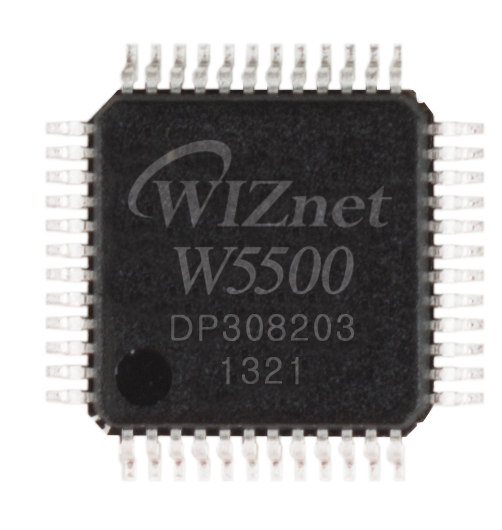
WIZnet - W5500
x 1

📌 Overview
ADSBee는 항공기가 스스로 송출하는 위치 신호(ADS-B)를 수신·해독하여, 항공기 위치·고도·식별 정보를 네트워크로 전달하는 오픈소스 임베디드 ADS-B 수신기 프로젝트입니다.
ADS-B(Automatic Dependent Surveillance–Broadcast)는 항공기가 레이더에 의존하지 않고 자신의 GPS 위치, 고도, 속도, 항공기 식별 정보 등을 1090MHz 무선 신호로 주기적으로 방송(Broadcast) 하는 항공 감시 기술입니다.
이 신호는 지상 관제소뿐 아니라, 적절한 수신 장치를 갖춘 드론·항공기·지상 시스템에서도 직접 수신할 수 있어 항공 교통 감시, 충돌 회피, 항공 데이터 수집에 활용된다.
ADSBee는 이러한 ADS-B 신호(주로 1090MHz)를 RP2040 마이크로컨트롤러의 PIO(State Machine) 만으로 실시간 디코딩하고, 디코딩된 데이터를 ESP32-S3와 WIZnet W5500 기반 Ethernet/Wi-Fi 네트워크를 통해 외부 시스템으로 전송합니다.
그 결과, ADSBee는 PC나 SDR 장비 없이도 동작하는 소형·저전력·상시 운용 가능한 네트워크형 ADS-B 수신기를 구현하며, 드론 충돌 회피 보조, 고정형 항공기 수신 노드, 항공 데이터 수집 인프라 등으로 확장 가능한 구조를 제공합니다.
📌 Background
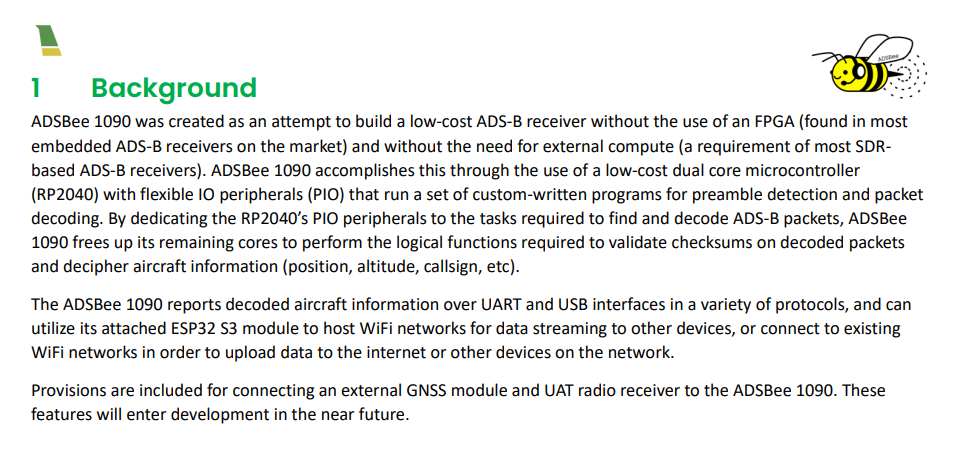
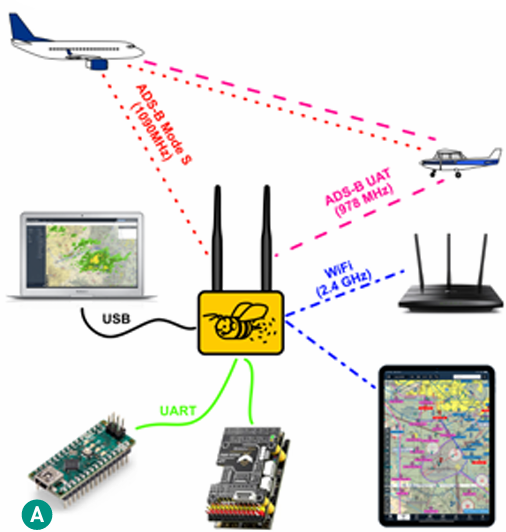
출처 : https://pantsforbirds.com/wp-content/uploads/2024/10/datasheet_adsbee_1090.pdf
ADSBee 1090은 복잡하고 비싼 기존 ADS-B 수신기를 더 단순하고 저렴하게 만들기 위해 시작된 프로젝트입니다.
기존의 ADS-B 수신기는 FPGA를 사용한 고가 장비이거나, SDR과 PC 같은 외부 컴퓨팅 장치가 함께 필요해 설치와 운용이 어렵다는 한계가 있었습니다. ADSBee 1090은 이러한 문제를 해결하기 위해 FPGA와 외부 컴퓨터 없이도 동작하는 임베디드 ADS-B 수신기를 목표로 설계되었습니다.
RP2040 마이크로컨트롤러의 PIO 기능을 활용해 ADS-B 신호의 프리앰블 검출과 디코딩을 실시간으로 처리하고, 다른 코어는 항공기 정보 해석과 데이터 정리에 집중하도록 역할을 분리했습니다. 디코딩된 항공기 정보는 USB나 UART로 바로 출력되거나, 보드에 포함된 ESP32-S3를 통해 Wi-Fi 네트워크로 전송할 수 있어 별도의 장비 없이도 항공 데이터 스트리밍이 가능합니다.
📌 Development Process
개발 과정은 블로그를 통해 거의 매달 업데이트되고 있었습니다.
2024.12 - W5500 Lite 모듈과 연결 지원
https://pantsforbirds.com/adsbee-1090-december-update/
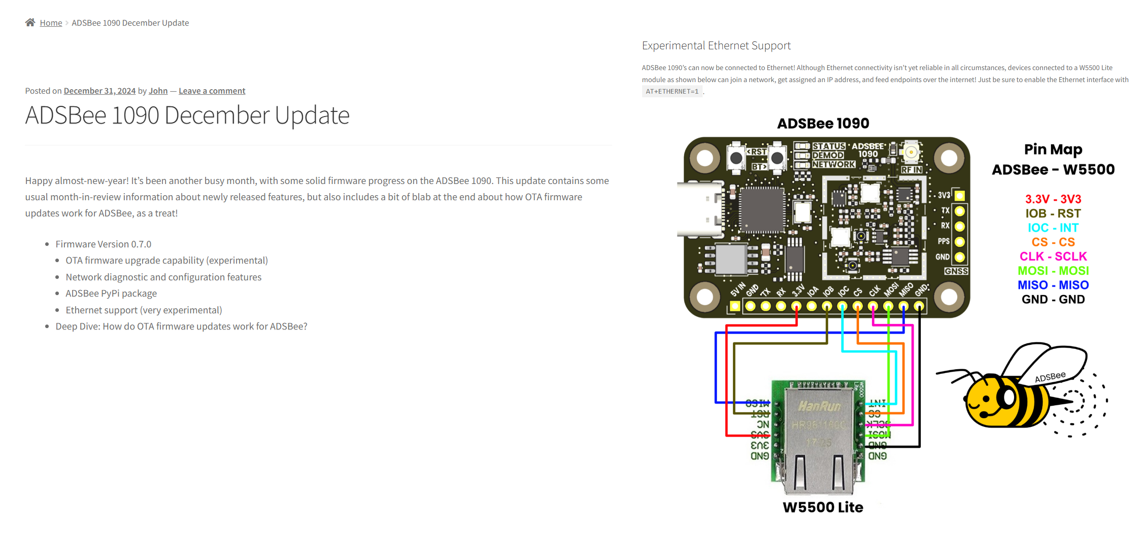
2024년 12월 업데이트에서는 ADSBee 1090에 W5500 Lite Ethernet 모듈을 연결할 수 있는 기능이 추가되었습니다.
이를 통해 기존 Wi-Fi 기반 데이터 전송 방식 외에 유선 LAN을 통한 네트워크 연결이 가능해졌습니다. 해당 시점의 Ethernet 기능은 초기 단계로, 실제 적용 가능성을 검증하기 위한 성격이 강합니다.
2025.05 - ADSBee PoE pant 출시
https://pantsforbirds.com/adsbee-1090-may-2025-update/
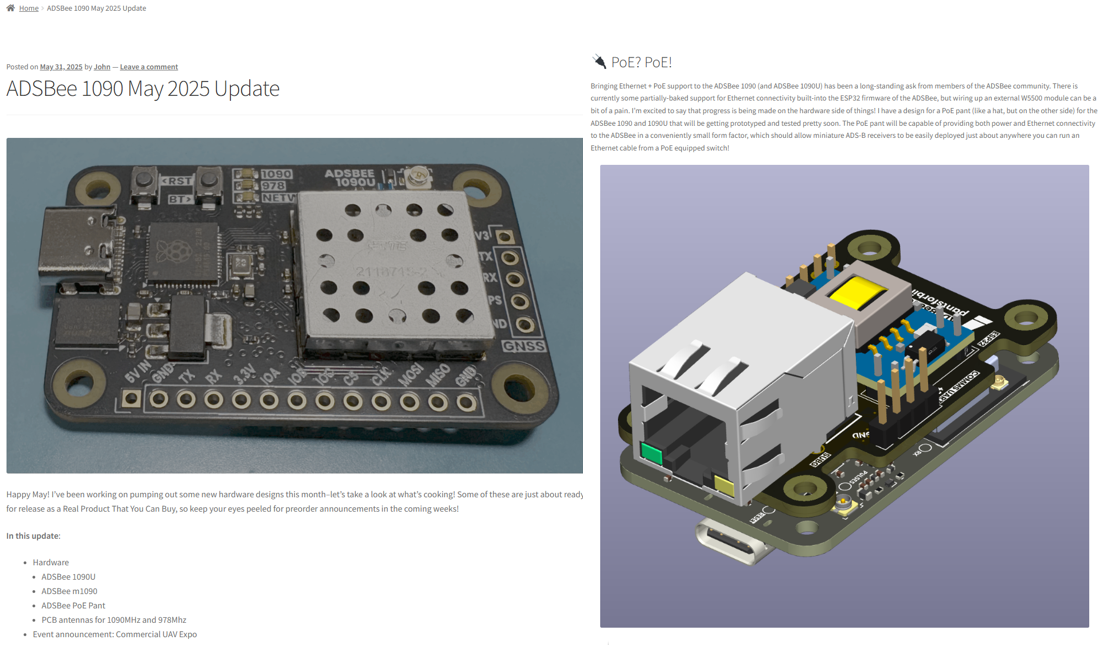
2025년 5월에는 ADSBee PoE Pant 확장 보드가 공개되었습니다.
PoE Pant는 Ethernet 연결과 전력 공급을 하나의 케이블로 제공하는 구조로, 외부 전원 어댑터 없이 PoE 환경에서 장치를 구동할 수 있도록 설계되었습니다. 이를 통해 고정 설치 환경에서의 배선 복잡도가 줄어들었습니다.
2025.08 - ADSBee GS3M PoE 출시
https://pantsforbirds.com/adsbee-1090-august-2025-update/
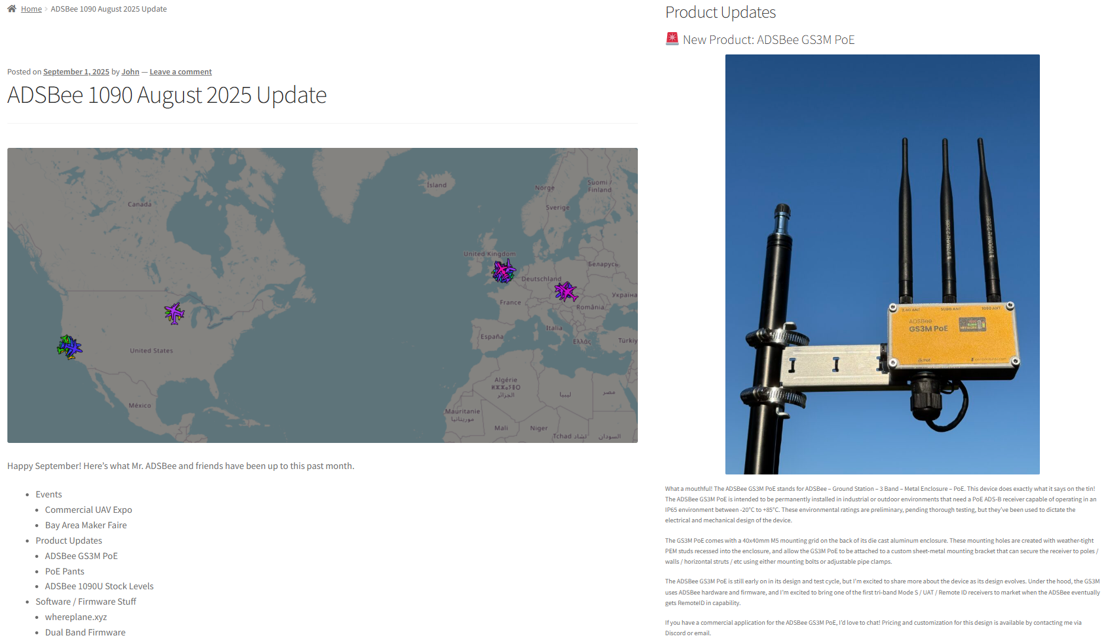
2025년 8월 업데이트에서는 ADSBee GS3M PoE 모델이 출시되었습니다.
ADSBee GS3M PoE는 기존 PoE Pant 개념을 기반으로 한 PoE 전용 수신기 형태의 하드웨어 구성으로,
전원과 네트워크를 PoE로 통합한 설치를 전제로 합니다. 이 단계에서 ADSBee는 실험적 확장을 넘어 구성 완성도를 높이는 방향으로 발전하고 있음을 확인할 수 있습니다.
2025.11 - ADSBee GS3M PoE 테스트
https://pantsforbirds.com/adsbee-1090-november-2025-update/
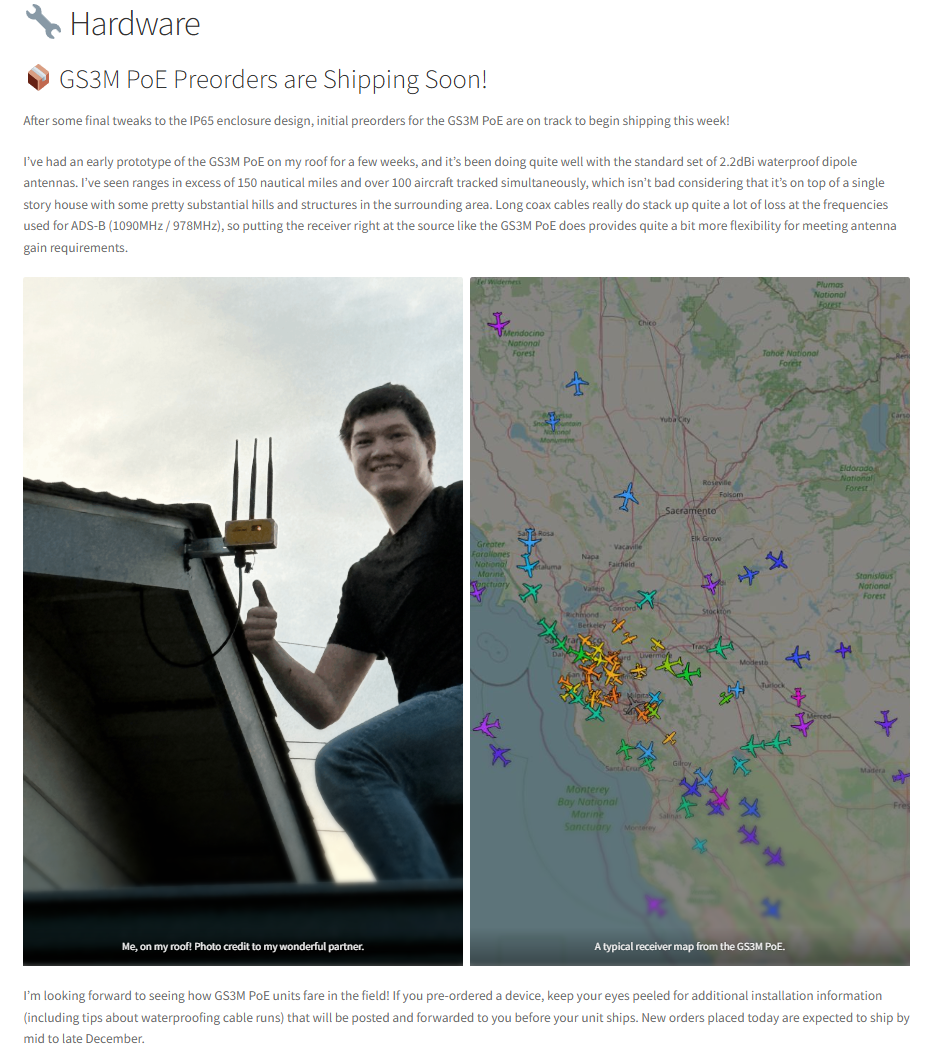
2025년 11월에는 ADSBee GS3M PoE를 실제 설치 환경에 배치한 테스트 결과가 공유되었습니다.
실외 설치 후 100대 이상의 항공기 신호 수신, 네트워크 연결 상태, 장시간 동작 여부 등이 확인되었으며, 개발 보드 수준을 넘어 실사용 환경에서의 운용 가능성 검증 단계에 진입했음을 보여줍니다.
📌 Product
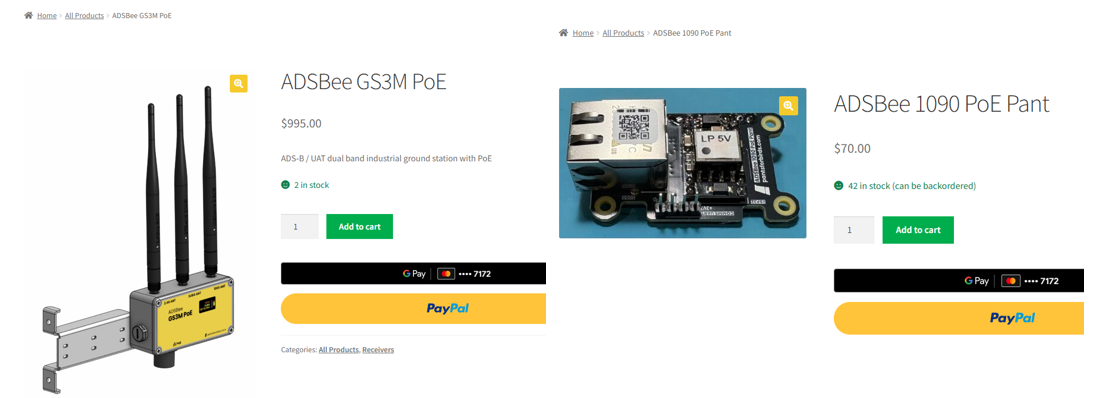
ADSBee GS3M PoE : https://pantsforbirds.com/product/adsbee-gs3m-poe/
ADSBee 1090 PoE Pant : https://pantsforbirds.com/product/adsbee-1090-poe-pant/
📌 Features
FPGA 없는 ADS-B 실시간 디코딩
- RP2040 PIO로 프리앰블 검출 및 Manchester 디코딩 수행
- 저전력·저비용 구조
이중 MCU 역할 분담 구조
- RP2040: RF 신호 디코딩 및 메시지 생성
- ESP32-S3: 네트워크 및 시스템 관리
Ethernet 확장 지원 (WIZnet W5500)
- Wi-Fi에 의존하지 않는 유선 LAN 연결
- 고정 설치·상시 운용에 적합
📌 System Architecture
RF Frontend(1090MHz)
- SAW 필터/LNA/로그 파워디텍터 등으로 ADS-B 파형을 증폭·정형 후, 비교기(Comparator)로 디지털 펄스열 생성 → RP2040 PIO 입력.
- PWM 기반 바이어스 조정으로 비교기 임계값을 조절해 수신 민감도를 튜닝(혼잡 환경에서 강신호 위주/최대 감도 등).
MCU/무선/네트워크 블록
- RP2040(메인 디코더): PIO로 1090MHz ADS-B/Mode S 디코딩, 장치 전체 펌웨어/업데이트 허브 역할.
- CC1312(서브GHz 수신, 옵션/듀얼밴드): 978MHz UAT 등 서브GHz 프로토콜 수신을 목표로 하며, 메시지를 SPI로 RP2040에 전달.
- ESP32-S3(네트워크 기능): RP2040에서 받은 패킷을 받아 Wi-Fi/이더넷(옵션)으로 외부에 제공하는 네트워크 허브.
데이터 흐름(요약)
항공기 트래스폰더(1090MHz/978MHz) → RF Frontend/Comparator → RP2040 PIO 디코딩 → 내부 프로토콜 변환/딕셔너리 유지→ 출력(USB/UART/Wi-Fi, 옵션 Ethernet) → 드론/앱/서버/온라인 DB로 전달
📌 Role and Application of the WIZnet's Chip
ADSBee 에는 WIZnet의 Ethernet 컨트롤러 W5500이 사용됩니다. W5500은 보드에 탑재된 ESP32-S3와 SPI 인터페이스로 연결할 수 있으며, 유선 Ethernet 통신을 담당하는 네트워크 인터페이스 역할을 수행합니다.
ADSBee 의 전체 구조에서 RP2040은 ADS-B 신호의 실시간 디코딩을 담당하고, ESP32-S3는 네트워크 및 시스템 제어를 담당합니다. 이 중 W5500은 ESP32-S3가 처리한 항공기 데이터를 Ethernet을 통해 외부 네트워크로 전달하는 역할을 맡습니다.
W5500을 사용함으로써 ADSBee는 Wi-Fi 환경에 의존하지 않고 유선 LAN 기반으로 안정적인 데이터 전송이 가능해졌으며, PoE 확장 구성과 결합해 장시간 상시 운용되는 고정형 수신기로 활용할 수 있는 기반을 갖추게 되었습니다.
📌 Market & Application Value
적용 산업/시장
- UAV/드론: ADS-B IN 기반 충돌 회피, 지상국 수신기 연동(MAVLink 출력 등).
- 항공 취미/교육/연구: 저비용 오픈소스 수신기로 항공 데이터 기반 프로젝트(시각화/통계/교육용 실습).
- 온라인 항공기 트래킹/데이터 수집
제품화/서비스 확장 가능성
- 단일 보드(1090U, m1090 모듈, PoE 기반 GS3M 등)로 라인업을 확장하고, 베타 테스터/현장 배포 사례를 언급합니다.
📌 External Indicators
Blog
- 월간 업데이트 및 2025 연간 리뷰
- ADSBee PoE pant, ADSBee m1090, ADSBee GS3M PoE 등 제품화 진행과 기능 확장 기록
- https://pantsforbirds.com/adsbee-1090/
Github
- Star 182 / Fork 21 / Issues 15
- 공개 저장소 기준 커뮤니티 반응이 꾸준한 편
- https://github.com/CoolNamesAllTaken/adsbee
Maker Faire
- 전시/프로젝트 등재 + Ribbon Recipient(수상) 표기
- https://makerfaire.com/maker/entry/77202/
- https://makerfaire.com/yearbook/projects/adsbee1090%3Aopensourceembeddedads-breceiver-2025/
Community
- PX4 포럼에서 베타테스터 모집
- https://discuss.px4.io/t/help-me-test-an-open-source-ads-b-receiver-adsbee-1090/43292
미디어/행사

- 2025년 회고에서 “Make Magazine에 소개”, UAV Expo ‘Pitch the Press’ 수상 등 언급
- https://pantsforbirds.com/adsbee-1090-december-2025-update/
- https://www.expouav.com/defendeye-pants-for-birds-and-skyline-nav-ai-win-pitch-the-press-at-commercial-uav-expo-2025/
Hackaday
- 2026년 1월 7일 게시, 댓글 34개
- https://hackaday.com/2026/01/07/an-rp2040-powered-ads-b-receiver/
Youtube
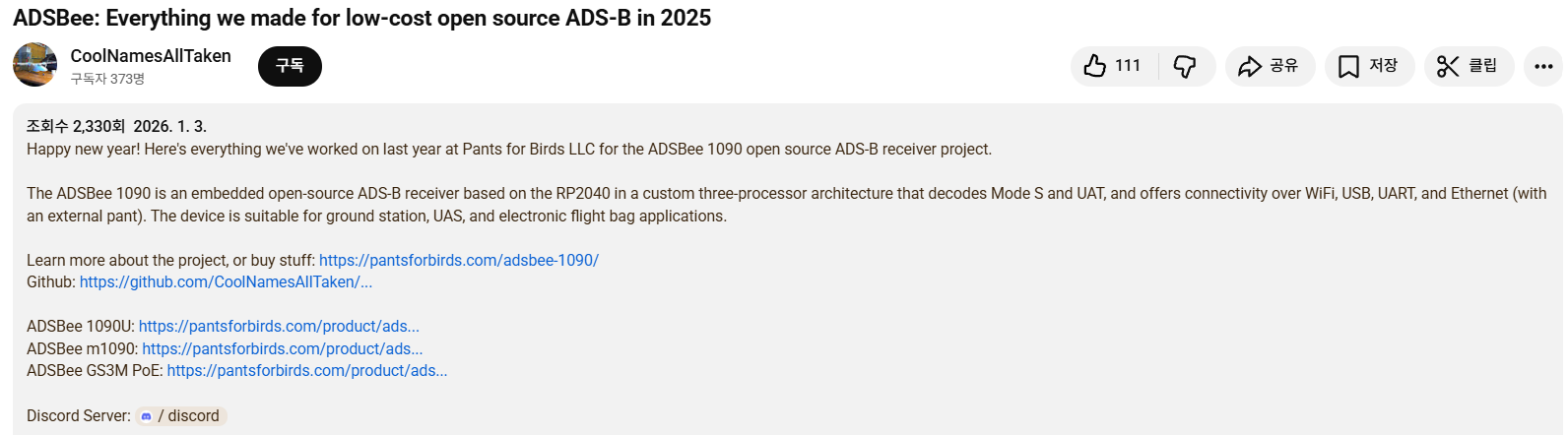
- 2026년 1월 3일 게시, 조회수 2.3천회, 댓글 24개
- https://www.youtube.com/watch?v=6ckqEnRU9_w
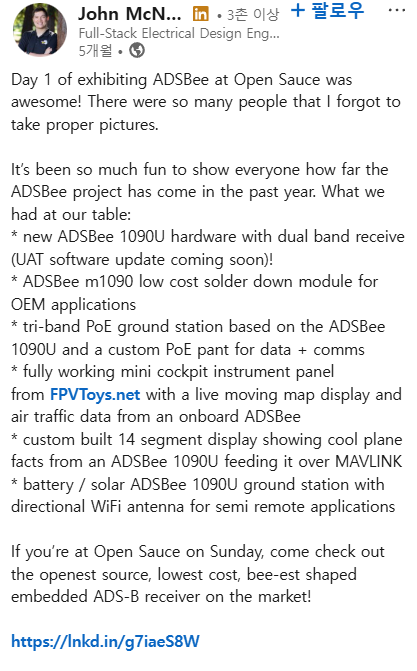
- 좋아요 64개, 댓글 2개
- https://www.linkedin.com/posts/john-mcnelly_day-1-of-exhibiting-adsbee-at-open-sauce-activity-7352586704416858112-FVwv/
📌 WIZnet Strategic Value
ADSBee WIZnet Ethernet 칩이 실제 동작하는 임베디드 항공 데이터 수집 시스템에 적용된 사례라는 점에서 의미가 있습니다.
특히 Wi-Fi 중심으로 시작한 프로젝트가 개발 과정에서 W5500 기반 Ethernet 및 PoE 구조로 확장되었다는 점은 현장 설치형 임베디드 장치에서 유선 네트워크의 필요성이 자연스럽게 드러난 사례로 볼 수 있습니다.
ADSBee는 단순한 데모나 실험 수준을 넘어 장시간 상시 운용을 전제로 한 네트워크 노드로 발전하고 있으며, 이 과정에서 W5500이 안정적인 유선 통신을 담당하는 역할을 수행하고 있습니다. 이는 W5500이 산업·인프라 환경에서 요구되는 연속 동작, 네트워크 안정성, 단순한 시스템 구성에 적합함을 보여줍니다.
또한 ADSBee 의 구조는 고속 RF 데이터 처리(RP2040)와 네트워크 처리(ESP32-S3 + W5500)를 분리한 형태로, 향후 센서 노드, 원격 모니터링 장치, 데이터 수집 장비 등 다른 임베디드 네트워크 시스템에도 그대로 적용할 수 있는 구조적 참고 사례가 됩니다.
결과적으로 ADSBee은 WIZnet Maker 생태계에서 **Wi-Fi만으로는 한계에 도달한 프로젝트가 Ethernet 기반으로 확장되는 실제 경로**를 보여주는 사례이며, W5500의 활용 가능성을 항공·드론·고신뢰 데이터 수집 분야까지 확장해 설명할 수 있는 근거를 제공하고 있습니다.
📌 Summary
ADSBee 는 RP2040(PIO 디코딩) + ESP32-S3(네트워크 처리) + WIZnet W5500(Ethernet)이라는 명확한 역할 분담 구조를 가진 고완성도 오픈소스 ADS-B 수신기입니다.
이는 WIZnet 칩이 실제 항공 데이터 수집 인프라에 채택된 신뢰도 높은 사례임을 보여줍니다.
📌 QnA
Q1. ADSBee 1090이란 무엇인가요?
A: ADSBee 1090은 항공기가 송신하는 1090 MHz ADS-B(Automatic Dependent Surveillance–Broadcast) 신호를 수신·해독하는 오픈소스 임베디드 ADS-B 수신기 프로젝트입니다. SDR 동글 없이도 동작하도록 설계되었으며, 소형 MCU 기반 하드웨어와 전용 RF 프론트엔드를 사용해 저전력·저비용으로 항공기 위치 데이터를 수집합니다.
Q2. ADSBee 1090은 어떤 문제를 해결하나요?
A: 기존 ADS-B 수신은 PC + SDR 조합에 의존해 전력 소모와 설치 복잡도가 컸습니다. ADSBee 1090은 독립형 임베디드 수신기로 설계되어, 장시간 연속 운용이 가능하고, 옥외 설치나 원격 위치 배치에 적합합니다. 이는 개인 항공 추적, 교육, 연구, 메이커 프로젝트에 특히 유용합니다.
Q3. ADSBee 1090의 하드웨어 아키텍처 특징은 무엇인가요?
A: 프로젝트는 1090 MHz RF 프론트엔드 + MCU 기반 디지털 처리부 구조를 채택합니다. RF 단에서 항공기 ADS-B 신호를 수신·증폭·필터링한 뒤, MCU에서 Mode S/ADS-B 프레임 디코딩을 수행합니다. 이 구조는 SDR 대비 BOM 비용을 낮추고, 펌웨어 최적화를 통해 실시간 처리 성능을 확보합니다.
Q4. ADSBee 1090은 어떤 소프트웨어 스택을 사용하나요?
A: ADSBee 1090 펌웨어는 임베디드 C/C++ 기반으로 작성되며, ADS-B 프레임 파싱, CRC 검사, 메시지 디코딩을 MCU 단에서 직접 처리합니다. GitHub 저장소에서는 RF 샘플 처리, 프레임 동기화, 메시지 출력 로직이 명확히 분리된 구조를 확인할 수 있어, 교육·연구용으로 분석하기에 적합합니다.
Q5. ADSBee 1090 프로젝트는 현재 어떤 방향으로 발전하고 있나요?
A: 2025년 월별 업데이트에 따르면, 프로젝트는 수신 감도 개선, RF 안정성 향상, 펌웨어 최적화, 장시간 운용 안정성에 초점을 맞추고 있습니다. 특히 실제 운용 환경에서의 테스트 결과를 바탕으로 회로·안테나·펌웨어가 반복적으로 개선되고 있어, 단순 데모가 아닌 실사용 가능한 오픈소스 수신기를 목표로 합니다.
Q6. ADSBee 1090은 어떤 사용자에게 적합한가요?
A: 이 프로젝트는 항공 데이터에 관심 있는 메이커, RF·임베디드 학습자, 대학·연구소, 개인 ADS-B 수신 스테이션 구축자에게 적합합니다. SDR과 리눅스 환경에 대한 깊은 지식 없이도 ADS-B 시스템 전체 흐름(RF → 디코딩 → 데이터 활용)을 이해할 수 있다는 점이 큰 장점입니다.
Q7. ADSBee 1090은 상용 ADS-B 수신기와 비교해 어떤 차이가 있나요?
A: 상용 제품은 완성도와 지원이 강점이지만 내부 구조가 폐쇄적입니다. ADSBee 1090은 회로·펌웨어·알고리즘이 모두 공개되어 있어, 사용자가 직접 수정·확장할 수 있습니다. 이는 교육·연구·커스텀 응용 측면에서 상용 장비보다 훨씬 높은 자유도를 제공합니다.
Q8. ADSBee 1090 프로젝트의 활용 사례는 무엇인가요?
A: 개인 항공기 추적 스테이션 구축, 항공 교통 데이터 시각화, RF 신호 처리 교육, Maker Faire 전시, 오픈소스 항공 감시 프로젝트 연계 등으로 활용되고 있습니다. Maker Faire와 공개 영상 사례는 이 프로젝트가 실제 동작하는 하드웨어 기반 오픈소스 프로젝트임을 보여줍니다.
📌 Reference Link
https://github.com/CoolNamesAllTaken/adsbee
📌 Overview
ADS-B (Automatic Dependent Surveillance–Broadcast) is an air surveillance technology in which aircraft periodically broadcast their GPS position, altitude, speed, and aircraft identification information via 1090 MHz radio signals without relying on radar. These signals can be received not only by ground control stations but also directly by drones, aircraft, and ground systems equipped with appropriate receivers, enabling applications such as air traffic monitoring, collision avoidance, and aviation data collection.
ADSBee decodes these ADS-B signals (primarily 1090 MHz) in real time using only the PIO (State Machine) of the RP2040 microcontroller, and transmits the decoded data to external systems via Ethernet/Wi-Fi networks based on the ESP32-S3 and WIZnet W5500.
As a result, ADSBee implements a compact, low-power, always-on, network-based ADS-B receiver that operates without a PC or SDR equipment, and provides an extensible architecture suitable for applications such as drone collision avoidance assistance, fixed aircraft reception nodes, and aviation data collection infrastructure.
📌 Background
Reference: https://pantsforbirds.com/wp-content/uploads/2024/10/datasheet_adsbee_1090.pdf
ADSBee 1090 is a project that was initiated to make complex and expensive conventional ADS-B receivers simpler and more affordable.
Traditional ADS-B receivers are either costly devices based on FPGAs or require external computing equipment such as SDRs and PCs, making installation and operation difficult. ADSBee 1090 was designed to address these limitations, with the goal of creating an embedded ADS-B receiver that operates without an FPGA or an external computer.
By leveraging the PIO feature of the RP2040 microcontroller, ADSBee 1090 performs real-time ADS-B signal preamble detection and decoding, while the other core is dedicated to aircraft information interpretation and data processing. The decoded aircraft data can be output directly via USB or UART, or transmitted over a Wi-Fi network through the onboard ESP32-S3, enabling aviation data streaming without the need for additional equipment.
📌 Development Process
The development process was updated on the blog almost every month.
December 2024 – Support for connection with the W5500 Lite module
https://pantsforbirds.com/adsbee-1090-december-update/
In the December 2024 update, support was added to ADSBee 1090 for connecting the W5500 Lite Ethernet module.
This enabled network connectivity over wired LAN in addition to the existing Wi-Fi–based data transmission method. At that stage, the Ethernet functionality was in an early phase and was primarily intended to validate practical applicability.
May 2025 – Release of the ADSBee PoE pant
https://pantsforbirds.com/adsbee-1090-may-2025-update/
In May 2025, the ADSBee PoE Pant expansion board was released.
The PoE Pant is designed to provide both Ethernet connectivity and power supply through a single cable, allowing the device to operate in a PoE environment without an external power adapter. This reduces wiring complexity in fixed installation environments.
August 2025 – Release of ADSBee GS3M PoE
https://pantsforbirds.com/adsbee-1090-august-2025-update/
In the August 2025 update, the ADSBee GS3M PoE model was released.
ADSBee GS3M PoE features a hardware configuration in the form of a PoE-dedicated receiver based on the existing PoE Pant concept, and is designed for installations that integrate both power and networking via PoE. At this stage, ADSBee can be seen as evolving beyond experimental expansion toward a more complete and mature system configuration.
November 2025 – ADSBee GS3M PoE testing
https://pantsforbirds.com/adsbee-1090-november-2025-update/
In November 2025, test results from deploying ADSBee GS3M PoE in a real installation environment were shared.
After outdoor installation, reception of signals from more than 100 aircraft, network connectivity status, and long-term operation were verified, demonstrating that the project had moved beyond a development board stage and entered a phase of validating operability in real-world usage environments.
📌 Product
ADSBee GS3M PoE : https://pantsforbirds.com/product/adsbee-gs3m-poe/
ADSBee 1090 PoE Pant : https://pantsforbirds.com/product/adsbee-1090-poe-pant/
📌 Features
FPGA-less real-time ADS-B decoding
- Preamble detection and Manchester decoding performed using RP2040 PIO
- Low-power, low-cost architecture
Dual-MCU role separation architecture
- RP2040: RF signal decoding and message generation
- ESP32-S3: Network and system management
Ethernet expansion support (WIZnet W5500)
- Wired LAN connectivity without reliance on Wi-Fi
- Suitable for fixed installation and always-on operation
📌 System Architecture
RF Frontend(1090MHz)
- ADS-B waveforms are amplified and shaped using components such as SAW filters, LNAs, and logarithmic power detectors, then converted into a digital pulse stream via a comparator and fed into the RP2040 PIO input.
- The comparator threshold is adjusted using PWM-based bias control to tune reception sensitivity (e.g., prioritizing strong signals in congested environments or maximizing sensitivity).
MCU / Wireless / Network Blocks
- RP2040 (main decoder): Performs 1090 MHz ADS-B / Mode S decoding using PIO and serves as the firmware and update hub for the entire device.
- CC1312 (sub-GHz receiver, optional / dual-band): Targets reception of sub-GHz protocols such as 978 MHz UAT and delivers messages to the RP2040 via SPI.
- ESP32-S3 (network functions): Acts as a network hub that receives packets from the RP2040 and provides them externally via Wi-Fi or Ethernet (optional).
Data Flow (Summary)
Aircraft transponder (1090 MHz / 978 MHz) → RF frontend / comparator → RP2040 PIO decoding → internal protocol conversion / dictionary maintenance → output (USB / UART / Wi-Fi, optional Ethernet) → delivery to drones, applications, servers, or online databases
📌 Role and Application of the WIZnet's Chip
ADSBee uses WIZnet’s Ethernet controller, the W5500. The W5500 can be connected to the onboard ESP32-S3 via an SPI interface and serves as the network interface responsible for wired Ethernet communication.
In the overall ADSBee architecture, the RP2040 handles real-time decoding of ADS-B signals, while the ESP32-S3 is responsible for network and system control. Within this structure, the W5500 plays the role of delivering aircraft data processed by the ESP32-S3 to external networks via Ethernet.
By using the W5500, ADSBee is no longer dependent on a Wi-Fi environment and can achieve stable data transmission over wired LAN. When combined with a PoE expansion configuration, this enables ADSBee to function as a fixed receiver suitable for long-term, always-on operation.
📌 Market & Application Value
Target industries / markets
- UAV / drones: ADS-B IN–based collision avoidance and integration with ground station receivers (e.g., MAVLink output).
- Aviation hobby, education, and research: Aviation data–driven projects (visualization, statistics, hands-on educational exercises) using low-cost open-source receivers.
- Online aircraft tracking and data collection.
Productization / service expansion potential
- Expanding the lineup with single-board solutions (such as 1090U, m1090 modules, and PoE-based GS3M), and referencing beta tester programs and field deployment cases.
📌 External Indicators
Blog
- Monthly updates and the 2025 annual review
- Records of productization progress and feature expansion, including ADSBee PoE Pant, ADSBee m1090, and ADSBee GS3M PoE
- https://pantsforbirds.com/adsbee-1090/
Github
- Stars: 182 / Forks: 21 / Issues: 15
- Steady community engagement based on the public repository
- https://github.com/CoolNamesAllTaken/adsbee
Maker Faire
- Exhibition / project listing + Ribbon Recipient (award) designation
- https://makerfaire.com/maker/entry/77202/
- https://makerfaire.com/yearbook/projects/adsbee1090%3Aopensourceembeddedads-breceiver-2025/
Community
- Recruiting beta testers on the PX4 forum
- https://discuss.px4.io/t/help-me-test-an-open-source-ads-b-receiver-adsbee-1090/43292
Media / Events
- Mentioned in the 2025 retrospective, including being featured in Make Magazine and winning UAV Expo’s “Pitch the Press” award
- https://pantsforbirds.com/adsbee-1090-december-2025-update/
- https://www.expouav.com/defendeye-pants-for-birds-and-skyline-nav-ai-win-pitch-the-press-at-commercial-uav-expo-2025/
Hackaday
- Posted on January 7, 2026, with 34 comments
- https://hackaday.com/2026/01/07/an-rp2040-powered-ads-b-receiver/
Youtube
- Posted on January 3, 2026, with 2.3k views and 24 comments
- https://www.youtube.com/watch?v=6ckqEnRU9_w
- 64 likes, 2 comments
- https://www.linkedin.com/posts/john-mcnelly_day-1-of-exhibiting-adsbee-at-open-sauce-activity-7352586704416858112-FVwv/
📌 WIZnet Strategic Value
ADSBee is significant as a real-world example in which a WIZnet Ethernet chip is applied to an embedded aviation data collection system that operates in practice.
In particular, the fact that a project that initially centered on Wi-Fi expanded during development to a W5500-based Ethernet and PoE architecture can be seen as a natural illustration of the need for wired networks in field-installed embedded devices.
ADSBee has evolved beyond a simple demo or experimental level into a network node designed for long-term, always-on operation, with the W5500 playing the role of providing stable wired communication throughout this process. This demonstrates that the W5500 is well suited to the continuous operation, network reliability, and simple system configuration required in industrial and infrastructure environments.
In addition, the ADSBee architecture separates high-speed RF data processing (RP2040) from network processing (ESP32-S3 + W5500), making it a valuable structural reference that can be directly applied to other embedded network systems such as sensor nodes, remote monitoring devices, and data collection equipment.
Ultimately, ADSBee serves as an example within the WIZnet Maker ecosystem that shows a real development path in which a project that reached the limits of Wi-Fi expands to an Ethernet-based architecture, and provides concrete grounds for explaining the applicability of the W5500 to aviation, drone, and high-reliability data collection domains.
📌 Summary
ADSBee is a highly complete open-source ADS-B receiver with a clear role separation architecture consisting of the RP2040 (PIO decoding), ESP32-S3 (network processing), and WIZnet W5500 (Ethernet).
This demonstrates that WIZnet chips have been adopted in a reliable, real-world aviation data collection infrastructure.
📌 QnA
Q1. What is ADSBee 1090?
A: ADSBee 1090 is an open-source embedded ADS-B receiver project that receives and decodes 1090 MHz ADS-B (Automatic Dependent Surveillance–Broadcast) signals transmitted by aircraft. It is designed to operate without an SDR dongle, using compact MCU-based hardware and a dedicated RF frontend to collect aircraft position data with low power consumption and low cost.
Q2. What problem does ADSBee 1090 solve?
A: Traditional ADS-B reception relies on a PC + SDR combination, which results in high power consumption and installation complexity. ADSBee 1090 is designed as a standalone embedded receiver, enabling long-term continuous operation and making it suitable for outdoor installations or deployment in remote locations. This makes it particularly useful for personal aircraft tracking, education, research, and maker projects.
Q3. What are the key hardware architecture features of ADSBee 1090?
A: The project adopts a structure consisting of a 1090 MHz RF frontend and an MCU-based digital processing unit. ADS-B signals are received, amplified, and filtered at the RF stage, after which the MCU performs Mode S / ADS-B frame decoding. Compared to SDR-based approaches, this structure reduces BOM cost and achieves real-time processing performance through firmware optimization.
Q4. What software stack does ADSBee 1090 use?
A: The ADSBee 1090 firmware is written in embedded C/C++ and directly handles ADS-B frame parsing, CRC checking, and message decoding on the MCU. The GitHub repository shows a clearly separated structure for RF sample processing, frame synchronization, and message output logic, making it well suited for educational and research analysis.
Q5. In what direction is the ADSBee 1090 project currently evolving?
A: According to the monthly updates in 2025, the project is focusing on improving reception sensitivity, enhancing RF stability, optimizing firmware, and ensuring long-term operational stability. In particular, circuits, antennas, and firmware are being iteratively improved based on real-world deployment test results, aiming to become a practical open-source receiver rather than a simple demo.
Q6. Who is ADSBee 1090 suitable for?
A: This project is suitable for makers interested in aviation data, RF and embedded systems learners, universities and research institutes, and individuals building personal ADS-B receiving stations. A major advantage is that it allows users to understand the entire ADS-B system flow (RF → decoding → data utilization) without requiring deep knowledge of SDRs or Linux environments.
Q7. How does ADSBee 1090 differ from commercial ADS-B receivers?
A: Commercial products offer high completeness and strong support, but their internal structures are closed. ADSBee 1090, on the other hand, is fully open in terms of hardware, firmware, and algorithms, allowing users to modify and extend it freely. This provides far greater flexibility than commercial equipment for education, research, and custom applications.
Q8. What are the use cases of the ADSBee 1090 project?
A: It is used for building personal aircraft tracking stations, aviation traffic data visualization, RF signal processing education, Maker Faire exhibitions, and integration with open-source aviation surveillance projects. Maker Faire and publicly available video examples demonstrate that this is a real, working, hardware-based open-source project.
📌 Reference Link
https://github.com/CoolNamesAllTaken/adsbee