---
title: "diagrams"
url: "https://maker.wiznet.io/TheoIm/projects/diagrams/"
markdown_url: "https://maker.wiznet.io/TheoIm/projects/diagrams/md"
type: "UCC: User Created Content"
author: "usini"
author_url: "https://github.com/usini/diagrams"
editor: "WIZnet"
editor_url: "https://maker.wiznet.io/"
original_author: "usini"
original_url: "https://github.com/usini/diagrams"
published: "2026-03-20"
language: "en"
hardware: ["WIZnet WIZ550io"]
likes: 0
views: 474
comments: 0
source: "WIZnet Makers (https://maker.wiznet.io/)"
---
# diagrams
> By analyzing WIZ550io schematics, this project reconstructs a hardware TCP/IP offload architecture over SPI, enabling deterministic, low-overhead ethernet.
Original author: usini (source: https://github.com/usini/diagrams)
## Components
- **WIZnet WIZ550io** x 1 ([docs](https://docs.wiznet.io/Product/ioModule/wiz550io))
## Article
## What the Project Does
This repository is fundamentally a **hardware visualization library**, not an embedded system. It generates a Markdown gallery from SVG assets, meaning:
No MCU firmware exists
No runtime communication stack exists
No actual networking logic is executed
However, the **important signal is hidden in the hardware abstraction**:
The file:
```plaintext
Communication/ethernet_WIZ550io_ver1_0.svg
```
represents a **fully integrated Ethernet module (WIZ550io)**, which includes:
W5500 Ethernet controller
Internal PHY
Magnetics
RJ45 connector
This is not just a drawing — it encodes a **canonical embedded Ethernet architecture pattern**:
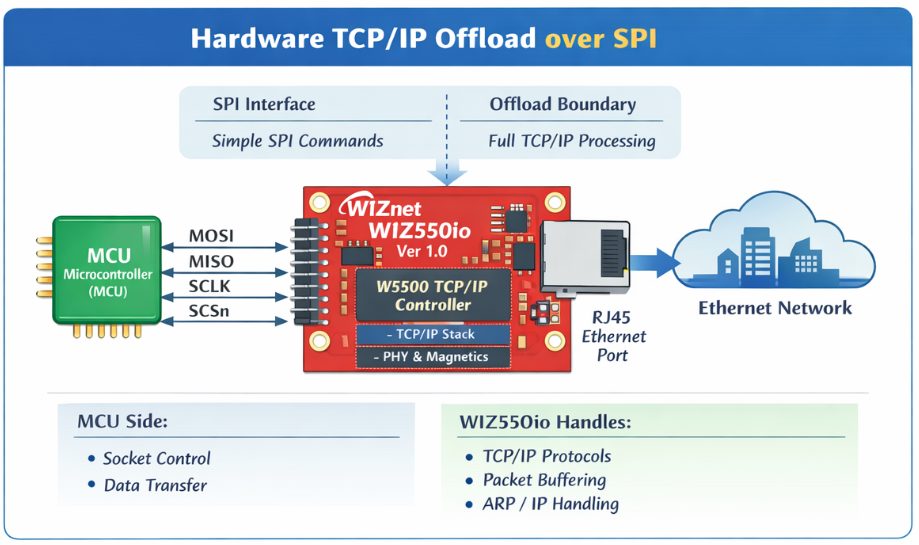
```plaintext
MCU ──(SPI)── W5500 ──(PHY + Magnetics)── RJ45 ── Ethernet Network
```
So while there is no software, the repository implicitly defines:
**network boundary (RJ45)transport offload boundary (W5500)MCU interaction model (SPI register access)**

---
## Where WIZnet Fits
The WIZnet W5500 appears as a **module-level integration point**, not a chip-level schematic.
This distinction matters.
Instead of exposing RMII/PHY complexity, the WIZ550io module:
Collapses Ethernet PHY + MAC + TCP/IP into a **single SPI peripheral**
Presents the network stack as **memory-mapped socket registers**
From the diagram, we can infer:
### 1) Offload Boundary
Everything beyond SPI is handled by W5500:
TCP state machine
retransmission
packet buffering
ARP/IP handling
### 2) MCU Responsibility
SPI transactions only
Socket configuration
Payload read/write
### 3) Architectural Implication
This is a **hard separation between control logic and networking**, which is exactly what you want in:
real-time control systems
deterministic edge nodes
low-RAM MCUs
---
## Implementation Notes
### WIZ550io Module Identity
**File**: `Communication/ethernet_WIZ550io_ver1_0.svg`
```plaintext
WIZnet
WIZ550io Ver1.0
```
This confirms:
Module type (not bare chip)
Integration level (RJ45 included)
**Why this matters:**
No external PHY routing
No impedance-controlled Ethernet layout required
Reduced PCB risk for non-high-speed designers
---
### SPI-Based Host Interface (Critical Design Insight)
```plaintext
MSOI
MISO
SCLK
SCSn
RSTn
INTn
RDY
```
This is the most important part of the entire repository.
#### Interpreted Signals
| Signal | Role | System Meaning |
| --- | --- | --- |
| MOSI (MSOI) | MCU → W5500 | Command + TX data |
| MISO | W5500 → MCU | RX data |
| SCLK | Clock | SPI timing |
| SCSn | Chip Select | Multi-device SPI support |
| RSTn | Reset | Hardware recovery |
| INTn | Interrupt | Event-driven networking |
| RDY | Ready | Boot / link readiness |
---
### Engineering Insight: SPI = Network Abstraction Layer
This is not just “communication”.
This is **architecture compression**:
Instead of:
```plaintext
MCU + MAC + PHY + TCP/IP stack (LwIP)
```
You get:
```plaintext
MCU + SPI + W5500
```
Meaning:
No DMA-heavy Ethernet MAC
No ISR storm from packet RX
No TCP retransmission logic in firmware
---
### No Networking Stack in Code (Important Negative Signal)
**File**: `generate_gallery.py`
```plaintext
import os
import codecs
folders = [x for x in os.listdir() if not os.path.isfile(x)]
```
Key observation:
- No `socket`
- No `EthernetClient`
- No `lwIP`
- No `MQTT`
- No `HTTP`
This confirms:
> The repository is not a software reference — only a hardware abstraction reference.
---
## Practical Tips / Pitfalls
Treat this diagram as **architecture guidance**, not implementation truth
Always verify pin names against official W5500 datasheet (`MSOI` typo exists)
Use **INTn pin** to avoid polling-based socket handling
Plan SPI bandwidth carefully (W5500 can saturate slow SPI configs)
Use **hardware reset (RSTn)** for long-term stability (critical in field devices)
Prefer WIZ550io in early prototypes to avoid Ethernet PCB layout complexity
Separate SPI CS lines if sharing bus with Flash or sensors
---
## FAQ
**Q: Why is W5500 still relevant when there is no code in this repo?**
A: Because the diagram exposes the architectural boundary: W5500 replaces the entire TCP/IP stack and PHY layer with a single SPI device, which directly impacts system design decisions even before firmware is written.
---
**Q: What is the most important insight from this repository?**
A: The SPI interface is not just a connection—it defines a clean separation where networking becomes a peripheral, not a software burden.
---
**Q: If I were to implement this in firmware, what would change?**
A: You would add:
WIZnet ioLibrary (or Arduino Ethernet)
Socket initialization (Sn_MR, Sn_PORT)
TX/RX buffer handling via SPI
But the hardware architecture would remain identical.
---
**Q: Why use WIZ550io instead of a discrete PHY + MAC?**
A: It eliminates:
RMII routing complexity
external magnetics design
TCP/IP stack implementation
Result: faster development, fewer failure points.
---
**Q: How does this compare to Wi-Fi modules?**
A: This architecture prioritizes:
deterministic latency
stable wired link
predictable timing
Whereas Wi-Fi introduces:
RF variability
connection drops
non-deterministic delays
---
## Source
Repository: diagrams-main (hardware diagram collection)
Key file: `Communication/ethernet_WIZ550io_ver1_0.svg`
License: Not specified
---
## Tags
#W5500 #WIZ550io #EthernetOffload #SPI #EmbeddedArchitecture #HardwareDesign #IoT #DeterministicNetworking #WIZnet
---
Source: https://maker.wiznet.io/TheoIm/projects/diagrams/