


KinCony KC868-A2v3: A W5500-Based ESP32-S3 Relay Controller Built for Wired-First Automation
KinCony's KC868-A2v3 swaps its old LAN8720A PHY for a W5500, giving a 2-channel ESP32-S3 relay board a hardwired TCP/IP path across its whole v3 lineup.
WIZnet - W5500
x 1


Nabu Casa - ESPHome
x 1
📌 Overview
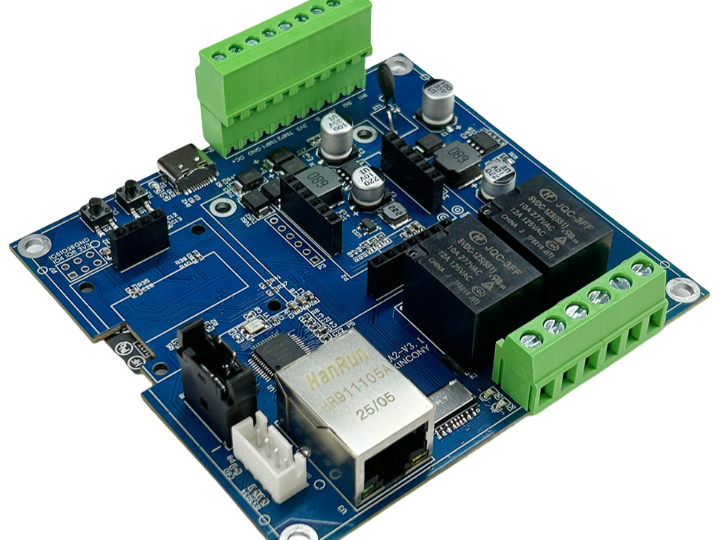
KinCony is a Hangzhou-based smart-home hardware manufacturer that has built its KC868 line since 2007 around one recurring idea: a DIN-rail ESP32 controller with real relay outputs, isolated inputs, and a wired network fallback next to Wi-Fi. The KC868-A2v3, released April 2025, is the current generation of its smallest relay board: 2 relay outputs, 2 opto-isolated dry-contact inputs, an ESP32-S3-WROOM-1 (N16R8) module, and, as of this revision, a WIZnet W5500 in place of the LAN8720A RMII PHY the previous KC868-A2 used.
A2v3 in one line: a $55 ESP32-S3 relay controller that pairs Wi-Fi with a dedicated W5500 wired Ethernet socket, so a DIN-rail automation node keeps working over LAN even if the wireless link does not.
That single component swap is the technical spine of this article. KinCony did not add the W5500 as a one-off feature on this board. It is part of a documented "v3" refresh across the KC868-A series, and it changes how the board behaves under the two firmware paths KinCony actually ships: its own KCS v3 stack and the community-standard ESPHome integration.
Vendor, Availability, and Price
KinCony (HANGZHOU KinCony Electronics Co., Ltd) markets itself as a home-automation hardware manufacturer building ESP32, Raspberry Pi, and PLC-based controllers, and describes its mission as making "local and remote automation control" easy for installers and DIY builders. The company is based in Xihu District, Hangzhou, Zhejiang, China, and lists direct WhatsApp, Telegram, and email (web@kincony.com) contact channels.
The KC868-A2v3 bare-PCB SKU is listed at $55.00 USD on KinCony's own Shopify store (observed July 23, 2026), with bundle options that add the plastic DIN-rail shell, the SSD1306 display, or a SIM7600E 4G module. The same product is also listed on Alibaba under KinCony's official store account, where wholesale-tier pricing runs roughly $55 to $125 depending on quantity and bundle. KinCony directs sample buyers to its Alibaba, AliExpress, or Amazon storefronts rather than quoting retail-only pricing on the manufacturer site.
System Configuration
The A2v3 is a compact (87 mm x 93 mm) DIN-rail board built around the ESP32-S3-WROOM-1 (N16R8) module, which gives it 16 MB flash and 8 MB PSRAM, more headroom than the plain ESP32 used in the original A2. Power comes in at 12 to 24V DC. On the I/O side it has 2 relay outputs rated 250V/10A across COM, NO, and NC, plus 2 opto-isolated dry-contact inputs that KinCony rates for cable runs up to 500 meters, useful when a sensor or switch sits far from the controller box. Two 1-Wire GPIO headers, an I2C extender header, and four free GPIO pins are broken out beside the ESP32-S3 module for further expansion.
Beyond the core I/O, the board carries a DS3231 high-precision RTC with a CR1220 battery backup, an SD card over SPI for local logging, an SSD1306 128x64 I2C display that shows the board's Wi-Fi and Ethernet IP addresses, an RS485 port, and a socket for a SIM7600E (4G) or SIM800L (2G) cellular module. USB-C handles power and flashing. This is a meaningfully denser feature set than a bare relay shield, and it is the same chassis pattern KinCony reuses across the rest of its v3 controller line.
The Wired Path: W5500 SPI Wiring
What the W5500 does here: it gives the ESP32-S3 a second, hardwired network interface over SPI, independent of the board's Wi-Fi radio, so LAN control and MQTT/HTTP traffic keep working during Wi-Fi interference or an access-point outage.
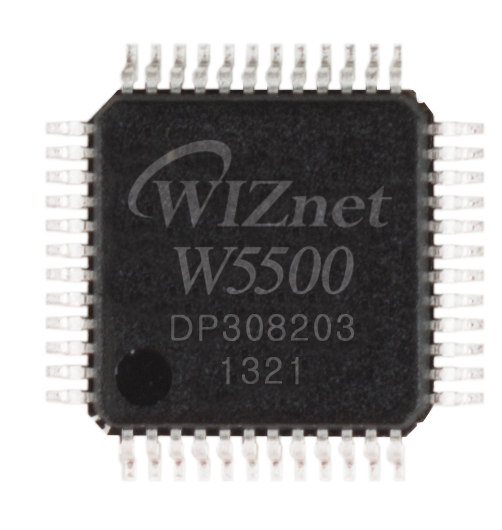
KinCony's own vendor description of the upgrade is blunt about the reason: point 3 of its published "improvements based on old KC868-A2" list reads simply, "replace LAN8720A with W5500 ethernet chip, more stable." LAN8720A is an RMII PHY that needs the ESP32's built-in EMAC peripheral and a small handful of supporting components to bring up Ethernet; W5500 is a full hardwired TCP/IP offload controller that talks to the host MCU over a plain SPI bus, which removes the RMII clock-and-strapping fragility that RMII designs are known for on ESP32 boards.
The official ESPHome device profile for the KC868-A2v3 confirms the exact SPI map in its published YAML: clock on GPIO42, MOSI on GPIO43, MISO on GPIO44, chip-select on GPIO41, interrupt on GPIO2, and reset on GPIO1. The same config block declares ethernet: type: W5500, which is the ESPHome-native way of telling the firmware to treat the chip as a first-class wired interface rather than a generic SPI peripheral. Relay outputs sit on GPIO39 and GPIO40 in that same reference file, with the two dry-contact inputs on GPIO16 and GPIO17.
This is a hardware-verified pin map from KinCony's own published ESPHome configuration, not an inferred wiring guess. Builders replacing the stock KCS v3 firmware with ESPHome can drop that block in directly.

⚙️ Role of the WIZnet Chip
The practical effect of the W5500 swap shows up in how each of KinCony's two supported firmware paths uses it.
Under KinCony's own KCS v3 firmware, the W5500 lets the board keep serving HTTP, MQTT, TCP, and RS485 Modbus traffic over the wired LAN port even when the Wi-Fi radio is busy, out of range, or reconfigured. The SSD1306 display shows both the Wi-Fi and Ethernet IP addresses simultaneously, which is a small but telling detail: KinCony expects installers to actually use both paths side by side, not treat Ethernet as a rarely touched fallback. KCS v3 also layers MQTT-based Home Assistant auto-discovery, Apple HomeKit, and Loxone Miniserver support on top of whichever network path is active.
Under ESPHome, the W5500 is declared as the board's ethernet: interface, which in ESPHome's architecture takes priority as the primary network transport when both Wi-Fi and Ethernet are configured. For a DIN-rail relay controller wired into a breaker panel or utility closet, a fixed, hardwired IP address is often more valuable than yet another Wi-Fi client hanging off a residential access point, particularly in installations where the board is mounted inside a metal enclosure that would otherwise attenuate Wi-Fi signal.
Neither firmware path documents a specific throughput or offload benchmark for the W5500 on this board. What is verifiable from the vendor's own materials is the wiring, the ethernet: type: W5500 ESPHome declaration, and the vendor's own stated reliability rationale for the swap.
Product Family: The v3 Refresh Across the KC868-A Series
Not a one-board choice: the W5500 swap is a lineup-wide decision. KinCony's KC868-A16v3, a 16-channel ESP32-S3 MOSFET/GPIO controller in the same physical family, carries the identical line item in its own "improvements based on old" list: "replace LAN8720A with W5500 ethernet chip, more stable."
That repetition across two different channel counts and two different board sizes (A2v3 at 87x93mm, A16v3 at 186x106mm) is the strongest evidence that this is a platform decision rather than a per-SKU feature. Both boards share the same ESP32-S3-WROOM-1(U) N16R8 module, the same DS3231 RTC, SD card logging, SSD1306 display, and the same KCS v3 / ESPHome / Tasmota software stack. What differentiates the A2v3 within that family is scale and application: 2 relay channels and a compact footprint for small automation nodes (a single garage door, a pump, a gate) versus the A16v3's 16 MOSFET channels for larger installations, or the further members of the same v3 generation (A6v3, A8v3, and the GPIO-only A16v3 variant) that KinCony has been rolling out through 2025 and 2026 as prior A-series boards reach end of life.
For a builder standardizing on one controller family for a whole property, this means the wired-Ethernet behavior, ESPHome config pattern, and KCS v3 firmware model carry over from the smallest relay node to the larger MOSFET boards, which is a meaningfully different proposition than picking one Wi-Fi-only relay board per room.
Software Ecosystem and Where This Fits
KinCony ships four documented ways to program the A2v3: its own KCS v3 firmware (multi-protocol, zero-config Home Assistant MQTT discovery, Tuya app support requiring a separate license, HomeKit, and Loxone Miniserver integration), the official ESPHome YAML profile referenced above, Tasmota, or fully custom Arduino / MicroPython / ESP-IDF code against the ESP32-S3 module. KinCony explicitly recommends running Tuya's app for remote/internet control alongside Home Assistant for local LAN control on the same board, which is a workable pattern precisely because the W5500 keeps the LAN path independent of whatever the Wi-Fi radio is doing for cloud connectivity.
What is not publicly documented: independent third-party reviews, forum reports of real W5500 link-reliability numbers in the field, or a formal CE/FCC/UL declaration page linked from the product listing. The relay rating (250V/10A) and input isolation figures are vendor-stated specifications rather than independently tested numbers. Builders relying on the relay outputs for mains-voltage switching should treat KinCony's ratings as manufacturer claims pending their own verification, standard practice for any DIN-rail automation hardware in this price class.
Value and Limits
The KC868-A2v3 is a straightforward, well-documented small relay controller whose main technical interest for a WIZnet-focused audience is the W5500 swap and how visibly KinCony ties it to reliability rather than treating it as a spec-sheet checkbox. The exact SPI pin map is public through the ESPHome device page, the relay and input specs are stated plainly, and the board fits into a documented, multi-SKU family that shares the same wired-network design choice.
The limits are the ones common to inexpensive Chinese DIN-rail controllers sold direct-to-consumer: no independent lab verification of relay ratings, no public safety certification page linked from the listing, and no forum-sourced field data on W5500 link stability specific to this board at the time of writing. None of that contradicts KinCony's claims; it simply means the claims come from the vendor rather than a third party.
Related WIZnet Maker Reading
Builders comparing wired-first ESP32 controllers may also want to look at other W5500-based reseller boards already on WIZnet Maker, such as MQTT ioModul 16DI/16DO (XMMQTT) and the MQTT Unit with RJ45 Port (W5500), both of which use the same "MQTT plus hardwired Ethernet" pattern for industrial or DIN-rail automation rather than the ESPHome-first path KinCony emphasizes here.
Source-backed Summary
The KC868-A2v3 connects a small, DIN-rail-mounted ESP32-S3 relay board to a genuinely wired network path: W5500 over SPI (GPIO41-44, with GPIO1/2 for reset and interrupt), declared directly as the primary `ethernet:` interface in KinCony's own ESPHome profile, backing both the vendor's KCS v3 firmware and the open ESPHome/Home Assistant path. The same W5500-for-LAN8720A swap appears across at least two other boards in KinCony's v3 generation, which is the clearest evidence that this is a lineup-wide reliability decision rather than a one-board feature.
❓ FAQ
Q. Does the KC868-A2v3 need Ethernet to work, or is it Wi-Fi only? It supports both. The board has a Wi-Fi radio on the ESP32-S3 module and a separate wired RJ45 port driven by the W5500, and the SSD1306 display shows both IP addresses at once.
Q. What exactly changed from the older KC868-A2? KinCony's own changelog lists nine changes, the most relevant here being the ESP32-S3-WROOM-1 upgrade and the W5500 replacing the LAN8720A PHY, alongside a new NTC power-protection circuit, DS3231 RTC, SSD1306 display, SD card logging, and newer KCS v3 firmware features.
Q. Can I run Home Assistant without KinCony's own firmware? Yes. KinCony publishes an official ESPHome YAML profile with the exact GPIO map for relays, inputs, the display, and the W5500 Ethernet interface, so ESPHome plus Home Assistant is a fully supported path independent of KCS v3.
Q. Is the W5500 used only on this one board? No. KinCony's own product page for the KC868-A16v3, a larger 16-channel controller in the same generation, documents the identical LAN8720A-to-W5500 swap, showing this is a platform-wide change across the v3 refresh.
Q. What is the real price and where do I buy it? KinCony's own store lists the bare PCB at $55.00 USD, with bundle options for the shell, display, and 4G module priced separately. The same listing also appears through KinCony's official Alibaba store for bulk orders.